
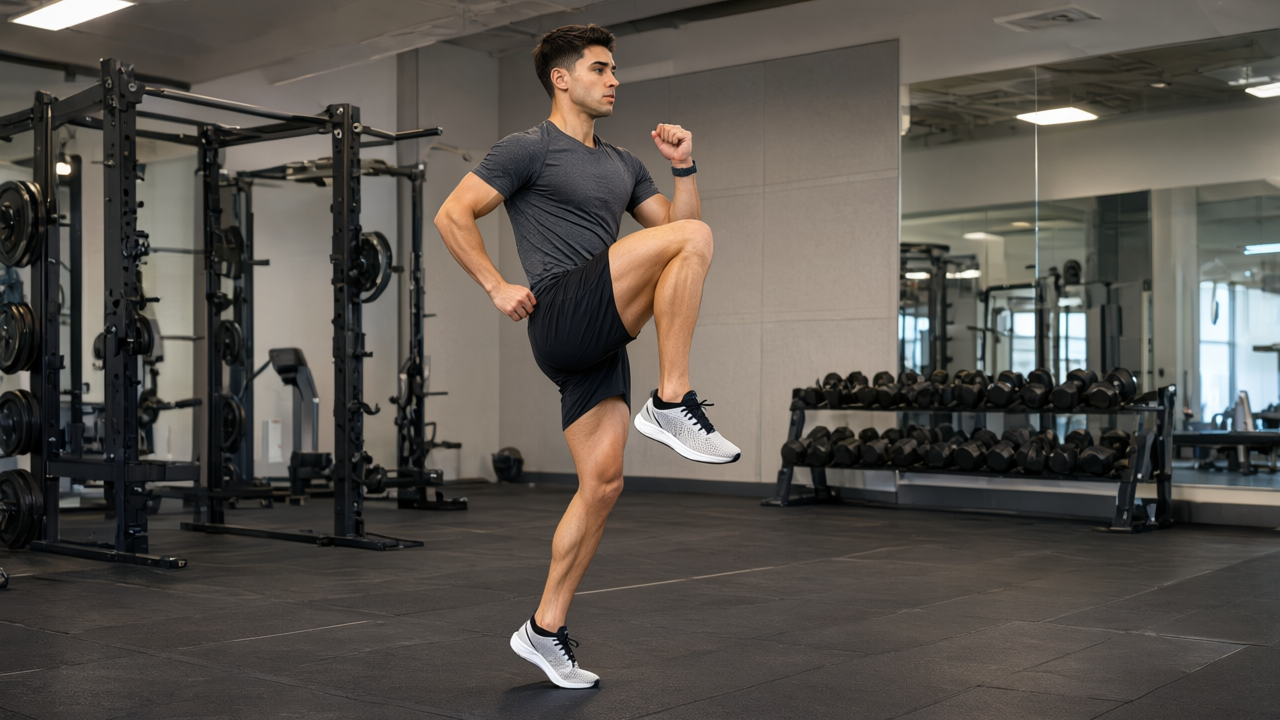
High Knees
high-knees
I want you to feel light, rhythmic, and completely in sync with your breath as your knees drive upward. Good high knees aren’t about frantic speed; they’re about crisp, controlled elevation and a springy return to the ground. You should feel a steady burn in your hip flexors and a light, bouncing cadence that elevates your heart rate without compromising your posture or joint alignment.
Jika Anda Pemula
Start at a manageable pace that allows you to maintain a straight spine and soft landings. You should feel a steady, rhythmic pulse in your thighs and core, not a sharp jarring in your knees or lower back. If your form breaks down—your shoulders round, your feet slap the floor heavily, or your breathing turns ragged—pause immediately and reset. Beginners often compensate by leaning too far backward or driving their knees past their waistline, which strains the lumbar spine. Focus instead on keeping your chest proud and your foot strikes directly beneath your hips. Remember that consistency beats intensity every single time. You can always modify this movement by marching in place with exaggerated knee lifts until your cardiovascular system and stabilizers build the necessary endurance. Trust the rhythm, protect your joints, and celebrate the small wins as your stamina naturally expands.
Melangkah Lebih Jauh
To make high knees genuinely harder, shift your focus from duration to ground contact time. Spend less time on the floor and more in the air by driving each foot down forcefully rather than simply lifting the knee higher. For load, a light resistance band around your thighs increases hip flexor demand without altering the movement pattern; if you prefer bodyweight only, extend your working sets beyond forty-five seconds or shorten your rest intervals to accumulate fatigue. Tempo matters most at the top of each drive—pause for a split second with the thigh parallel to the floor before switching legs to build isometric control. Once you can sustain sixty seconds with a banded variation whilst keeping your torso perfectly upright, progress to bounding high knees, where you cover forward distance with each stride. Alternatively, try the single-leg version, holding one knee at hip height whilst rapidly cycling the other, which exposes asymmetries and demands far greater core stability.
Kesalahan Umum
Most practitioners sacrifice form for speed, resulting in heavy heel strikes that send unnecessary shockwaves through the shins and knees. Another frequent error is allowing the torso to collapse forward, which shifts the workload away from the hip flexors and places dangerous torque on the lower back. Many also forget to actively pump their arms, which severely limits momentum and disrupts the natural running gait. Finally, holding your breath during the explosive drives creates premature fatigue and spikes blood pressure unnecessarily. Prioritize crisp mechanics and controlled breathing over frantic velocity to maximize cardiovascular benefit and protect your joints.
Rutinitas
- Sets
- 3
- Reps
- 30-45 seconds
- Rest
- 90s
- RPE
- 5
- Per set
- ~60s
- Frekuensi
- 2-3x/week
Increase your sprint duration by ten seconds each week or add a light resistance band around your thighs to amplify hip flexor engagement.
Cues
Otot
- Hip flexors
- Quadriceps
- Calves
- Abs
- Glutes
Peralatan
- Bodyweight
- 1
Stand tall with your feet hip-width apart, shoulders relaxed, and arms bent at ninety degrees at your sides.
- 2
Inhale deeply through your nose while engaging your core and bracing your abdominal wall.
- 3
Drive your right knee sharply toward your chest while simultaneously pushing off your left forefoot.
- 4
Exhale forcefully through your mouth as your right knee reaches its peak height.
- 5
Switch legs instantly, driving the left knee upward while landing softly on your right forefoot.
- 6
Maintain a brisk, metronomic rhythm, keeping your torso upright and your gaze fixed forward.
- 7
Continue alternating legs for the prescribed duration, matching each knee drive to a sharp exhale.
- 8
Gradually slow your pace, lower your knees, and return to a standing neutral position to reset.