
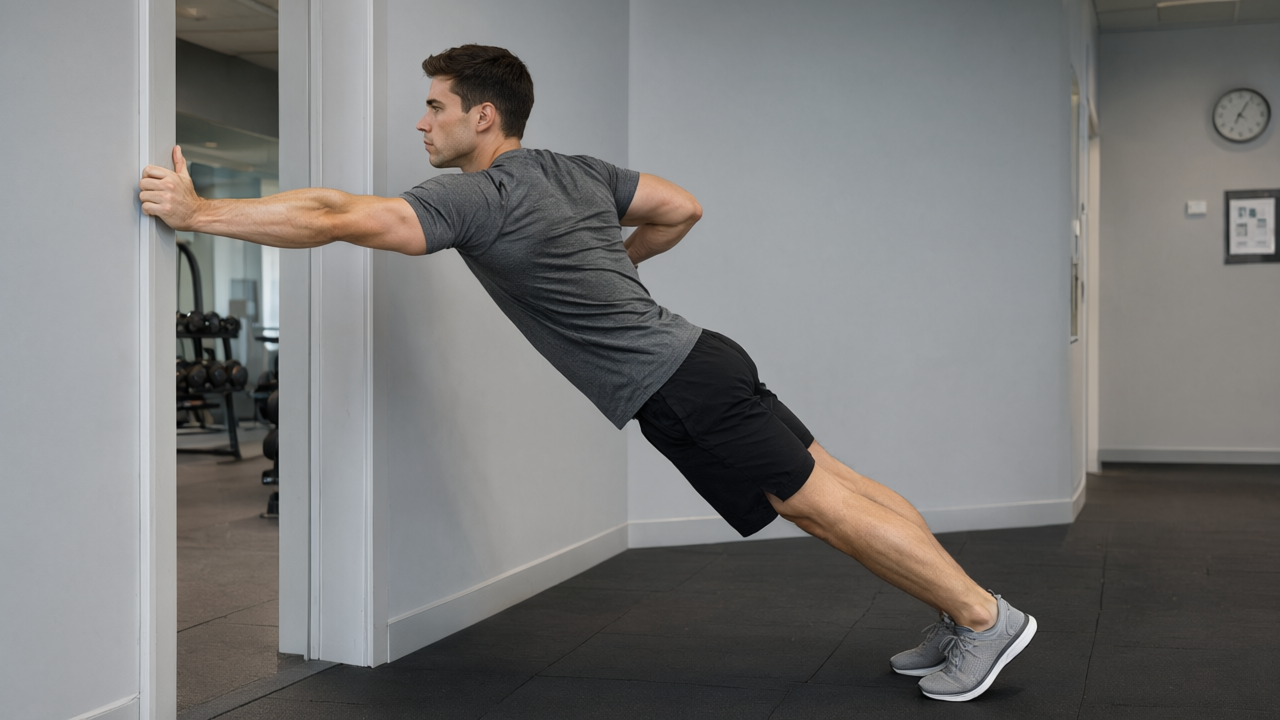
Doorway Row
doorway-row
Perhatikan
- caution · Rotator cuff tear — Pulling places the humeral head under load while the cuff is supposed to centre it, and with a tear the stabilising force is not there to spare. Reduce the demand by standing more upright — a shorter lean is genuinely a different exercise in terms of load — and keep the elbow travelling beside the ribs rather than out to the side. If pulling reproduces pain or weakness, this needs the shoulder assessed rather than angled around.
- caution · Shoulder impingement — This is the substitute the rest of the library sends pinching shoulders to, so it has to be genuinely tolerable — and the two things that make it hurt are the grip height and the shrug. Move the hands down to about waist height, keep the shoulder blades packed down away from the ears, and pull the elbows back rather than flaring them out. Shorten the lean if the front of the shoulder catches at the finish. This library has no entry that trains the rear shoulder without any overhead involvement, so if waist-height gripping still pinches, stop loading it and have the shoulder looked at rather than working through.
- modify · Acute lower back injury — The lean-back position is a mild hip hinge held for every rep, and when the upper back tires the lumbar spine tends to arch to keep the chest off the frame. Squeeze the glutes, keep the body in one straight line from heels to head as step 4 says, and stand closer to the doorway so the angle is shallower. If the hinge is the limiting factor rather than the pull, substitute Chest-Supported Row, where nothing has to be held.
- modify · Herniated disc — The lean is sustained in a slightly forward position under load, which most discs tolerate far better than a barbell row but which will still complain if the spine rounds instead of hinging at the hips. Keep the torso rigid and one straight line, take the feet closer to the frame to shorten the lever, and stop the set while the line holds. If a sustained lean is symptomatic, substitute Chest-Supported Row, which trains the same pull with the spine supported.
When I cue you into the Doorway Row, I am giving you the gentlest horizontal pull available. You grip an open door frame and lean back, then pull your chest towards it. This teaches your upper back to retract without heavy load. It is the entry point for anyone who has never rowed, building the mind-muscle connection before you progress to harder variations.
Jika Anda Pemula
The first time you try this, you will likely pull with your biceps rather than your back. Your elbows will flare wide and your shoulders will shrug up towards your ears. To fix this, think about dragging your elbows along your ribs as if tucking them into your back pockets. Before you even bend your arms, gently draw your shoulder blades down and together. The effort should feel like a mild squeeze between your shoulder blades, not a strain in your arms or wrists. If your lower back arches excessively, step your feet closer to the frame to reduce the angle until you can hold your core steady. Stop the set when you can no longer touch your chest to the frame without jerking your body or losing that flat back. This is a teaching exercise; treat it patiently. Once three sets of fifteen feel effortless, move your feet further forward to increase the lean before seeking a harder exercise entirely.
Melangkah Lebih Jauh
Use a deliberate three-second lowering phase to maximise time under tension on the eccentric portion. Perform three to four sets of fifteen to twenty repetitions, resting forty-five seconds between sets. Progress by walking your feet further forward until your body approaches parallel to the floor, or elevate your feet onto a low step to increase the pulling angle. Once you can perform twenty controlled reps at maximum lean without form breakdown, graduate to table inverted rows or ring rows. For variation, try a single-arm doorway row by gripping one side of the frame only, which introduces anti-rotation demand on your core. Another option is adding a two-second pause at peak contraction to eliminate momentum entirely. Keep the tempo strict: one second to pull, two seconds to hold, three seconds to lower.
Kesalahan Umum
The most frequent error is initiating the pull with the biceps rather than retracting the shoulder blades first. This shifts the work away from the upper back and overloads the arms, limiting strength development where it matters. Correct this by consciously pinching your shoulder blades together before bending your elbows. A second mistake is allowing the lower back to sag into extension, which happens when the core disengages during the lean. Brace your abdominals as though preparing for a light tap to the stomach. Third, people often shrug their shoulders toward their ears during the pull, recruiting the upper traps unnecessarily. Keep your shoulders depressed throughout. Finally, rushing the return phase wastes the eccentric stimulus; lower yourself deliberately over two to three seconds rather than dropping back passively.
Rutinitas
- Sets
- 3
- Reps
- 12–20
- Rest
- 60s
- Tempo
- 1-1-3
- RPE
- 6
- Frekuensi
- 3
Increase foot distance from frame to deepen lean angle
Cues
Otot
- Upper back
- Lats
- Biceps
- Forearms
- Abs
Peralatan
- Bodyweight
- 1
Stand facing an open doorway with feet hip-width apart, heels just behind the frame line.
- 2
Grip both sides of the door frame at chest height with a full hand wrap.
- 3
Walk your feet slightly forward and lean back until your arms are straight and torso angled.
- 4
Brace your core and keep your spine neutral from head to hips throughout the movement.
- 5
Exhale and pull your chest towards the frame by driving your elbows straight back.
- 6
Squeeze your shoulder blades together briefly when your chest touches or nears the frame.
- 7
Inhale and slowly lower yourself back to the starting position with straight arms.
- 8
Adjust difficulty by stepping feet further forward for more lean, or closer for less.