
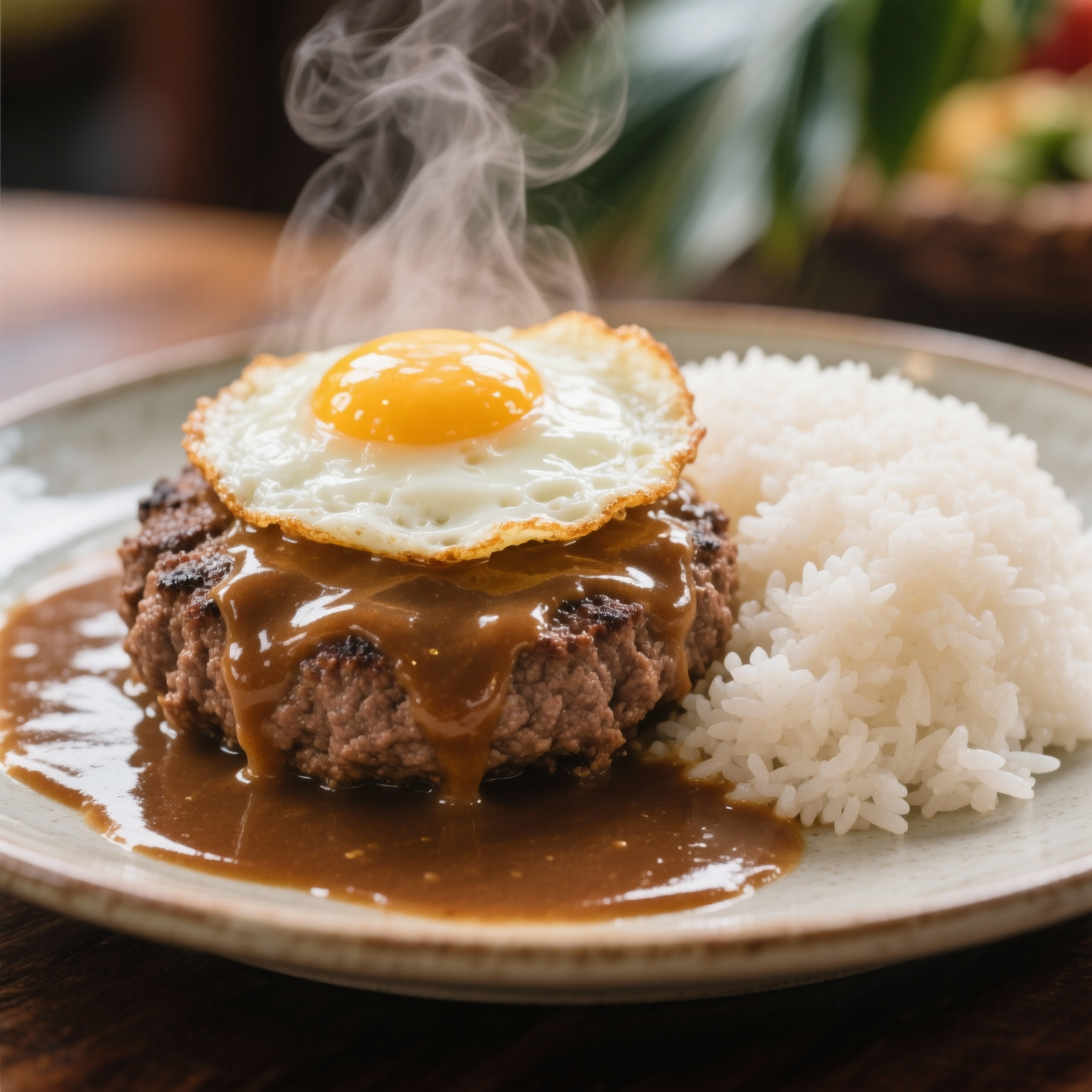
Loco Moco
When I think about the true soul of Hawaiian comfort food, my mind always drifts to the Loco Moco. Born in 1949 at the Lincoln Grill in Hilo, this iconic dish was famously invented by a group of hungry teenagers who wanted something cheap, hearty, and different from the standard hamburger. They asked the restaurant to add a fried egg and gravy, and a culinary legend was born. To me, the Loco Moco matters because it represents the beautiful, unpretentious melting pot of Hawaii’s local food culture, taking humble, accessible ingredients and elevating them into pure, unadulterated comfort. It is the ultimate hangover cure and a deeply satisfying weeknight dinner, especially when you need to get a spectacular meal on the table in under thirty minutes. However, achieving that perfect balance requires avoiding a few common pitfalls. The most frequent mistake I see home cooks make is overcooking the fried egg; the yolk must remain perfectly runny to act as a rich, secondary sauce when it breaks over the hot rice. Another major trap is serving cold, clumpy rice. Always use freshly steamed, piping-hot rice to ensure the gravy and egg meld seamlessly. Finally, do not rush the gravy by using a watery broth; take those extra few minutes to properly brown your ground beef and build a deeply savory, thick brown gravy that coats the back of a spoon. When executed correctly, every single bite is a harmonious, messy, and deeply satisfying experience.
Nutrition
| Par portion | calories | protein | carbs | fat | satFat | fibre | sugar | sodium |
|---|---|---|---|---|---|---|---|---|
| beginner | 450kcal | 21g | 45g | 20g | 7g | 1g | 1g | 1291mg |
| intermediate | 450kcal | 21g | 45g | 20g | 7g | 1g | 1g | 1291mg |
| expert | 623kcal | 22g | 45g | 39g | 19g | 1g | 1g | 1293mg |
Par portion · Estimation Ava — un guide, pas une donnée clinique.
- 200 gwhite rice— jasmine or short-grain
- 300 gground beef— 80/20 fat ratio
- 2 unitlarge egg
- 50 gyellow onion— finely diced
- 10 ggarlic clove— minced
- 250 mlbeef broth— low sodium preferred
- 30 mlsoy sauce
- 10 gcornstarch— mixed with equal water to form a slurry
- 15 mlcooking oil— neutral oil such as canola or vegetable
- 5 gsalt
- 2 gblack pepper— freshly ground
- 240 mljarred brown gravy
- 30 gclarified butter
- 60 gbutter
This beginner-friendly Loco Moco relies on sensible shortcuts to get a comforting Hawaiian classic on the table in under 30 minutes. We use pre-formed beef patties and a simple, jarred brown gravy base doctored with a splash of soy sauce and garlic powder to mimic the traditional from-scratch depth. The key to success here is timing your components so everything is perfectly hot when assembled. Keep your cooked rice warm in a low oven or tightly covered while you pan-fry the patties and eggs. Watch the eggs very closely; you want the whites fully set but the yolks still beautifully runny to create that signature rich sauce when broken. Don't overcrowd the pan when frying the patties, ensuring a good, even sear on both sides. This streamlined approach guarantees a highly confident first attempt at this hearty, soul-warming dish without the stress of making a roux-based gravy from scratch. It is a fantastic, foolproof weeknight dinner.
Equipment
- Large non-stick skillet— Crucial for easy egg flipping and preventing sticking.
- Small saucepan— Used for gently warming the doctored gravy.
- Rice cooker or medium pot(optional)— A rice cooker is highly recommended for hands-off perfection.
Method
- 1
Rinse and cook 2 cups of white rice in a rice cooker or pot according to package directions.
Start this first so it finishes alongside the rest of the meal.
boiling~ 20 min - 2
Warm 2 cups of jarred brown gravy in a small saucepan over medium-low heat, whisking in 2 tablespoons of soy sauce and 1 teaspoon of garlic powder.
Keep on low heat to prevent scorching while you cook the meat.
simmering~ 5 min - 3
Pat 4 pre-formed beef patties dry with paper towels and season both sides generously with kosher salt and black pepper.
Drying the surface ensures a much better, crustier sear.
seasoning~ 1 min - 4
Heat 1 tablespoon of neutral oil in a large non-stick skillet over medium-high heat, then cook the patties for 4 minutes per side.
Do not press down on the patties; let the crust form naturally.
searing~ 8 minTricky bit - 5
Transfer the cooked patties to a resting plate, lower the skillet heat to medium, and crack 4 large eggs directly into the pan, frying until the whites are completely set.
Baste the eggs with hot oil for 10 seconds if you prefer the yolks slightly firmer.
frying~ 4 minTricky bit - 6
Scoop a generous mound of warm rice into each of four bowls, top each with a beef patty and a fried egg, and ladle the hot gravy over everything.
Serve immediately while the eggs are still warm and the yolks are runny.
plating~ 2 min
Les durées de conservation sont indicatives — utilisez toujours votre jugement et conservez les aliments en toute sécurité.