
Single-Arm Landmine Squat to Press
single-arm-landmine-squat-to-press
Take care with
- caution · Vertigo / balance disorder — Squatting and pressing overhead with weight on one side shifts your centre of gravity in ways the inner ear cannot warn you about in time. Do the same work seated with back support and a dumbbell instead — you keep the leg and the press and drop the balance demand.
- caution · Shoulder impingement — The landmine's arc is more shoulder-friendly than a straight barbell, but the overhead position still requires full flexion. If this causes pain, switch to a goblet squat or a landmine press from a standing position without the squat.
- modify · Acute knee injury — Squatting to parallel under load on one side concentrates force through the loaded leg. Shorten the depth to the range that is pain-free and keep the knee tracking over the second toe, or drop the squat and do a standing single-arm landmine press, which spares the knee entirely.
- modify · Acute lower back injury — One-sided load while squatting is exactly the pattern an irritable back argues with — the weight tries to twist you and your spine pays for the difference. Keep the brace brutal, drop the load until you can own the wobble, or cut the squat out and press standing with both hands.
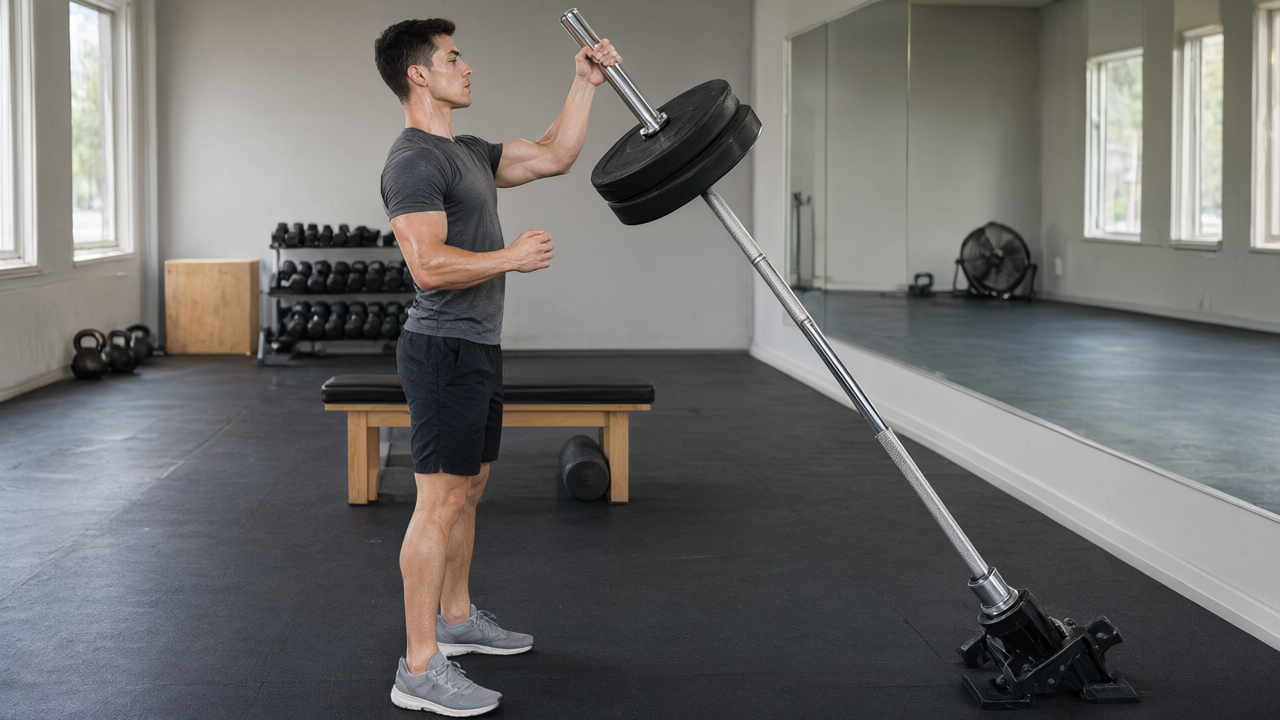
One arm of a squat that finishes in an overhead press, with the barbell anchored at one end so the load travels on an arc rather than a straight line. The arc is why the shoulder stays comfortable at lockout; the offset is what makes the abs work, since the weight pulls you sideways and your midline has to answer it. Wedging the barbell into a corner is enough to do it anywhere; a gym landmine attachment is more secure and lets you load up without worrying about the bar escaping.
If you’re new to this
Start with just the bar to learn the movement pattern. The landmine's arc is different from a straight barbell path — the bar travels up and slightly forward. If you cannot bodyweight squat to parallel with good form, build that capacity first before adding the load.
Going further
Slow the lowering phase to three or four seconds to increase time under tension and force your obliques to work harder against the offset load. The press itself should remain fast, but add a two-second pause at full lockout to challenge shoulder stability before descending. Six to eight reps per side builds strength; pushing towards twelve shifts the emphasis to conditioning. Add weight only when you can complete every rep without drifting towards the loaded side. If balance limits you before your legs or shoulders fatigue, that is your true bottleneck. Once you handle the target weight smoothly for all sets, progress to a single-arm landmine push press, using leg drive to manage heavier loads. Alternatively, try the half-kneeling landmine press to isolate the pressing pattern and remove the squat entirely. Both variations use the same barbell but change what limits the set.
Common mistakes
Letting the knee cave inward during the squat — push it out over the second toe. Leaning forward as you stand up instead of driving vertically. Pressing too early — the press should start as you reach the top of the squat, not at the bottom. Losing balance to the loaded side — brace hard and keep your weight centered.
Routine
- Sets
- 3
- Reps
- 6-8 per side
- Rest
- 120s
- Tempo
- 2-1-X
- RPE
- 7
Increase weight when you can complete all sets with good balance and full range of motion
Cues
Easier, harder, instead
Muscles
- Quadriceps
- Shoulders
- Abs
- Glutes
- Triceps
Equipment
- Barbell
- 1
Wedge one end of a barbell firmly into a corner where it cannot slip out and load the free end. Stand side-on to it with your working side closest.
- 2
Clean the free end to shoulder height with both hands, elbow tucked forward and slightly down. Step back until your feet are shoulder-width apart.
- 3
Release the top hand and extend it out to the side for balance. The working arm holds the weight at shoulder height.
- 4
Brace your core, push your hips back and bend your knees. Keep your chest up and your weight centred, and descend until your thighs are parallel to the floor.
- 5
Drive through your heels to stand tall. As your hips finish extending, press the weight overhead along the arc, up and slightly forward, to a full lockout.
- 6
Lower the weight back to the shoulder under control and sink straight into the next rep. Finish all reps on one side before switching.