
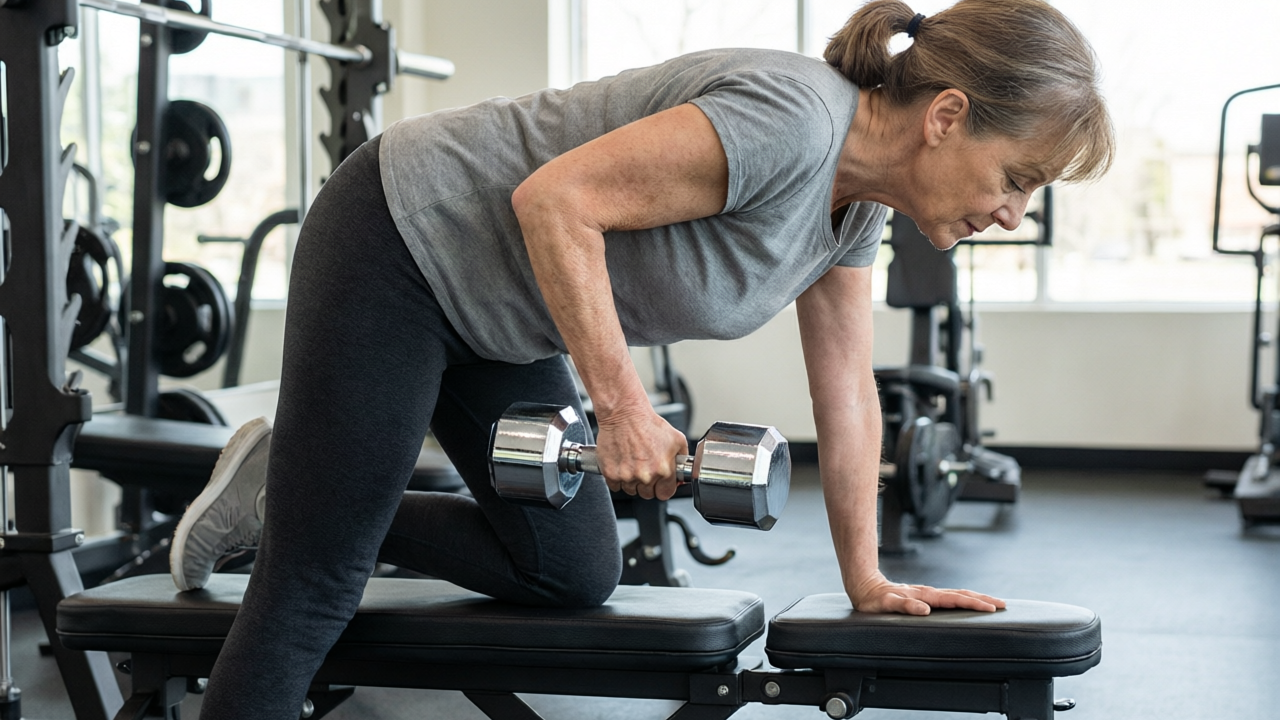
Single-Arm Dumbbell Row
single-arm-dumbbell-row
Take care with
- avoid · Herniated disc — Rounding the lower back under load creates dangerous shear forces on the lumbar discs. Instead, use a chest-supported row machine to train the horizontal pull with a fully stabilized spine.
- caution · Shoulder impingement — Allowing the supporting shoulder to collapse or hike upward can compress the subacromial space. Instead, keep the supporting arm slightly bent and focus on seated cable rows with strict scapular control.
- caution · Acute lower back injury — The unsupported horizontal torso position places sustained isometric demand on the lumbar spine. Instead, perform chest-supported dumbbell rows to load the lats without stressing the lower back.
I always chase that deep, controlled stretch across my lats with each descent, followed by a powerful squeeze as the dumbbell tracks toward my hip. Perfect reps never feel rushed; they feel anchored and fluid, with my torso completely still while my shoulder blade drives the motion. I feel a steady, satisfying burn building through my mid-back, leaving my core braced, my spine neutral, and my posture feeling instantly taller.
If you’re new to this
When you first approach this movement, I want you to focus entirely on the mind-muscle connection rather than the number on the dumbbell. Keep your supporting knee soft, never locked, and imagine your working shoulder blade sliding into your back pocket before you even bend your elbow. You will know you have reached muscular failure when the weight starts to stall halfway up, your lower back begins to arch, or your torso starts twisting to generate momentum. That is your exact cue to rack the weight and finish the set. Do not push through joint strain or lower back fatigue. Beginners often overcompensate by shrugging the shoulders toward the ears or using a jerking hip motion to swing the weight upward. Instead, keep your neck long and let the elbow lead the movement. Start light, master the controlled descent, and trust that consistency builds strength far faster than ego. I am right here with you as you build that foundational pulling power.
Going further
Extend the lowering phase to three or four seconds and add a distinct two-second pause at full stretch to increase time under tension without needing a heavier dumbbell. The eight-to-twelve rep range suits hypertrophy, but dropping to six to eight with a heavier load builds raw pulling strength. Add weight only when every rep in your top set finishes with a dead stop at the hip and zero torso rotation. Once you handle your heaviest available dumbbell cleanly for sets of eight, progress to a renegade row using two dumbbells, which forces your core to resist rotation far more aggressively. Alternatively, try a chest-supported row on an incline bench to remove lower back involvement entirely and isolate the lats. You can also experiment with a pronated grip instead of neutral; this shifts emphasis slightly higher into the rhomboids and rear deltoids while reducing biceps contribution.
Common mistakes
Lifters frequently sacrifice spinal integrity by rounding their lower back, which shifts the load away from the back and places dangerous stress on the lumbar spine. Another pervasive error is leading with the biceps instead of driving the elbow upward, which reduces back activation and turns a horizontal pull into an inefficient arm curl. Many also allow their supporting shoulder to collapse or hike upward, breaking the stable base and compromising shoulder health. Finally, rushing the eccentric phase by dropping the weight abruptly eliminates the tension needed for muscle growth. I always remind athletes to treat the lowering phase as the true builder of strength, keeping the weight under constant control from start to finish.
Routine
- Sets
- 3
- Reps
- 8-12
- Rest
- 90s
- Tempo
- 2-0-2-0
- RPE
- 8
- Per set
- ~120s
- Frequency
- 2-3x/week
Increase the dumbbell weight once you can consistently complete all sets with strict form at the top of the rep range.
Cues
Muscles
- Lats
- Upper back
- Biceps
- Forearms
- Abs
Equipment
- Bench
- Dumbbells
- 1
Position a flat bench horizontally and place your working-side knee and hand firmly on the padded surface.
- 2
Plant your opposite foot flat on the floor with your hip aligned directly over your working shoulder.
- 3
Grasp a dumbbell in your free hand using a neutral grip and let it hang straight toward the ground.
- 4
Engage your core and flatten your spine to create a rigid, straight line from head to tailbone.
- 5
Exhale as you pull the dumbbell upward and backward toward your hip while keeping your elbow close to your torso.
- 6
Squeeze your shoulder blades together at the top position and pause briefly to maximize back engagement.
- 7
Inhale as you lower the weight slowly back to the starting position with strict control.
- 8
Place the dumbbell securely on the floor after your final repetition and step away from the bench to reset.