
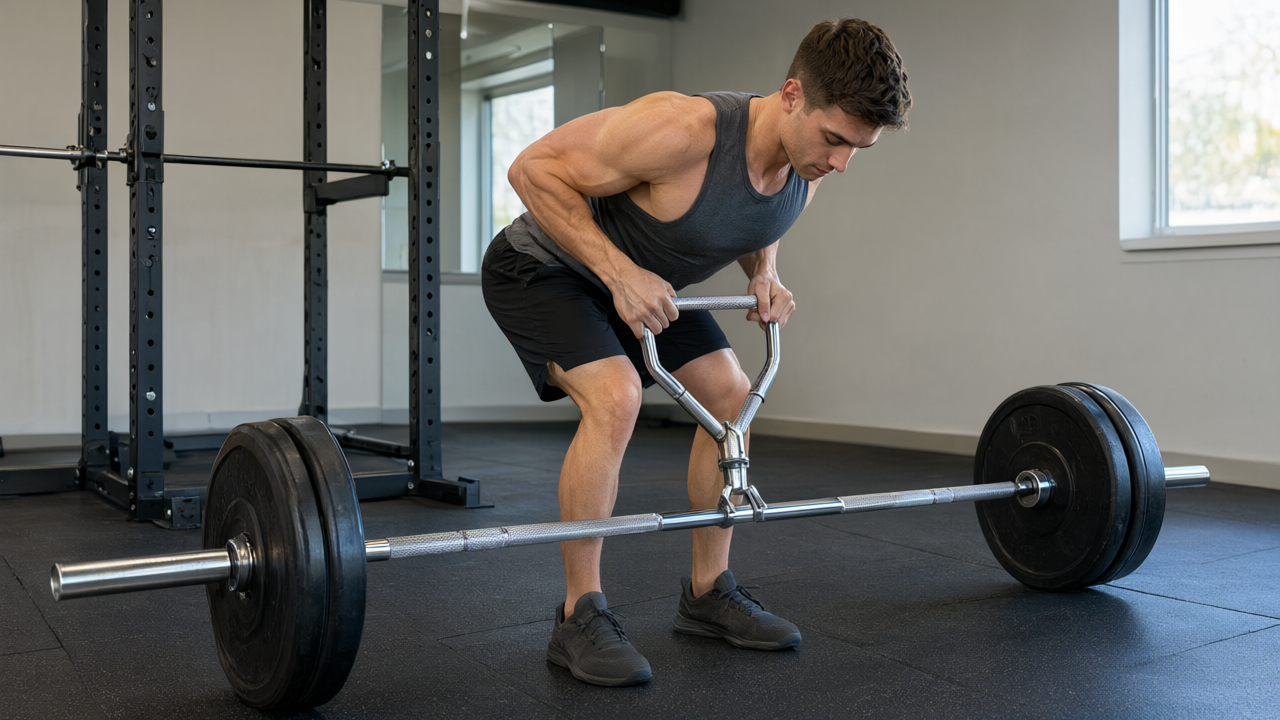
T-Bar Row
t-bar-row
انتبه عند
- avoid · Acute lower back injury — The sustained hip hinge places constant shear stress on the lumbar spine. Instead, perform chest-supported rows to target the upper back without loading the lower back.
- avoid · Herniated disc — You hold a forty-five-degree hinge for the entire set, and the fatigue pattern is the spine rounding forward as the back gives up — which raises intradiscal pressure at exactly the moment control is worst. Avoid it. In this library, substitute Chest-Supported Row, where the bench carries the torso and the spine stays neutral, or Cable Row seated with an upright trunk. Numbness, tingling or weakness down a leg is a clinician's question, not a technique adjustment.
- caution · Pregnancy — Bracing hard against a heavy load in a hinged position drives intra-abdominal pressure down and forward, and the hinge itself becomes unavailable as the belly limits how far the torso can fold. Instead, use Chest-Supported Row, which removes the hinge entirely, or Single-Arm Dumbbell Row with the hand on a Bench and the back kept level. Stop before you feel the midline coning, and raise any leaking or pelvic heaviness with your midwife or obstetric team.
- modify · Shoulder impingement — Driving the elbows high at the top narrows the space under the front of the shoulder — the squeeze people chase is the pinch. Keep the elbows nearer the ribs, stop short of where the front of the shoulder catches, and pull the handle toward the lower sternum as written rather than toward the chest. Substitute Chest-Supported Row, where the arm finishes beside the hip and the bench takes the hinge away as well. Stop if pain runs down the arm or the shoulder goes weak — that is a clinician's visit, not a grip change.
An angled row that loads the lats and mid-back through a long, hanging pull. The wedged bar is what separates it from a barbell row: the slope lets the elbows finish beside the ribs instead of being levered out to the sides. The loaded end wedged into a corner needs no special kit, and a gym landmine attachment holds it more securely if one is there. The hinge sets the limit — the rep ends when the spine stops staying flat.
إذا كنت جديدًا على هذا
Start with a lighter load to master the hip hinge before chasing heavy plates. Keep your chest proud and imagine a straight line running from your head to your tailbone. If your lower back begins to round or ache, immediately reduce the weight or stop the set entirely. True muscular failure here feels like your shoulder blades simply refuse to squeeze together any tighter, not like your spine is buckling under pressure. Watch out for the urge to use momentum; swinging your torso upward to lift the weight robs your back of tension and shifts dangerous stress to your joints. Instead, keep your hips locked in place and let your upper back do all the work. Breathe out as you pull the bar toward you, and inhale slowly on the way down. Consistency with strict form will build a resilient, powerful back far faster than reckless ego lifting ever could. Trust the process, stay tight, and let each controlled repetition forge your foundation.
المضي قدماً
Slow the lowering phase to three or four seconds to increase time under tension across your mid-back, and add a deliberate two-second pause at full stretch before initiating the next pull. The concentric should remain fast but never jerky. Sets of eight to twelve build thickness effectively, whilst dropping to six to eight with heavier plates develops raw pulling strength. Add 2.5 to 5 pounds once you complete all prescribed reps across every set without your hips shifting or your torso rising. When you can handle heavy loads for sets of six cleanly, progress to the Pendlay row from the floor to demand greater starting strength and stricter positioning. For variation, try a wide-grip T-bar attachment if available; it shifts emphasis towards the rear deltoids and upper traps. Alternatively, perform the movement with a neutral grip on the standard handle to bias the lats through a longer range of motion.
أخطاء شائعة
Lifters frequently sacrifice spinal alignment by rounding their lower back or hyperextending at the top of the movement, both of which invite serious lumbar strain. Another prevalent error involves using excessive momentum, where athletes violently swing their hips forward to generate upward force instead of relying on pure scapular retraction. Many also pull the weight too high toward the neck, which shifts tension away from the targeted back musculature and places unnecessary stress on the rotator cuff. Finally, gripping the handle with white-knuckle intensity often leads to premature forearm fatigue, causing the back muscles to fail long before they actually should. Keeping a relaxed grip and focusing on driving the elbows back will instantly correct this imbalance.
الروتين
- Sets
- 3
- Reps
- 8-12
- Rest
- 90s
- Tempo
- 2-0-1-0
- RPE
- 8
- Per set
- ~180s
- التكرار
- 2-3x/week
Increase the load by 2.5 to 5 pounds once you can complete the top end of the rep range across all sets with strict form.
Cues
العضلات
- Lats
- Upper back
- Traps
- Biceps
- Forearms
المعدات
- Squat rack
- Barbell
- 1
Wedge the loaded end of the barbell firmly into a corner so the shaft cannot kick out, then hook a handle onto the free end.
- 2
Straddle the shaft with feet shoulder-width apart and hinge at the hips until your torso reaches a forty-five degree angle.
- 3
Bend your knees slightly, grip the handle with both hands, and let your arms hang straight down.
- 4
Brace your abdomen and pull your shoulder blades down to lock your spine in a flat, neutral position.
- 5
Exhale steadily while driving your elbows back and pulling the handle toward your lower sternum.
- 6
Squeeze your mid-back muscles at the top and hold for one second before starting the descent.
- 7
Inhale slowly as you lower the weight under control until your arms reach full extension.
- 8
Place the handle safely on the floor, step backward, and stand upright to complete the set.