
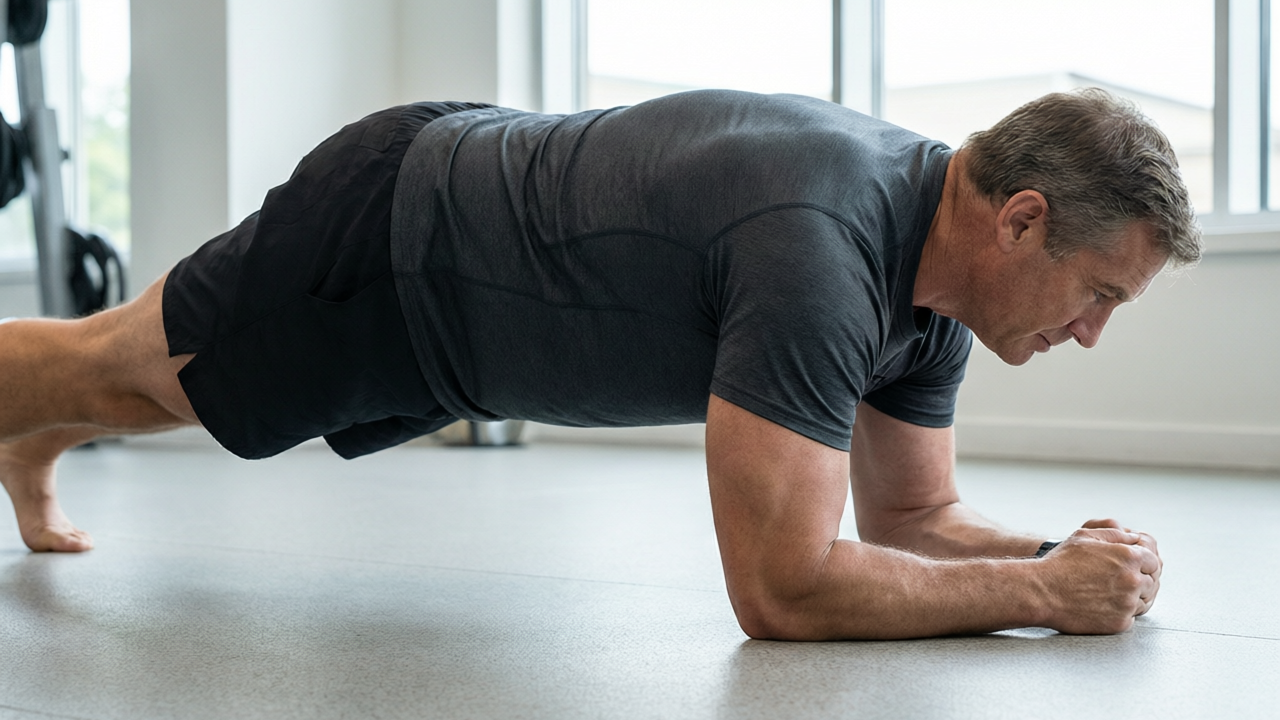
Plank
plank
انتبه عند
- caution · Shoulder impingement — Sustained loading through the shoulders in a fixed position can provoke pinching under the acromion, especially with elbows drifting behind the shoulder line. Stack elbows directly under shoulders, or raise the forearms onto a bench to reduce the demand.
- modify · Acute lower back injury — As the abs fatigue the hips sag and the lumbar spine takes the load the core was meant to carry. Shorten the lever instead of lengthening the hold: plank from the knees, or with forearms on a bench, and reset the moment the lower back arches.
When I hold a proper plank, I feel a steady, humming tension running straight through my midsection. It is not a sharp burn, but a deep, stabilizing engagement that locks my shoulders, ribs, and hips into one solid line. My breath stays rhythmic and calm, even as the seconds tick by. I am not fighting gravity; I am quietly mastering it. That quiet, grounded strength is exactly what a well-executed plank should feel like.
إذا كنت جديدًا على هذا
If you are just beginning, start with short holds of ten to twenty seconds and prioritize perfect alignment over duration. Imagine your body as a single, solid plank of wood that refuses to bend or twist. When your lower back starts to ache or your shoulders begin to shake excessively, those are clear signals that your stabilizing muscles are reaching their limit. At that exact moment, it is safer to drop to your knees or step back rather than let your spine collapse into a deep arch. Beginners often compensate by shrugging their shoulders toward their ears or letting their hips sag heavily toward the floor, which shifts the strain away from the core and onto the joints. Keep your shoulder blades gently pulled down and away from your ears, and actively push the floor away with your forearms to maintain upper-body tension. Progress gradually by adding five seconds each week as your endurance builds. Trust that consistency will quickly turn this foundational hold into an effortless daily practice.
المضي قدماً
Once you can hold a strict sixty-second plank without your form wavering, simply adding time yields diminishing returns. Instead, make the hold harder through greater tension. The RKC plank does exactly this: you actively drag your elbows towards your toes and squeeze your glutes and quads as hard as possible, turning a relaxed endurance hold into a maximal effort lasting only ten to fifteen seconds per set. This teaches your body to generate full-body stiffness on demand. If you prefer to keep the duration longer, place a weight plate or sandbag across your upper back to increase the anti-extension challenge. You can also shift your forearms further forward, past your shoulders, which lengthens the lever and demands considerably more from your abdominals. When even these variations feel manageable for three sets of thirty seconds, it is time to move on to dynamic anti-rotation work such as the Pallof press or bodyweight rollouts, where you must maintain that same rigid alignment whilst your limbs are in motion.
أخطاء شائعة
The most frequent error is allowing the lumbar spine to hyperextend, which happens when the abdominal wall disengages and the hips sink toward the ground. Many lifters also hike their glutes too high toward the ceiling, mistakenly believing this reduces the load when it actually removes the core from the equation entirely. Another widespread compensation involves shrugging the shoulders tightly toward the ears, which creates unnecessary neck tension and destabilizes the upper back. Finally, holding your breath to artificially brace the midline is counterproductive and spikes blood pressure unnecessarily. True stability relies on continuous, rhythmic breathing paired with deliberate muscular tension.
الروتين
- Sets
- 3
- Reps
- 30-60s
- Rest
- 60s
- RPE
- 7
- Per set
- ~90s
- التكرار
- 2-3x/week
Increase hold time by 10-15 seconds once strict form is maintained, then progress to weighted or leveraged variations like the RKC plank.
Cues
العضلات
- Abs
- Obliques
- Glutes
- Shoulders
- Lower back
المعدات
- Bodyweight
- 1
Place forearms flat on the floor with elbows stacked directly under the shoulders.
- 2
Extend both legs straight back and press the balls of the feet firmly into the ground.
- 3
Tuck the chin slightly and fix the gaze on the floor between the hands.
- 4
Inhale deeply through the nose while drawing the belly button toward the spine.
- 5
Lift the hips off the floor until the body forms a rigid straight line from head to heels.
- 6
Maintain steady nasal breathing while actively squeezing the glutes and quads.
- 7
Scan the posture for sagging hips or elevated shoulders and correct alignment immediately.
- 8
Hold the static position while continuing slow, rhythmic breaths in and out.
- 9
Exhale fully while slowly lowering the knees to the supporting surface.
- 10
Release the abdominal tension and rest on the forearms before standing up.