
Diaphragmatic Breathing
diaphragmatic-breathing
When you nail this, your breath feels like a slow, grounding tide washing through your core. You’ll notice your ribs gently expanding outward and downward while your chest stays beautifully quiet. Each inhale draws you deeper into a state of calm readiness, and each exhale melts tension from your spine. It’s less about forcing air and more about allowing your natural rhythm to restore your nervous system.
إذا كنت جديدًا على هذا
Focus on letting your breath happen rather than forcing it. You should feel a gentle expansion in your lower abdomen and lower ribs, not a lifting of your shoulders or chest. If you feel lightheaded, dizzy, or notice your chest heaving upward, stop immediately and return to your natural breathing pattern. A common compensation is gripping the stomach or arching the lower back to simulate deep breathing. Keep your core relaxed and let gravity do the work. When fatigue sets in, your exhales will shorten, and tension will creep into your neck. That is your signal to pause. Remember that mastering this rhythm takes patience. Start with just a few mindful cycles and build consistency over intensity. With regular practice, your body will naturally default to this efficient pattern during stressful moments, turning conscious effort into an automatic anchor for calm.
المضي قدماً
To make this practice genuinely harder, extend the exhale rather than forcing more air in. Push your six-second exhale to eight or ten seconds over several weeks, keeping the four-second inhale steady; a longer exhale deepens parasympathetic engagement and demands greater diaphragmatic control. You can also introduce a light abdominal brace during the final two seconds of each exhale, which trains the diaphragm to work against mild resistance without recruiting the neck. Eight to twelve breaths per set remains appropriate, but if you maintain the extended ratio comfortably for three sets, increase the duration rather than the rep count. Once you can sustain a 4-1-10-0 tempo with full rib expansion and no chest movement, progress to seated diaphragmatic breathing, where gravity no longer assists your abdominal excursion. For a useful variation, try crocodile breathing by lying face down with your hands beneath your forehead; the floor provides direct feedback against your belly, ensuring true posterior-lateral expansion.
أخطاء شائعة
Many beginners mistakenly lift their chest and shoulders during inhalation, which shifts the workload to accessory neck muscles and defeats the purpose. Others actively suck their stomach in on the inhale instead of allowing it to expand outward, creating artificial tension across the midsection. A third frequent error is forcing the breath too quickly, which spikes heart rate rather than calming the nervous system. Finally, some people hold their breath at the top of the cycle out of habit, turning a restorative practice into a stressful breath holding drill. Keep the rhythm slow, the chest quiet, and the belly soft to avoid these pitfalls.
الروتين
- Sets
- 3
- Reps
- 8-12 breaths
- Rest
- 60s
- Tempo
- 4-1-6-0
- RPE
- 3
- Per set
- ~180s
- التكرار
- 2-3x/week
Gradually extend your exhale duration by one second each week, or add a light abdominal brace at the end of each breath.
Cues
العضلات
- Abs
المعدات
- Bodyweight
- 1
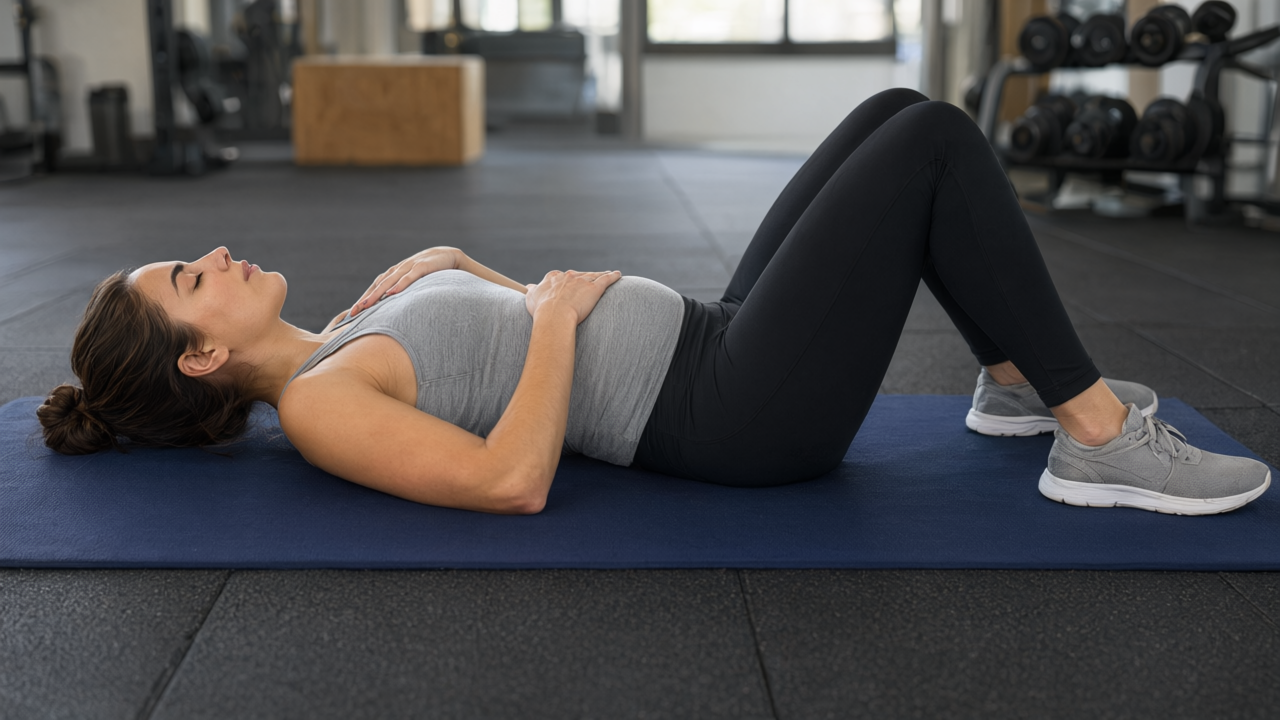
Lie flat on your back with knees bent and feet resting comfortably on the floor.
- 2
Place one hand lightly on your upper chest and the other directly over your belly button.
- 3
Close your eyes and relax your jaw, shoulders, and neck completely.
- 4
Inhale slowly through your nose for four seconds, directing the air deep so your bottom hand rises while your top hand stays still.
- 5
Pause gently at the top of the breath for one second without holding tension.
- 6
Exhale smoothly through pursed lips for six seconds, feeling your lower hand sink as your abdomen naturally draws inward.
- 7
Repeat this cycle for the prescribed duration, maintaining a slow and steady rhythm.
- 8
Open your eyes, roll onto your side, and press up to a seated position to finish.