
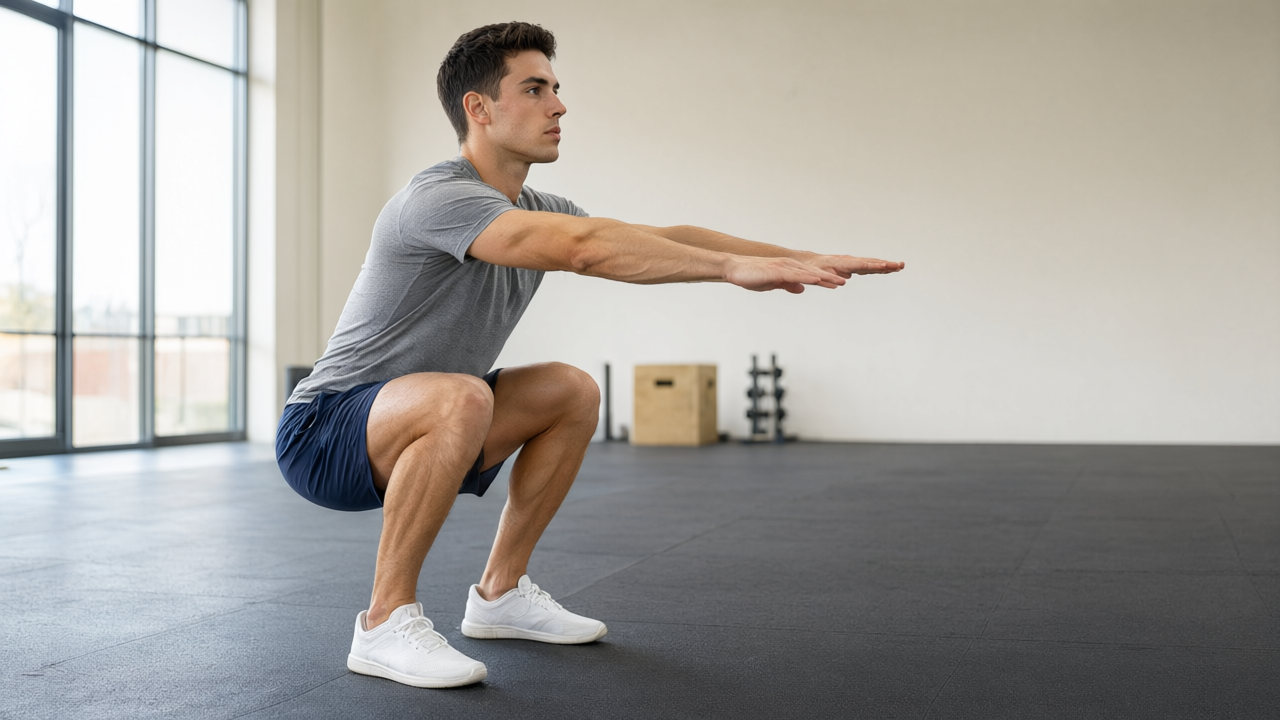
Bodyweight Squat
bodyweight-squat
انتبه عند
- caution · Hip replacement (post-op) — Deep hip flexion combined with external rotation (toes out) may risk impingement or dislocation depending on the surgical approach. Avoid going below parallel unless cleared by a surgeon. Keep toes more forward and limit range of motion to safe limits.
- modify · Acute knee injury — Deep flexion and high shear forces at the bottom of the squat can aggravate knee pain. Limit depth to a comfortable range (e.g., quarter or half squat) or use a box for support. Focus on controlled tempo.
- modify · Acute lower back injury — Maintaining an upright torso while dropping hips below knees places significant load on the lumbar spine. Reduce depth to parallel or above, ensure strict core bracing, and avoid rounding the lower back. If pain persists, switch to a supported movement like a wall sit.
When you nail a bodyweight squat, you’ll feel a grounded, full-foot connection and a smooth hinge through your hips. Your chest stays proud while your knees track naturally over your toes, and the descent feels controlled, not rushed. Rising up should generate power from your midfoot and heels, leaving your quads and glutes engaged but never strained. I want every rep to feel stable, rhythmic, and completely intentional.
إذا كنت جديدًا على هذا
Focus on keeping your knees tracking in line with your second toe throughout the entire range of motion. If your heels lift or your knees cave inward, widen your stance slightly and actively push your knees outward. True muscular fatigue feels like a steady burn in your thighs and glutes, not sharp pain in your lower back or knees. Stop immediately if you experience joint discomfort, dizziness, or if your torso collapses forward despite your best effort. A common compensation is letting your lower back round at the bottom; counter this by engaging your core and keeping your gaze forward. Remember that depth is a result of mobility, not a requirement. Work within your current range, prioritize control over speed, and trust that consistent, mindful practice will naturally unlock a deeper, smoother squat over time.
المضي قدماً
To make this movement genuinely demanding without external load, extend your lowering phase to four or five seconds and add a deliberate two- to three-second pause at the bottom. This removes any elastic rebound and forces your quads and glutes to work through dead-stop tension. Drive up with intent, but never sacrifice that full-foot connection. Rep ranges of fifteen to twenty build endurance, while sets of eight to twelve with a slow tempo bias strength. When you can complete three sets of twenty controlled reps with a pause and still feel fresh, you have outgrown the bodyweight version; transition to a weighted goblet squat using a kettlebell or dumbbell. Alternatively, shift your leverage by moving to a pistol squat or a Bulgarian split squat, both of which demand significantly more from each leg independently. Narrowing your stance slightly also increases the challenge on your quads and ankle mobility.
أخطاء شائعة
Most people rush the descent, sacrificing control and turning the movement into a momentum-driven drop rather than a deliberate strength exercise. Another frequent error is allowing the knees to collapse inward, which places unnecessary stress on the joint and disengages the stabilizing muscles. Many beginners also fail to brace their core properly, leading to a rounded lower back and compromised spinal alignment at the bottom. Finally, lifting the heels off the ground shifts the load away from the posterior chain and forces the knees forward excessively. Correcting these habits requires slowing down, planting the whole foot firmly, and treating the bottom position as an active checkpoint rather than a passive rest.
الروتين
- Sets
- 3
- Reps
- 8-12
- Rest
- 90s
- Tempo
- 2-0-2-0
- RPE
- 4
- Per set
- ~90s
- التكرار
- 2-3x/week
Advance by adding a two-second pause at the bottom or transitioning to a weighted goblet squat.
Cues
العضلات
- Quadriceps
- Glutes
- Hamstrings
- Adductors
- Abs
المعدات
- Bodyweight
- 1
Stand tall with your feet shoulder-width apart and toes angled slightly outward.
- 2
Brace your core and keep your chest lifted as you prepare to move.
- 3
Inhale steadily while pushing your hips back and bending your knees.
- 4
Lower yourself until your hip crease drops below your knee line, keeping weight centered.
- 5
Pause briefly at the bottom to maintain active tension through your midfoot and heels.
- 6
Exhale forcefully as you drive through your entire foot to return to standing.
- 7
Fully extend your hips and knees at the top without leaning backward.
- 8
Reset your posture, take a calm breath, and prepare for the next repetition.