
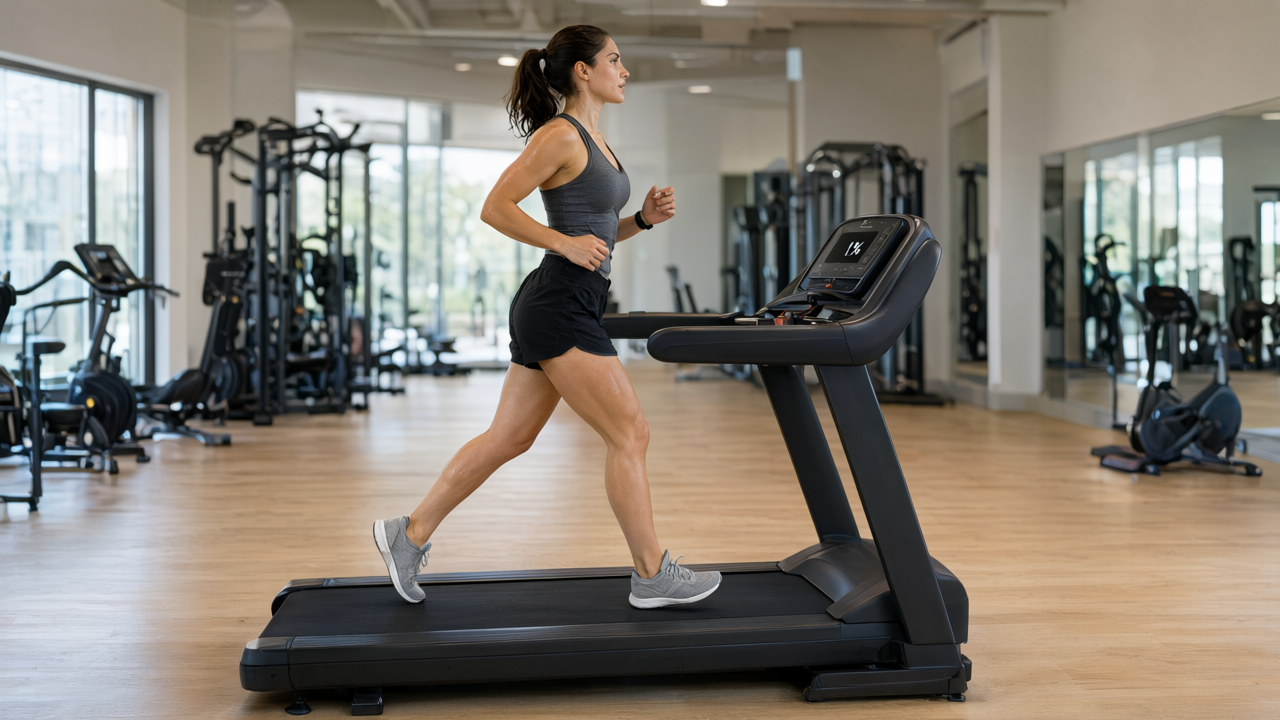
Treadmill Steady Run
treadmill-steady-run
注意
- caution · Acute knee injury — The repetitive impact of running loads the patellofemoral joint and tibial plateau with each stride. Instead, use the treadmill at a steep incline for walking to maintain cardiovascular stimulus without high impact.
- caution · Acute lower back injury — The vertical ground reaction forces travel through the lumbar spine during the stance phase of running. Instead, perform brisk incline walking on the treadmill to reduce spinal compression whilst sustaining aerobic effort.
When I cue you into a steady run on the treadmill, I want you to find a pace where conversation remains easy. This is your aerobic base builder. You will set a one per cent incline to mimic outdoor wind resistance, keep your posture tall, and land softly under your hips. It develops cardiovascular endurance without excessive fatigue, forming the foundation of your running fitness.
如果您是新手
The first time you attempt this, you will likely set the treadmill too fast because the controlled environment feels easier than it truly is. Your breathing will become ragged within five minutes, forcing you to grip the handrails. Let go of those rails immediately; holding them ruins your posture and reduces the training effect. Instead, lower the speed until you can speak in full sentences without gasping. Another common error is overstriding, where your foot lands far ahead of your body, creating a braking force that jars your knees. Shorten your stride so your foot lands directly under your hips. You should feel a rhythmic, almost meditative bounce, with your heart working steadily but not pounding. If your calves burn sharply or your shins ache, stop. Reduce the duration to fifteen minutes and alternate one minute of jogging with one minute of walking until your tissues adapt over several sessions.
進一步探索
Once you can hold forty-five minutes comfortably at zone two, progress by adding five minutes to your total duration every fortnight, capping at sixty minutes before increasing speed. Alternatively, raise the incline to two or three per cent while maintaining the same heart rate to build specific hill strength without extra impact. Keep your cadence above 175 steps per minute even as fatigue sets in during the final ten minutes. For variation, try a negative split run: cover the first half of your session slightly slower than the second, teaching your body to finish strong. Another option is a tempo-fartlek hybrid, inserting four one-minute surges at threshold pace into the middle of your steady run, returning immediately to your conversational baseline. Monitor your average heart rate across weeks; if it drops at the same speed, your aerobic base has genuinely improved.
常見錯誤
Gripping the handrails is the most frequent error, causing you to hunch your shoulders and disengage your core, which shifts the workload away from your legs and spine. Release your grip and let your arms swing naturally. Overstriding places excessive braking forces on your knees and shins, often leading to anterior knee pain or shin splints; shorten your steps so your feet land beneath your centre of mass. Running completely upright removes the natural forward momentum required for efficient gait, wasting energy; lean slightly from your ankles, not your hips. Finally, staring down at the console rounds your upper back and restricts your diaphragm, making breathing unnecessarily difficult. Keep your gaze fixed straight ahead on the horizon line of the room to maintain an open chest and relaxed neck.
訓練計劃
- Sets
- 1
- Reps
- 20–45 minutes
- Rest
- 0s
- Tempo
- steady
- RPE
- 4
- 頻率
- 3
Add five minutes every fortnight up to sixty minutes, then increase speed by 0.5 km/h.
Cues
有氧運動
- Style
- steady
- 時長
- 30 min
- Zone
- 2
肌肉
- Cardiovascular
- Quadriceps
- Glutes
- Hamstrings
- Calves
- Abs
廚具
- Treadmill
- 1
Stand on the treadmill belt with feet hip-width apart and hands near the side rails.
- 2
Set the incline to one per cent and select a speed between eight and eleven kilometres per hour.
- 3
Press start, walk briskly for thirty seconds, then transition smoothly into an easy jog.
- 4
Maintain tall posture with a slight forward lean from the ankles, not the waist.
- 5
Swing your arms at ninety degrees, keeping shoulders relaxed and hands unclenched throughout the stride.
- 6
Land each foot softly directly beneath your hips, aiming for a cadence of roughly 170 steps per minute.
- 7
Breathe rhythmically, exhaling gently as your foot strikes the belt to maintain a conversational effort.
- 8
Continue running steadily for twenty to forty-five minutes, adjusting speed only if breathing becomes laboured.
- 9
Gradually reduce the treadmill speed to a walk for two minutes before stepping off safely.