
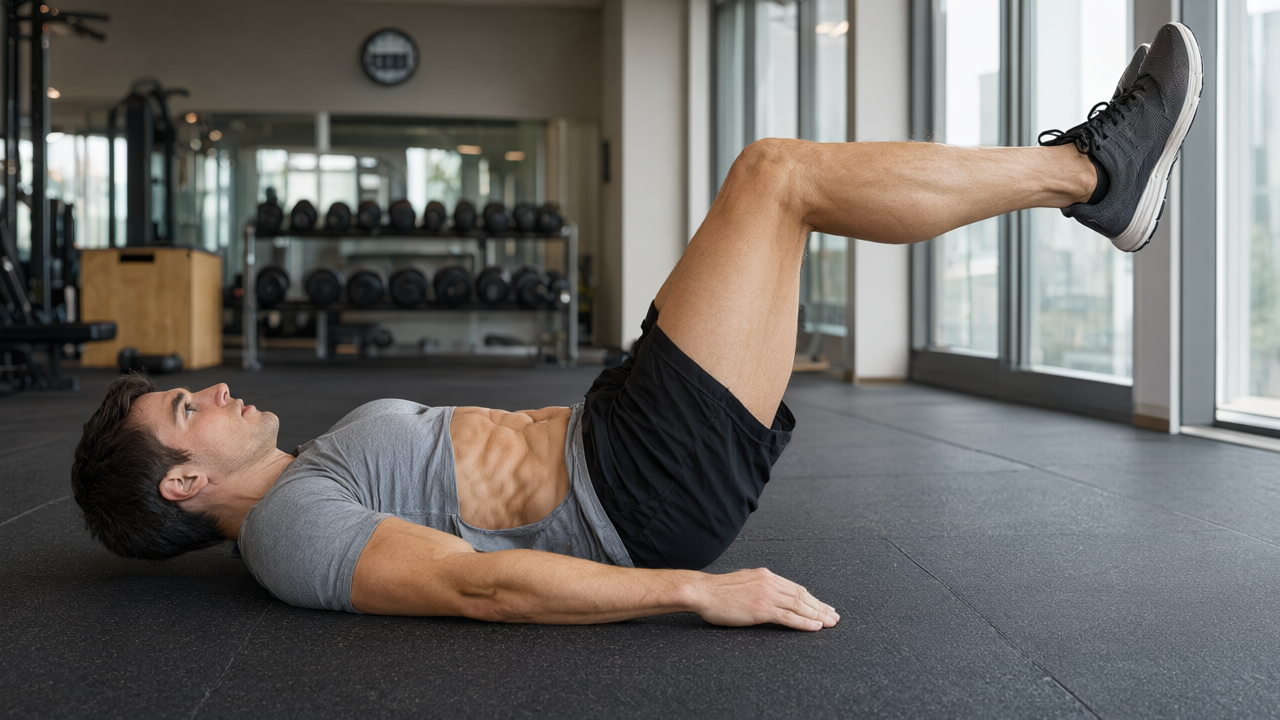
Lying Leg Raise
lying-leg-raise
When I cue this movement, I want you to feel a deep, sustained tension across your entire abdominal wall rather than just a superficial burn. Your lower back must remain anchored to the floor as your legs carve through the air. Focus on initiating every rep from your lower abs, exhaling sharply as you lift, and resisting the urge to swing. Control the descent completely to maximize time under tension and build real core stability.
如果您是新手
As a beginner, your primary goal is mastering spinal control before chasing height or speed. You should feel a deep, localized burn in your lower abdomen, not a sharp pinch in your lumbar spine. If your lower back arches or lifts off the floor, you have lost the protective engagement needed to perform the movement safely. Stop the set immediately when you can no longer maintain a flat back or when your legs begin to swing uncontrollably. Common compensations include using momentum to kick your legs upward or bending your knees excessively to reduce the load. Keep your pelvis slightly tucked and imagine pulling your belly button toward the floor throughout every repetition. Consistency with controlled, partial-range reps will build the foundational strength required for full-range execution. Trust the slow tempo and let your core muscles do the heavy lifting.
進一步探索
To make this movement genuinely demanding, extend the lowering phase to four or five seconds and add a distinct two-second pause at the bottom, hovering just above the floor where your abdominals work hardest against the lever. Sets of eight to twelve with this slower tempo build strength; higher reps of fifteen to twenty suit endurance, provided your back never leaves the mat. Progress by squeezing a light dumbbell between your ankles, which shifts the centre of mass further from your hips and forces deeper engagement without altering the pattern. Add weight only when you can complete every rep of a set with the extended descent and your spine fully anchored. Once weighted floor raises feel controlled across three sets of twelve, transition to hanging leg raises, where the absence of floor support demands far greater pelvic control. Alternatively, try single-leg lowers, keeping one leg vertical while the other descends, to challenge anti-rotation stability.
常見錯誤
Most lifters rush through the movement, allowing momentum to carry their legs upward instead of relying on abdominal contraction. This swinging motion completely bypasses the target muscles and places unnecessary shear force on the lumbar spine. Another frequent error is letting the lower back arch away from the floor during the descent, which indicates a loss of core bracing and shifts the workload to the hip flexors. Many people also drop their legs too quickly, sacrificing the eccentric phase where the most muscle damage and growth occur. Finally, holding your breath throughout the set creates dangerous intra-abdominal pressure spikes and disrupts the natural rhythm needed for sustained tension.
訓練計劃
- Sets
- 3
- Reps
- 10-15
- Rest
- 60s
- Tempo
- 2-0-2-0
- RPE
- 7
- Per set
- ~90s
- 頻率
- 2-3x/week
Advance by slowing the lowering phase, adding a light dumbbell between your ankles, or transitioning to hanging leg raises.
Cues
肌肉
- Abs
- Hip flexors
- Obliques
- Lower back
廚具
- Bodyweight
- 1
Lie flat on your back with your legs extended and arms resting firmly by your sides.
- 2
Press your lower back into the floor and engage your core before initiating any movement.
- 3
Inhale steadily as you brace your midsection and prepare to lift.
- 4
Exhale smoothly while raising both legs together until they reach a vertical ninety-degree angle.
- 5
Pause briefly at the top to maintain core tension and prevent momentum from taking over.
- 6
Inhale deeply and slowly lower your legs back toward the floor, keeping your spine completely flat.
- 7
Stop your descent just before your heels touch the ground to maintain constant abdominal engagement.
- 8
Reset your posture and repeat the cycle for your prescribed number of repetitions.