
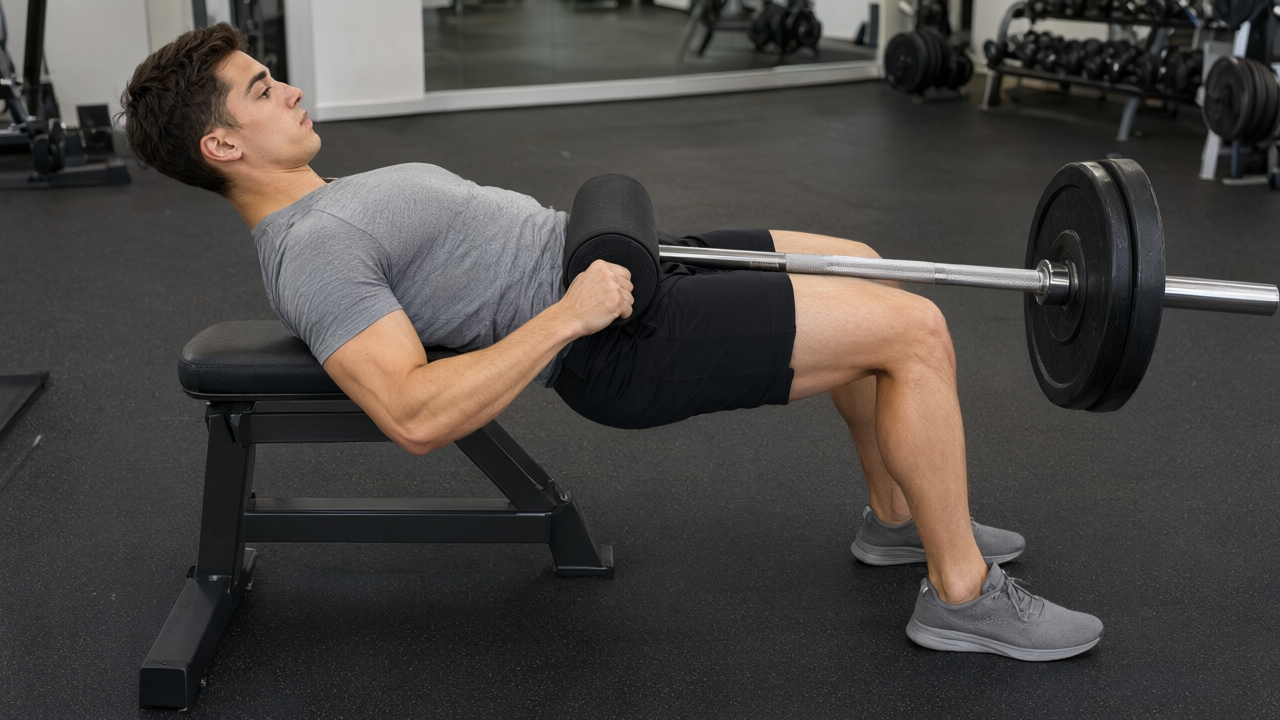
Hip Thrust
hip-thrust
注意
- avoid · Herniated disc — Axial loading across the hip crease combined with spinal flexion during the descent can compress and aggravate a herniated disc. Instead, use bodyweight glute bridges or cable pull-throughs to train hip extension without spinal loading.
- caution · Hip replacement (post-op) — The bottom of this range puts the hip at a right angle under a bar that presses across the front of the joint, which is the position a new replacement is protected against. Do not go there — set the bench height and foot placement to stop well short of that, and take the advice of whoever placed it. Cable Pull-Through trains the same extension standing.
- caution · Cardiac condition (un-cleared) — A heavy barbell lift with a forceful exhale spikes blood pressure hard, and getting into and out of the position under load is the strain. Keep the load light, breathe continuously rather than bearing down, and use moderate reps. Glute Bridge on the floor trains the same extension with nothing to hold over the pelvis.
- caution · Acute lower back injury — Overextending the lumbar spine at the top places shear stress on injured lower back structures. Instead, perform glute bridges on the floor to limit range of motion while still targeting the posterior chain.
- caution · Pregnancy — The barbell resting directly across the hip crease creates uncomfortable pressure against the pelvis and abdomen as pregnancy progresses. Instead, perform banded glute bridges or single-leg hip thrusts to maintain glute strength without anterior compression.
- modify · Acute knee injury — The knees sit bent at ninety degrees under load for the whole set, and foot placement too far forward moves that load into the joint. Set the feet back until the shins stay vertical at the top and drive through the heels. If the knee still protests, train the same extension unloaded with Glute Bridge or Cable Pull-Through.
The heaviest way to train hip extension without asking the lower back to carry the load. Upper back rests on a bench, a padded barbell sits across the hip crease, and the hips drive to full extension. Primary for the glutes, with the hamstrings working as hip extensors and the abdominals holding the ribs down. It is the loaded version of the floor Glute Bridge, and it is where most people's glute strength is actually built.
如果您是新手
Start with the empty bar, or the movement on the floor, until you can reach the top without your lower back arching to get there. Set your feet so the shins are vertical at the top and your fingertips just brush your knees; if your heels are far out in front, the quads take the lift and the lumbar spine finishes it. You should feel the work in the belly of the glutes, not in the spine. If the lower back protests or the hips shift to one side, end the set, take weight off, and move the feet slightly closer rather than pushing the hips higher. Stop the set when you can no longer hold full extension with the ribs down, not when the bar stops moving.
進一步探索
Extend the lowering phase to three or four seconds and hold the top for a full two-second squeeze: that time under tension makes a moderate barbell feel heavy without stressing the joints. Eight to twelve reps builds size, five or six with a heavier bar builds raw extension strength. Add 2.5 kilograms only when every prescribed rep across every set is completed with the pause intact. Once you handle heavy loads for sets of six, the two progressions worth knowing are Single-Leg Hip Thrust, which demands far more stability from each hip independently, and Banded Hip Thrust as a high-rep finisher when the barbell is unavailable. A band looped above the knees during the thrust itself is the other option — it forces constant outward pressure and recruits gluteus medius throughout.
常見錯誤
Many lifters rush through the top position without pausing, which robs the glutes of their peak contraction and shifts the load into the lower back. Overextending the lumbar spine at the top is another frequent error, often caused by pushing the hips too high or failing to brace the core properly. Some athletes also place their feet too far forward, turning the exercise into a quad-dominant bridge, while others allow their knees to cave inward under heavy loads, compromising joint stability. Finally, bouncing the bar off the floor eliminates time under tension and increases injury risk. Keep your ribs down, pause deliberately, and control every inch of the descent.
訓練計劃
- Sets
- 3
- Reps
- 8-12
- Rest
- 90s
- Tempo
- 2-0-2-0
- RPE
- 8
- Per set
- ~180s
- 頻率
- 2-3x/week
Increase the barbell load by 2.5 to 5 pounds once you successfully complete 12 reps across all sets with strict form.
Cues
肌肉
- Glutes
- Hamstrings
- Abs
- Lower back
廚具
- Bench
- Barbell
- 1
Sit on the floor with your upper back resting firmly against the edge of a sturdy bench.
- 2
Roll a padded barbell over your thighs until it rests securely across your hip crease.
- 3
Plant your feet flat on the floor shoulder-width apart with your knees bent at ninety degrees.
- 4
Brace your core, pull your ribs down, and inhale deeply through your nose.
- 5
Drive through your heels to extend your hips until your torso and thighs align in a straight line.
- 6
Exhale forcefully while squeezing your glutes tightly at the top position.
- 7
Hold the peak contraction for one second without overarching your lower back.
- 8
Inhale slowly as you lower your hips back toward the floor under strict control.
- 9
Stop the descent just before your glutes touch the ground to maintain continuous tension.
- 10
Return to the starting position, check your alignment, and reset for the next repetition.