
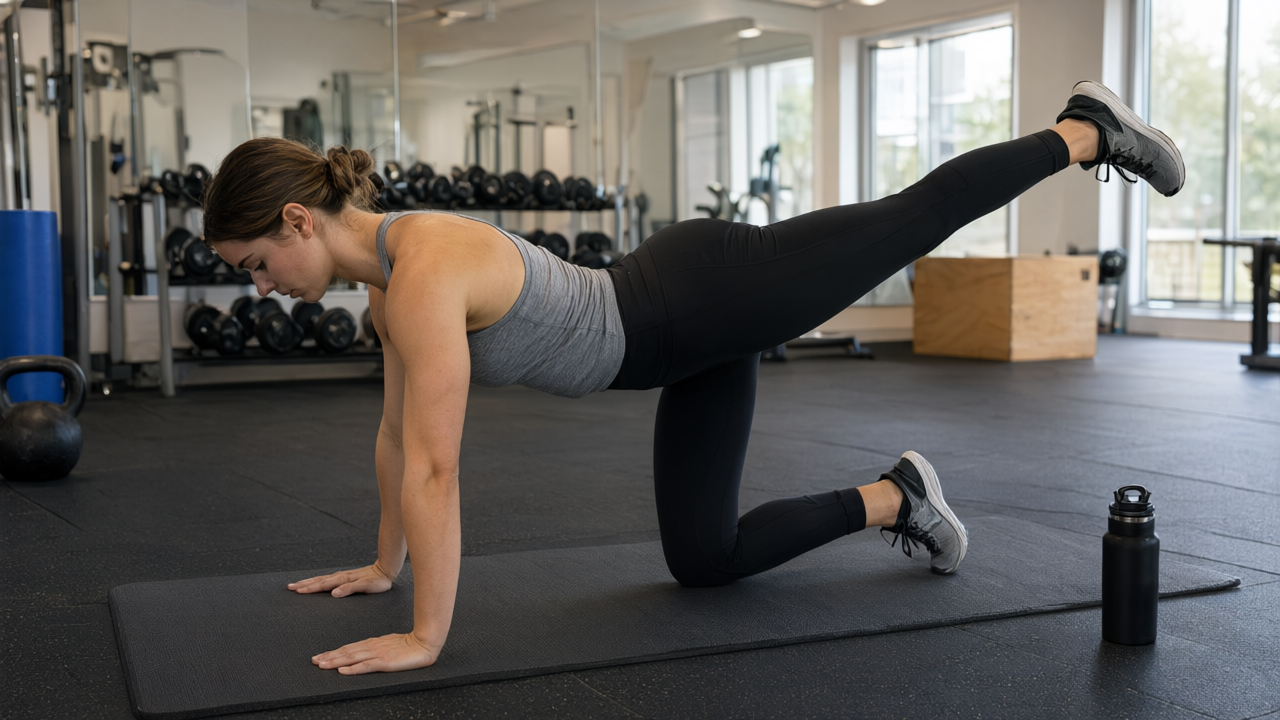
Fire Hydrant
fire-hydrant
I love how a properly executed fire hydrant isolates the hips without spinal compromise. You’ll feel a deep, controlled burn along the outer glute as the knee lifts, while your core stays quietly braced to anchor the pelvis. Good reps feel like slow, deliberate arcs—no momentum, no lower-back sway. Focus on keeping the working leg bent and the movement strictly lateral, letting the gluteus medius do all the heavy lifting while your torso remains completely still.
如果您是新手
Start light and prioritize control over range of motion. Keep your gaze fixed on the floor to prevent your neck from craning upward. As you lift, imagine your knee tracing a smooth arc outward rather than pushing straight up. You will feel muscular fatigue in the side of your hip and glute, which is exactly where it belongs. If your lower back begins to arch or your torso starts rocking side-to-side, you have reached your current stability limit; stop the set, reset your core, or reduce the height of the lift. Many beginners compensate by using momentum or letting the working foot drag on the ground. Instead, keep your supporting hand planted firmly and maintain a rigid midline. Progress takes patience here. Trust that small, perfectly controlled repetitions build stronger neural pathways and more resilient hips than rushed, sloppy reps ever could.
進一步探索
Because this is a low-load isolation movement, making it harder means extending time under tension rather than chasing speed. Stretch the lowering phase to three or four seconds and hold the top position for a full two-second squeeze before descending. Sets of fifteen to twenty reps build local muscular endurance, whilst staying in the eight-to-twelve range with added resistance favours strength. When you can complete three sets of fifteen with a one-second pause at the top without your pelvis shifting, loop a resistance band just above your knees. The band increases demand precisely where the gluteus medius is shortest, forcing you to fight inward pull throughout the entire arc. Once banded repetitions feel controlled, progress to the straight-leg lateral raise from the same all-fours position, which lengthens the lever and substantially increases the load on the outer hip. Alternatively, try the clamshell if you want to maintain the bent-knee angle whilst targeting deeper external rotators.
常見錯誤
The most frequent error is allowing the pelvis to tilt or hike upward as the leg lifts, which steals tension from the target muscles and shifts stress into the lumbar spine. Another common flaw is extending the knee instead of maintaining that crucial ninety-degree bend, turning an abduction movement into an awkward leg press. Many practitioners also rush the tempo, using momentum to swing the leg out rather than driving the motion with deliberate muscular contraction. Finally, forgetting to anchor the supporting hand leads to unnecessary shoulder collapse and spinal rotation. Keep your frame rigid and let the glute do the isolated work.
訓練計劃
- Sets
- 3
- Reps
- 8-12
- Rest
- 90s
- Tempo
- 2-0-2-0
- RPE
- 7
- Per set
- ~90s
- 頻率
- 2-3x/week
Add a resistance band around your thighs or slow the eccentric phase to increase time under tension.
Cues
肌肉
- Glutes
- Abductors
- Abs
- Obliques
廚具
- Bodyweight
- 1
Position yourself on all fours with your hands directly under your shoulders and knees under your hips.
- 2
Engage your core to flatten your lower back, keeping your spine in a neutral tabletop alignment.
- 3
Inhale to prepare, then exhale as you slowly lift one bent knee out to the side.
- 4
Keep the knee at a 90-degree angle throughout, stopping when your thigh reaches parallel with the floor.
- 5
Pause for one second at the top to squeeze the outer glute without hiking your pelvis.
- 6
Inhale as you lower the leg back to the starting position with controlled resistance.
- 7
Complete all prescribed repetitions on one side before switching to the opposite leg.