
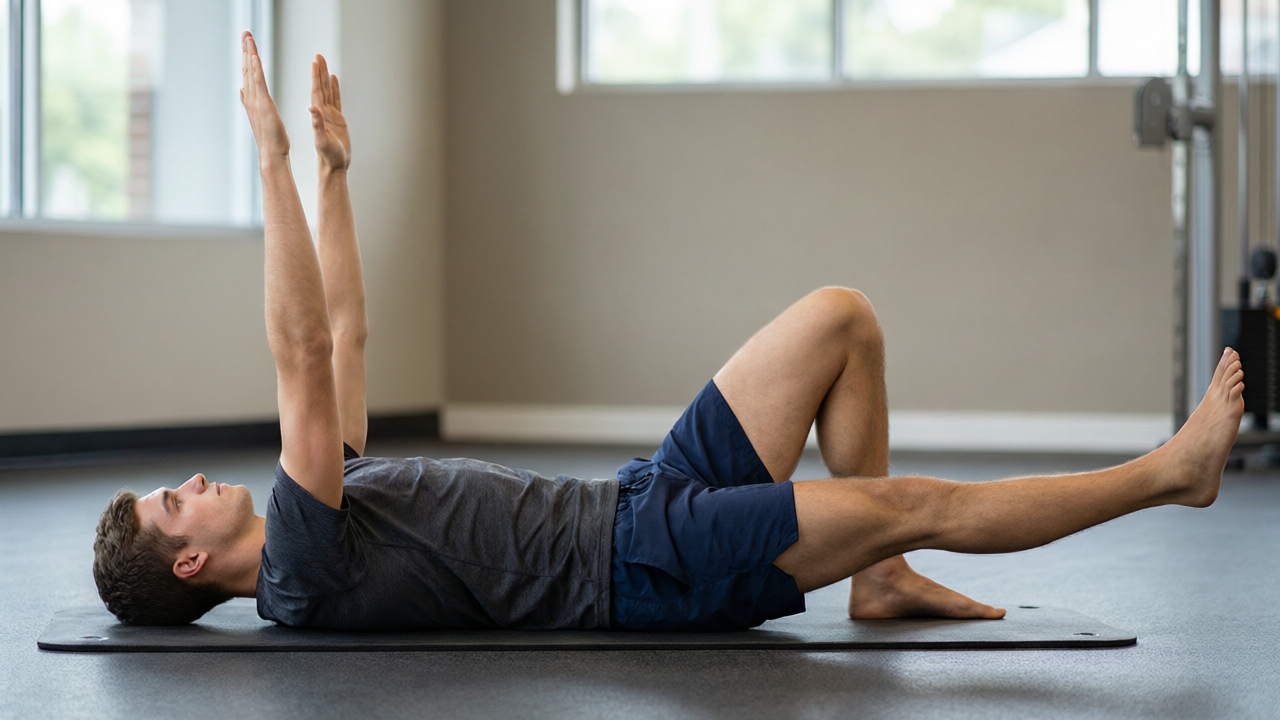
Dead Bug
dead-bug
注意
- modify · Acute lower back injury — The whole drill is keeping the lower back pressed into the floor while the limbs move, so when that contact is lost the movement has silently become a loaded extension of the spine. Shorten the range: keep the knee bent and only lower the leg as far as the back stays flat, and put the arms down instead of overhead. If you cannot hold the contact at all, go back to Bird Dog, which trains the same brace with the spine supported.
- modify · Pregnancy — Lying flat on the back becomes uncomfortable and then unworkable as the pregnancy continues, and the arms-overhead, legs-out version stretches an abdominal wall already lengthened. Keep the limbs moving but stay short of the point where the belly visibly cones or domes along the midline — a controlled range is the whole skill here. Instead, use Bird Dog, which trains the identical anti-extension brace on all fours with no supine position. Stop and raise it with your midwife or obstetric team if you feel separation, heaviness in the pelvis, or any leaking during the drill.
When I perform dead bugs correctly, I feel a deep, steady tension anchoring my lower back to the floor. Each slow, controlled extension feels like drawing a line through my core, keeping my ribs knit down and my pelvis perfectly neutral. There’s no rushing, just deliberate opposition. I notice a quiet burn in my deep abdominals, a grounded stability that makes every breath feel purposeful and every rep build unshakable control.
如果您是新手
If you are just starting out, prioritize the connection between your breath and your core over how far you can extend your limbs. Keep your range small at first, only lowering your heel until it lightly grazes the floor. You will know you are reaching failure when your lower back starts to lift or your breathing becomes shallow and strained. Stop the set the moment you feel your spine arching or your ribs flaring upward, as this means the load has shifted away from your abdominals and into your lumbar spine. A common compensation is rushing through the movement, which turns a stability drill into a momentum exercise. Slow it down, reset your brace, and focus on keeping your pelvis perfectly still. It is completely normal to feel your limbs trembling or your core shaking slightly, but that vibration should not translate into spinal movement. Trust the process, respect your current range, and let the tension build gradually with every controlled repetition.
進一步探索
To make this harder without adding weight, extend the lowering phase to four or five seconds and introduce a two-second pause when your hand and heel hover just above the floor. That isometric hold forces your deep abdominals to work against gravity at their longest lever. Rep ranges of eight to twelve per side suit this drill; once you can complete three sets of twelve with a slow eccentric and no spinal shift, progress by straightening both legs fully during the extension rather than keeping the working knee bent. If you use light ankle weights, treat them as a way to increase time under tension rather than chasing high numbers. For a different stimulus, try the contralateral dead bug where you lower the same-side arm and leg simultaneously, which demands considerably more rotational control from your obliques. Harder here always means greater leverage or longer tension, never speed.
常見錯誤
The most frequent error is allowing the lower back to arch away from the floor as the leg extends, which immediately compromises the anti-extension objective and places unnecessary shear on the lumbar vertebrae. Many lifters also flare their ribs upward instead of keeping the thoracic cage gently depressed, breaking the continuous tension across the abdominal wall. Rushing through the tempo is another widespread issue, as swinging the limbs relies on momentum rather than muscular control and defeats the purpose of the drill. Additionally, people often hold their breath or bear down excessively, which spikes intra-abdominal pressure in the wrong direction and causes premature fatigue. Finally, overextending the limbs to force a deeper range of motion usually triggers compensatory hip flexor dominance, shifting the workload away from the core entirely.
訓練計劃
- Sets
- 3
- Reps
- 8-12
- Rest
- 60s
- Tempo
- 3-0-1-0
- RPE
- 7
- Per set
- ~90s
- 頻率
- 2-3x/week
Advance by slowing the eccentric phase, adding light ankle weights, or progressing to extended limb variations.
Cues
肌肉
- Abs
- Obliques
- Hip flexors
廚具
- Bodyweight
- 1
Lie flat on your back on a comfortable surface with knees bent and feet flat on the floor.
- 2
Lift both legs to a tabletop position, keeping knees bent at exactly 90 degrees over your hips.
- 3
Extend both arms straight toward the ceiling, positioning wrists directly above your shoulders.
- 4
Exhale and drive your lower back firmly into the floor to establish a stable core brace.
- 5
Inhale, then exhale as you slowly lower your right arm overhead while straightening your left leg forward.
- 6
Halt the movement just before your right hand and left heel touch the floor, checking that your spine stays neutral.
- 7
Inhale while smoothly returning the right arm and left leg to the starting tabletop position.
- 8
Exhale as you extend your left arm and lower your right leg, maintaining rigid core tension throughout.
- 9
Inhale to draw both limbs back to center, completing one full alternating cycle.
- 10
Tuck both knees toward your chest, roll onto one side, and push up to a seated position to safely reset.