
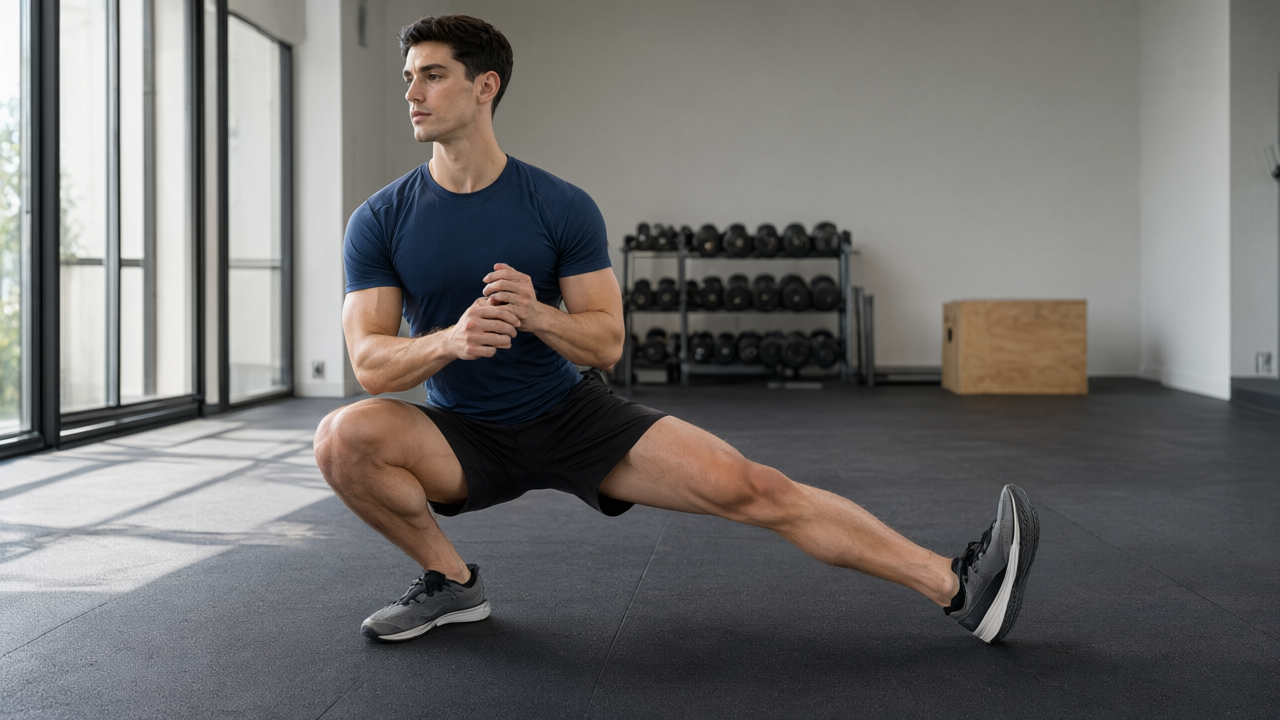
Cossack Squat
cossack-squat
注意
- avoid · Hip replacement (post-op) — The extreme hip abduction and external rotation required to keep the non-working leg straight can exceed safe range of motion limits for prosthetic hips, risking dislocation. Instead, perform gentle seated hip stretches or standing lateral leg swings within a comfortable, limited range.
- caution · Acute knee injury — The deep unilateral flexion places significant shear force on the knee joint and requires high stability. If you have meniscus or ligament issues, this may aggravate pain. Instead, perform a standard bodyweight squat with a narrower stance or use a box for support to limit depth.
- modify · Acute lower back injury — Maintaining a neutral spine while shifting weight laterally is difficult; many people compensate by rounding the lower back, which strains the lumbar discs. Instead, hold onto a sturdy pole or doorframe for balance and only descend as far as you can keep your chest up and spine neutral.
When I guide you through this movement, you will feel a deep, satisfying stretch opening across your inner thighs and hips. Good reps feel fluid and grounded, like a slow, controlled wave shifting from side to side. I love how your chest stays proud and your breathing stays steady, while each descent teaches your joints to move with quiet confidence. It is pure mobility in motion, leaving you wonderfully open, balanced, and ready.
如果您是新手
Start with a narrower stance and a shallower range until your hips and ankles adapt to the lateral demand. Keep your weight centered over the midfoot of the bending leg, never letting your knee cave inward past your toes. If you feel sharp pinching in the groin or a sudden loss of balance, stop immediately and reduce your depth. Beginners often compensate by rounding the lower back or lifting the heel of the working foot to force a deeper position; instead, keep that heel grounded and hinge from the hips. You might also notice the straight leg bending slightly at the knee to avoid the stretch. That is completely normal in the beginning. Allow the extended leg to remain straight but soft, letting the floor do the work. Breathe continuously and never push through joint pain. Progress gradually, adding only a few inches of depth each week as your tissues adapt. Trust the process, stay patient with your mobility, and let consistency build the foundation for a fluid, controlled movement.
進一步探索
Once your descent is controlled, extend the bottom pause to three or four seconds. This extra time under tension deepens the adductor stretch and forces the working hip to stabilise without momentum. Drive up briskly but deliberately, resetting fully at the centre before switching sides. Six to ten reps per side suits mobility work; if ten feels easy, widen your stance slightly or sink deeper rather than simply adding repetitions. Harder here means greater range, a longer hold at depth, or a wider base that demands more from your ankles and hips. When you can sit comfortably in the lowest position with a flat foot and upright torso for several seconds, you are ready for the goblet Cossack squat using a kettlebell or dumbbell to load the pattern. You might also try elevating the straight leg’s heel on a small plate, which intensifies the hamstring demand and further challenges your balance.
常見錯誤
Most practitioners rush the descent, sacrificing control for depth and allowing the working knee to collapse inward under the load. This valgus drift places unnecessary stress on the ligaments and robs the glutes of their stabilizing role. Another frequent error is lifting the heel of the planted foot, which shifts the center of gravity forward and turns a hip-dominant pattern into a quad-heavy squat. You will also see people forcefully push the straight leg into the ground, creating tension rather than allowing a passive, relaxed stretch. Finally, many forget to engage the core, resulting in a rounded spine and excessive lumbar flexion as they drop into the bottom position. Slow the tempo, prioritize a flat foot, and let the stretch happen naturally without muscular resistance.
訓練計劃
- Sets
- 3
- Reps
- 6-10 per side
- Rest
- 30s
- Tempo
- 3-1-1-0
- RPE
- 4
- Per set
- ~90s
- 頻率
- 4-5x/week
Gradually increase depth and control before adding external load or extending the bottom stretch hold.
Cues
肌肉
- Adductors
- Glutes
- Quadriceps
- Hamstrings
- Abs
- Calves
廚具
- Bodyweight
- 1
Stand with feet wider than shoulder-width apart and angle the toes slightly outward.
- 2
Engage the core muscles and lengthen the spine to maintain a tall torso.
- 3
Shift weight smoothly to the right side while bending the right knee and tracking it over the toes.
- 4
Inhale deeply as the hips lower toward the right heel, keeping the left leg fully extended.
- 5
Keep the left heel grounded and point the left toes upward to stretch the inner thigh.
- 6
Maintain a neutral spine and prevent the chest from collapsing forward during the descent.
- 7
Push firmly through the right foot while exhaling to drive the body back to the center.
- 8
Return to an even weight distribution across both feet and reset posture before alternating sides.