
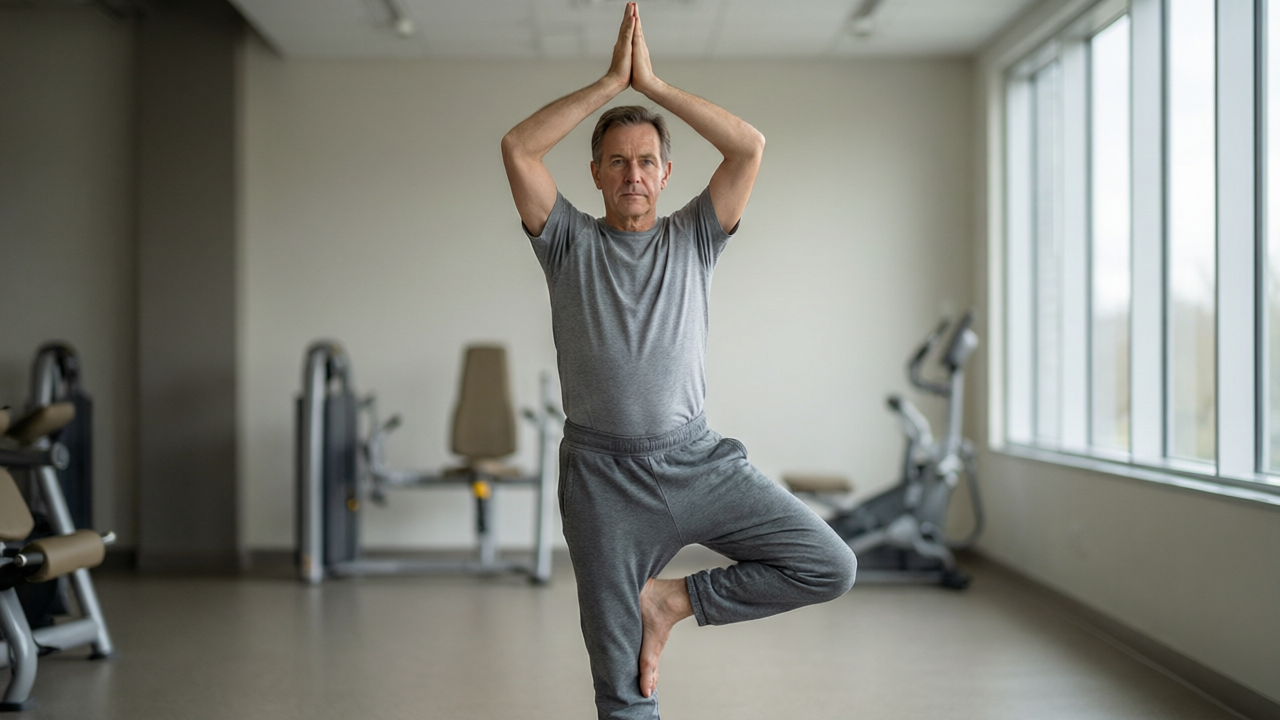
Tree Pose
tree-pose
注意
- avoid · Vertigo / balance disorder — The whole exercise is standing on one leg while lifting the arms overhead, and the safety net it relies on is your own gaze fixed on a still point — which is the first thing that fails when the room moves. Work it beside a wall or a sturdy chair with a hand ready, and skip the overhead reach entirely. Instead, use Wall Sit, which loads the same hip and thigh muscles with both feet planted and nothing to balance.
- modify · Acute knee injury — The working leg is bent under full bodyweight and the raised foot presses near the knee of the standing leg, so any knee that dislikes loaded flexion will complain here. Keep the foot on the inner calf rather than the thigh, bend the standing knee less, and hold a wall. If the knee is the limiter, substitute Wall Sit at a shallow angle, which loads the same thigh and hip muscles with the knee in a fixed, controlled bend.
When you find your root in Tree Pose, the world steadies around you. A successful rep feels like a quiet, grounded expansion—your standing foot roots deep into the floor while your spine lifts effortlessly toward the sky. You’ll notice a steady, rhythmic breath and a gentle engagement along your standing leg and core. Focus on stillness over height, and let your balance become a moving meditation rather than a rigid hold.
はじめての方へ
As a beginner, treat balance as a practice rather than a test. Focus on rooting through all four corners of your standing foot to create a stable foundation. If you feel your standing leg shaking or your ankle rolling, that is your nervous system recalibrating, not failing. Step down and reset whenever your spine collapses forward or your hips twist unevenly to compensate for a wobbly stance. Avoid forcing your foot high up your thigh; placing it on your calf or shin is completely valid and protects the knee joint. Keep your core lightly engaged to prevent overarching your lower back, and let your breath remain smooth and unbroken. When fatigue sets in, your shoulders will creep toward your ears or your gaze will dart around—soften your jaw, drop your shoulders, and return your focus to a single point. Consistency builds proprioception faster than perfection.
さらに先へ
To make this static hold genuinely demanding, slow your transitions. Take a full five seconds to lift and place the foot, pausing for two breaths at each stage to test your control under shifting leverage. Holding for sixty seconds across three to five sets builds endurance, but if that feels easy, "harder" means removing sensory input rather than adding weight. Close your eyes to force your proprioceptive system to work without visual feedback, or raise your arms into a V-shape to shift your centre of mass higher. When you can hold the eyes-closed variation steadily for thirty seconds per side, progress by transitioning smoothly from Tree Pose into a single-leg forward fold, maintaining balance as your torso lowers parallel to the floor. For variety, try the half-lotus placement with the foot resting higher on the opposite thigh to demand greater hip external rotation, or perform the pose standing on a folded towel to introduce an unstable surface beneath your rooting foot.
よくあるミス
Most practitioners compromise their alignment by pressing the raised foot directly against the standing knee, which creates dangerous lateral stress on the joint. Another frequent error is locking the standing leg completely straight, which traps the knee and cuts off circulation to the ankle stabilizers. Beginners also tend to flare their ribcage upward and arch the lower back in an attempt to reach higher, sacrificing spinal neutrality for false elevation. Finally, letting the gaze wander or staring at the floor breaks the vestibular feedback loop, making it nearly impossible to maintain equilibrium. Keep the knee soft, the ribs stacked over the pelvis, and the eyes fixed on a steady horizon.
ルーティン
- Sets
- 3
- Reps
- 3-5 holds per side
- Rest
- 90s
- RPE
- 3
- Per set
- ~60s
- 頻度
- 3-4x/week
Advance by closing your eyes, lifting your arms into a V-shape, or transitioning smoothly into a single-leg balance with a forward fold.
Cues
筋肉
- Glutes
- Abductors
- Calves
- Abs
- Obliques
道具
- Bodyweight
- 1
Stand tall on a flat surface with feet hip-width apart and arms resting at your sides.
- 2
Inhale deeply and shift your full weight onto your left foot, rooting through the heel, ball, and pinky toe.
- 3
Exhale slowly and bend your right knee, bringing your right foot to rest on your left inner calf or inner thigh.
- 4
Avoid pressing directly against the knee joint, and keep your right knee pointing outward.
- 5
Inhale and sweep your palms together at chest center, extending them overhead as you lengthen your spine.
- 6
Fix your gaze on a steady point ahead, breathing evenly for five to eight slow cycles.
- 7
Exhale and gently lower your hands to your hips while releasing the right foot back to the floor.
- 8
Inhale to reset your stance, then repeat the entire sequence on the opposite side.