
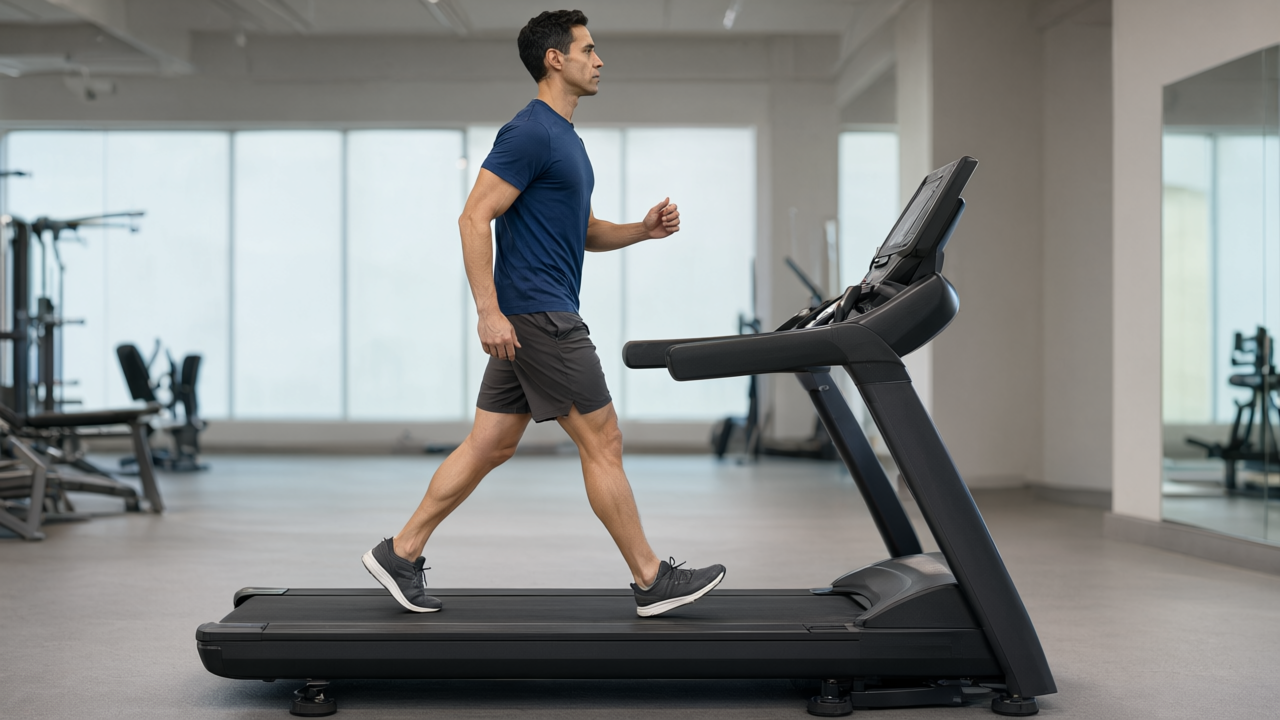
Treadmill Brisk Walk
treadmill-brisk-walk
注意
- caution · Vertigo / balance disorder — The moving belt beneath stationary surroundings can provoke dizziness or disorientation during sustained walking. Instead, perform outdoor walking on a flat, predictable path.
- caution · Acute knee injury — Repetitive heel striking on a firm belt may aggravate patellar or meniscal irritation if stride length is excessive. Instead, reduce speed and incline to minimise joint loading, or switch to a recumbent bike.
When I cue you into a brisk walk on the treadmill, I want you moving with purpose but without strain. This is steady, conversational-pace walking at roughly 5.5 to 6.5 kilometres per hour on a flat or one per cent incline. It builds your aerobic base, conditions your joints for impact, and serves as your reliable entry point into cardiovascular training or your safe return after time away.
はじめての方へ
The first mistake I see is gripping the handrails. When you hold on, you lean back, shorten your stride, and unload the very muscles we are trying to condition. Let your arms swing freely; if you cannot maintain the pace without holding on, the speed is too high. Lower it until you feel balanced and upright. You should feel a gentle warmth building across your chest and legs within five minutes, and your breathing should deepen without becoming ragged. If you find yourself gasping or unable to speak in full sentences, you have pushed past Zone 2 effort. Slow down immediately. Another common error is staring at your feet, which rounds your upper back and restricts your airway. Keep your gaze fixed on the console or the wall ahead. Stop the session if you feel sharp pain in your knees, hips, or shins. Mild muscular fatigue is expected; joint pain is not. Start with twenty minutes and add five minutes weekly as your comfort improves.
さらに先へ
Once you can sustain forty-five minutes comfortably at 6.5 kilometres per hour on a one per cent incline, progress by increasing the incline rather than the speed. Move to a three to five per cent grade to shift emphasis toward the glutes and hamstrings while maintaining Zone 2 heart rate. Alternatively, introduce brief intervals: two minutes at a faster pace followed by three minutes at your baseline. Maintain a tempo where your foot strikes are quick and light, aiming for roughly 120 to 130 steps per minute. For variation, perform the entire session walking backwards at 3.0 to 4.0 kilometres per hour to target the quadriceps eccentrically and challenge your proprioception, though only attempt this once your forward mechanics are flawless. Progress frequency to five sessions per week if recovery allows, using this as active recovery between heavier lifting days.
よくあるミス
Gripping the handrails is the most pervasive fault. It shifts your centre of gravity backwards, reduces caloric expenditure, and encourages a slouched thoracic spine. Release the rails and lower the speed until your balance returns. Overstriding is another frequent issue; reaching too far forward with the lead foot acts as a brake, sending jarring forces through the knee and shin. Instead, focus on pushing off powerfully from the back foot, keeping steps shorter and quicker. Finally, many walkers lock their elbows rigidly at their sides. This creates unnecessary tension in the shoulders and neck. Allow a soft bend at the elbow and let the arms pendulate in opposition to the legs, which naturally stabilises the pelvis and improves overall gait efficiency.
ルーティン
- Sets
- 1
- Reps
- 20–45 minutes
- Rest
- 0s
- Tempo
- steady
- RPE
- 3
- 頻度
- 3
increase duration by 5 minutes weekly, then add incline
Cues
有酸素運動
- Style
- steady
- 所要時間
- 30 min
- Zone
- 2
筋肉
- Cardiovascular
- Quadriceps
- Glutes
- Calves
- Hamstrings
道具
- Treadmill
- 1
Stand on the treadmill side rails, clip the safety key to your clothing, and press start at a slow pace.
- 2
Step onto the moving belt, place feet hip-width apart, and let your arms hang naturally by your sides.
- 3
Increase the speed gradually until you reach a brisk, purposeful pace between 5.5 and 6.5 kilometres per hour.
- 4
Set the incline to zero or one per cent, keeping your spine tall and eyes looking straight ahead.
- 5
Swing your arms naturally from the shoulders, bending elbows slightly, exhaling steadily as you walk.
- 6
Maintain this pace without gripping the handrails, letting your hips drive each stride forward smoothly.
- 7
Walk continuously for twenty to forty-five minutes, monitoring your breathing to ensure you can still hold a conversation.
- 8
Reduce the speed gradually over thirty seconds before stepping back onto the side rails to finish safely.