
Rowing (Erg)
rowing-erg
注意
- caution · Uncontrolled hypertension — Sprinting with a held breath drives blood pressure up sharply. Row at a conversational pace with the exhale timed to the finish of every drive, avoid all-out intervals, and clear higher intensities with your doctor first. Steady cycling at a low resistance is the gentler option.
- caution · Herniated disc — Every stroke cycles the lumbar spine through flexion under load, and the catch position is the most flexed and most loaded point of all. Row only if you can hold a tall torso at a short, high stroke rate; if the back rounds as you slide forward, swap to the bike or the stair climber, which train the same engine with a still spine.
- modify · Acute knee injury — The catch forces deep knee flexion under the full drive. Don't let the shins go past vertical — stop the slide earlier and take the same effort at a shallower angle, or move to the bike with low resistance, which loads the leg without the deep bend.
- modify · Acute lower back injury — Yanking with the arms before the legs have driven puts the whole force of the stroke into the lower back. Keep the sequence strictly legs then hips then arms, shorten the slide so you never lose your brace, and stop if the ache is sharp rather than muscular. The exercise bike is the substitute while it settles.
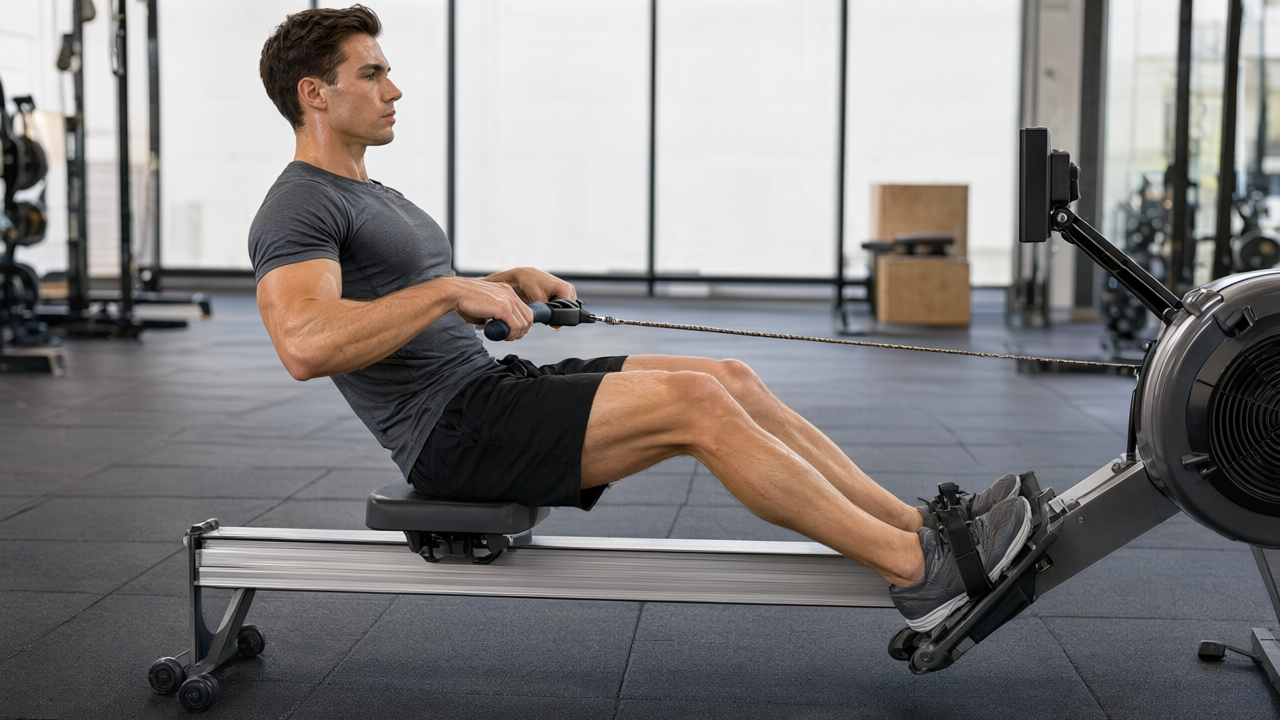
A rowing machine: legs, hips, then arms on the drive, and the same order in reverse on the recovery. It trains the quads, glutes and lats together while the flywheel rewards smoothness over muscle — a hard yank just stalls the wheel. Most people can push far harder than they think, so it is worth knowing that a damper between 3 and 5 mimics a real boat and a setting of 10 only makes it feel like one. Take it when you want the engine trained without pounding your joints.
はじめての方へ
Focus relentlessly on the sequence: legs, hips, arms, then arms, hips, legs. It sounds straightforward, but your nervous system will instinctively want to pull with your upper body too early. Resist that impulse completely. If your lower back begins to ache or your shoulders climb toward your ears, you are likely overreaching at the front or collapsing your spine during the pull. Stop immediately if you feel sharp joint pain or notice your rhythm fracturing into frantic, choppy strokes. True fatigue should manifest as heavy breathing and a deep burn in your thighs and lungs, not structural discomfort. Keep your grip relaxed, treating your hands as simple hooks. Prioritize a long, smooth cadence over raw speed, and you will quickly discover that deliberate sequencing generates far more sustainable power than frantic pulling.
さらに先へ
To extract more from the erg, manipulate your stroke ratio. Drive hard and fast through the legs, then deliberately slow the recovery slide to a two-to-one or even three-to-one ratio against the drive. This pause at the catch builds composure and forces you to generate peak power from a dead stop each stroke. For steady-state work, hold 18–22 strokes per minute over longer durations; for intervals, push towards 26–30. Making it harder means dropping your split time at the same stroke rate, not simply flailing faster. Add distance in five to ten per cent increments only when your average split stabilises without form breakdown. Once continuous twenty-minute pieces feel manageable at an RPE of 7, shift to shorter, sharper intervals like eight by 500 metres with equal rest. You can also introduce strapless rowing, which demands far greater core control and a cleaner finish, or use the dumbbell bent-over row to build raw pulling strength that transfers directly to your stroke.
よくあるミス
The most frequent error is reversing the kinetic chain by yanking the handle with the arms before the legs have fully driven, which robs you of mechanical advantage and strains the lumbar spine. Many rowers also rush the recovery phase, collapsing the chest and overextending at the catch, which disrupts forward momentum and forces the flywheel to jerk unpredictably. Another widespread compensation involves gripping the handle far too tightly, which prematurely fatigues the forearms and biceps while creating unnecessary tension across the shoulders and neck. Finally, setting the damper to the highest position creates a heavy, draggy resistance that sacrifices fluidity for brute force, often leading to compromised posture and inefficient pacing.
ルーティン
- Sets
- 3
- Reps
- 10-20 min continuous or 3-5 x 5 min intervals
- Rest
- 60s
- RPE
- 8
- Per set
- ~300s
- 頻度
- 2-3x/week
Gradually increase total distance or session duration by 5-10% weekly while maintaining or lowering your average split time.
Cues
筋肉
- Quadriceps
- Glutes
- Lats
- Hamstrings
- Abs
- Upper back
道具
- Rowing machine
- 1
Adjust the foot straps to secure the widest part of each shoe over the ball-of-foot marker.
- 2
Set the damper lever to a resistance setting between 3 and 5.
- 3
Sit tall on the sliding seat and grip the handle with a relaxed overhand grip.
- 4
Inhale deeply through the nose to brace the core and stabilize the torso.
- 5
Push forcefully through the heels to extend the legs while keeping the arms straight.
- 6
Lean the torso backward slightly once the legs reach full extension.
- 7
Pull the handle into the lower chest while exhaling steadily through the mouth.
- 8
Extend the arms straight forward to clear the knees.
- 9
Slide the seat forward by bending the knees while inhaling slowly.
- 10
Return the shins to a vertical position and pause briefly before starting the next drive.