
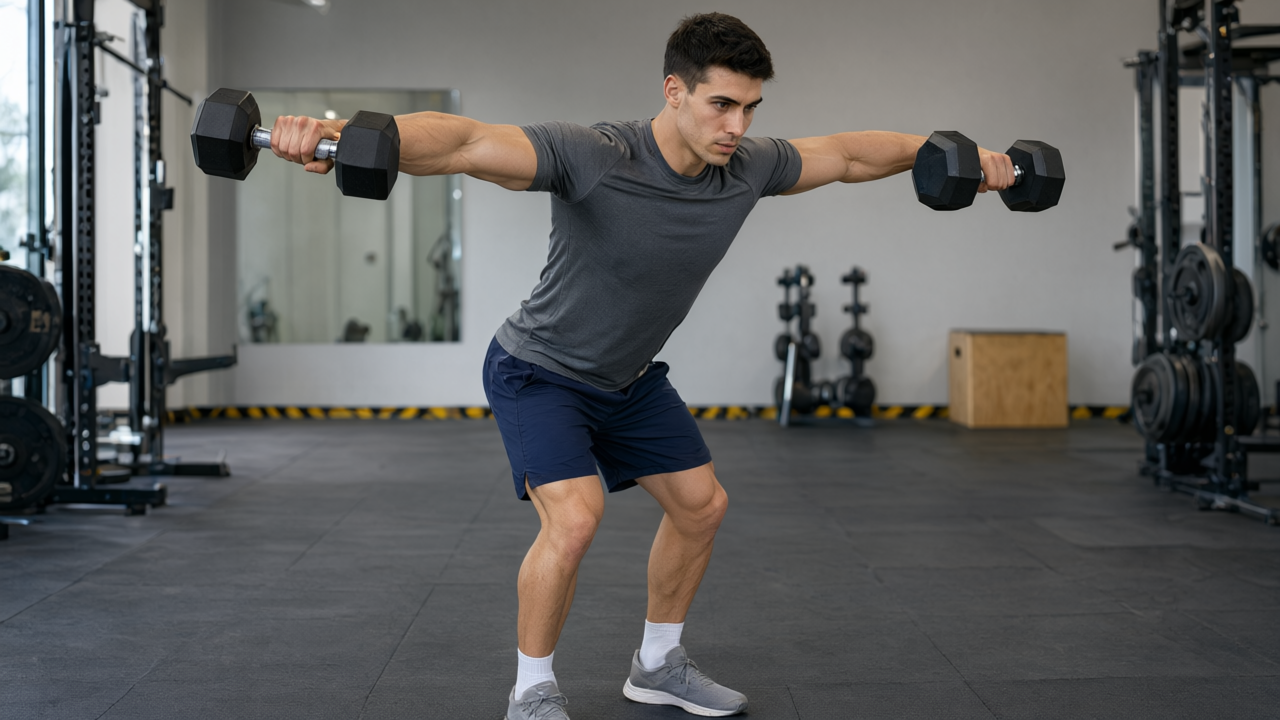
Lateral Raise
lateral-raise
注意
- avoid · Rotator cuff tear — The long lever arm places high shear stress on a compromised rotator cuff tendon. Instead, perform isometric wall presses or light scaption raises to maintain shoulder stability without overloading the tear.
- caution · Shoulder impingement — Raising the arms to shoulder height can compress inflamed tissues beneath the acromion. Instead, perform lateral raises only to a pain-free range below shoulder height or use cable face pulls to train the rear delts safely.
When you perform this right, you’ll feel a deep, burning pump along the outer curve of your shoulders rather than a shrugging sensation in your neck. I want you to focus on a smooth, controlled arc that keeps your torso completely still. Let the movement live entirely in your shoulder joints. Breathe steadily, embrace the moderate burn, and trust that light weight done perfectly builds the capped look you’re chasing.
はじめての方へ
Your shoulders are incredibly sensitive to leverage, so resist the urge to let your ego dictate the weight. Focus on keeping your wrists neutral and your elbows tracking slightly ahead of your torso as you lift. True muscular failure here feels like a sharp, localized burn in the mid-deltoid, not a grinding ache in your joints or a heavy pull in your neck. If you find yourself swinging your hips, shrugging your shoulders toward your ears, or bending at the waist to hoist the weight, stop immediately and drop the load. Form breakdown is your cue to regress, not push through. Celebrate the lighter weights that force perfect mechanics. Consistency with strict range of motion will build resilient, rounded shoulders far faster than heavy, compromised reps. Trust the process and let the muscle do the work.
さらに先へ
To extract more from the lateral raise, extend your lowering phase to three or four seconds and add a distinct two-second pause at shoulder height. This extended time under tension forces the side deltoid to work harder without requiring heavier dumbbells. The movement suits sets of 12–20 just as well as 8–12; higher reps with shorter rest periods build metabolic stress, while the lower end allows slightly more load for mechanical tension. Add weight only when you can complete every rep in your target range with that deliberate tempo and no torso sway. If progress stalls, try seated lateral raises using the same dumbbells, which removes any residual leg drive and isolates the shoulders further. Alternatively, perform the lift leaning sideways away from a fixed post to increase tension at the bottom of the arc where the muscle is fully stretched.
よくあるミス
Most lifters sabotage this movement by selecting weights that are far too heavy, which immediately forces the upper traps and lower back to hijack the lift. This manifests as aggressive torso swinging and pronounced shoulder shrugging at the top of the arc, completely robbing the side delts of their intended stimulus. Another frequent error is internally rotating the wrists or pouring the dumbbells like pitchers, which shifts tension into the rotator cuff and anterior shoulder. Finally, stopping the descent early by resting the weights against the hips eliminates the crucial eccentric tension that drives growth. Keep the load modest, maintain a neutral wrist, and control the full range to maximize results.
ルーティン
- Sets
- 3
- Reps
- 8-12
- Rest
- 90s
- Tempo
- 2-0-2-0
- RPE
- 7
- Per set
- ~75s
- 頻度
- 2-3x/week
Once you can comfortably hit the top of the rep range with strict form, add 2.5 to 5 pounds to each dumbbell.
Cues
筋肉
- Shoulders
- Traps
- Forearms
道具
- Dumbbells
- 1
Stand tall with your feet hip-width apart, holding a dumbbell in each hand at your sides.
- 2
Engage your core and slightly soften your knees to create a stable, grounded base.
- 3
Hinge forward just a few degrees at the hips to align your torso with the natural plane of your shoulder joints.
- 4
Inhale deeply, then exhale as you slowly drive both dumbbells outward to shoulder height, keeping your elbows slightly bent.
- 5
Pause briefly at the top while squeezing your outer delts, then inhale as you lower the weights with deliberate control.
- 6
Stop just before the dumbbells touch your thighs to maintain constant tension throughout the set.