
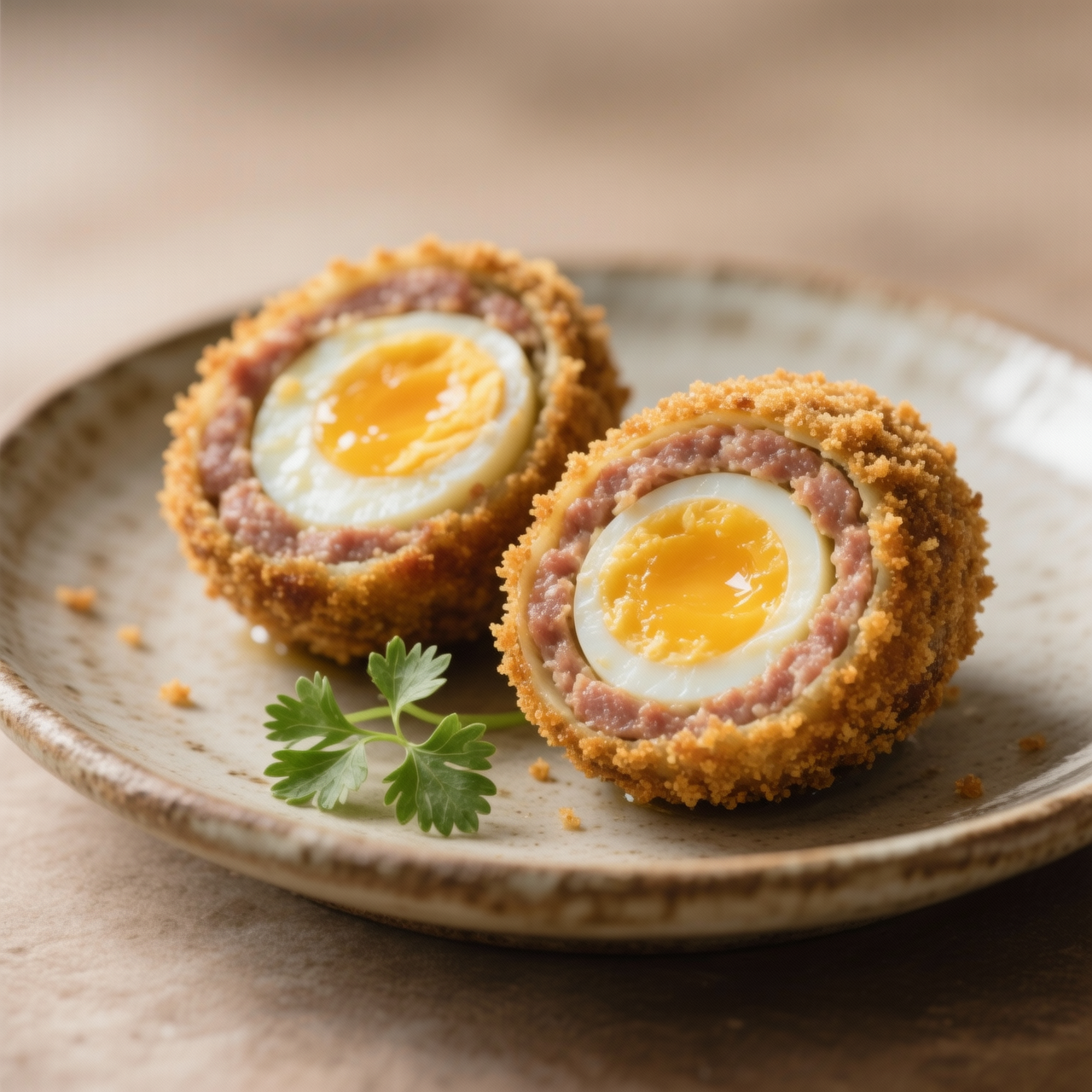
Scotch eggs
The Scotch egg is a quintessential British pub classic, supposedly originating at Fortnum & Mason in 1738 as a portable snack for wealthy travelers. Today, it remains the ultimate test of a cook's ability to balance textures and temperatures. I love this dish because it transforms humble ingredients into a masterpiece of contrasting crunch, rich pork, and a molten yolk. However, it is fraught with common pitfalls: the sausage casing splitting during frying, the breadcrumb coating sliding off, or the dreaded overcooked, chalky egg yolk. The secret lies in chilling the assembled eggs thoroughly and frying at a controlled temperature to cook the pork without burning the crust. When you compare this from-scratch triumph to the shop-bought versions found in supermarket chiller cabinets or petrol station hot counters, the difference is staggering. A mass-produced Scotch egg costs around two pounds, but you are paying for a highly processed, pink extrusion of mechanically recovered meat, rusk, and artificial preservatives that tastes of little more than salt, while the egg inside is invariably rubbery and grey. By starting from scratch, grinding your own pork shoulder and belly for the sausage meat, and carefully wrapping it around a perfectly soft-boiled, free-range egg, you achieve a juicy, deeply savory, and texturally perfect snack that completely shames those industrial imitations. It takes a bit of patience, but the reward is a true culinary triumph.
Nutrition
| Per serving | Calories | Protein | Carbs | Fat | Sat fat | Fibre | Sugar | Sodium |
|---|---|---|---|---|---|---|---|---|
| beginner | 1700kcal | 33g | 40g | 158g | 30g | 2g | 4g | 1310mg |
| intermediate | 1702kcal | 33g | 41g | 158g | 30g | 2g | 4g | 1310mg |
| expert | 1713kcal | 33g | 42g | 158g | 30g | 3g | 4g | 1310mg |
Per serving · Ava-estimated — a guide, not a clinical figure.
- 8 piecesegg— 6 for boiling, 2 beaten for coating
- 400 gpork sausage meat
- 50 gplain flour— for dusting
- 150 gbreadcrumb— fine or panko
- 1000 mlvegetable oil— for deep frying
- 2 gsalt
- 1 gblack pepper— freshly ground
- 400 gbelly
- 1 piecegrated nutmeg
- 4 piecebelly
- 3 grubbed sage
- 10 gfresh sage
- 2 gnutmeg
- 150 gcrustless sourdough
- 5 gthyme
- 1 gmace
Shop-bought Scotch eggs often cost upwards of £3 each and are typically stuffed with mechanically recovered meat, artificial preservatives, and a thick, dusty breadcrumb coating that masks a dry, overcooked centre. This beginner-friendly from-scratch version strips away the industrial shortcuts without relying on any packet mixes or pre-made sausage meat. You will mince and season your own pork shoulder and belly blend, ensuring a juicy, flavourful casing. The technique here focuses on simplicity: soft-boiling the eggs just until the whites set but the yolks remain perfectly runny, then chilling them thoroughly so they don't crack during wrapping. We use a simple three-stage breading station with freshly pulsed bread rather than shop-bought crumbs. Watch the oil temperature closely; if it's too hot, the outside burns before the pork cooks, but if it's too cool, the eggs will absorb excess grease and become heavy. By controlling the seasoning and frying time yourself, you achieve a crisp, golden crust encasing a molten, rich yolk and deeply savoury pork, far superior to any supermarket imitation.
Equipment
- Heavy-bottomed pan— cast iron or thick stainless steel for stable oil temperature
- Slotted spoon— for safely lowering and retrieving eggs from hot oil
- Three shallow bowls— to keep the breading station organised and prevent clumping
Method
- 1
Place the eggs gently into a pot of boiling water and cook for exactly six minutes before transferring them immediately to an ice bath.
This sets the whites while keeping the yolks perfectly runny.
soft-boiling~ 6 minTricky bit - 2
Mince the pork shoulder and belly together, then vigorously mix in the salt, pepper, and herbs until the mixture becomes sticky and cohesive.
The stickiness ensures the meat binds tightly around the egg without splitting during frying.
kneading~ 5 min - 3
Divide the seasoned pork into four equal portions, flatten each into a thin patty, wrap tightly around a peeled egg, and seal the seams completely.
Ensure there are no cracks in the meat layer, or the egg will leak during cooking.
wrapping~ 8 minTricky bit - 4
Dredge each meat-wrapped egg in plain flour, dip into beaten egg, and roll thoroughly in freshly pulsed breadcrumbs to create an even, unbroken coating.
Press the crumbs gently so they adhere firmly to the surface.
breading~ 5 min - 5
Heat the oil in a heavy-bottomed pan to 170°C and fry the Scotch eggs for eight to ten minutes, turning occasionally, until deeply golden and cooked through.
Drain on a wire rack rather than paper towels to prevent the bottom from steaming and turning soggy.
deep-frying~ 10 minTricky bit
Cooking from frozen
Thaw overnight in the fridge and reheat in a hot oven until piping hot to restore the crunch.
Storage times are a guide — always use your judgement and store food safely.