
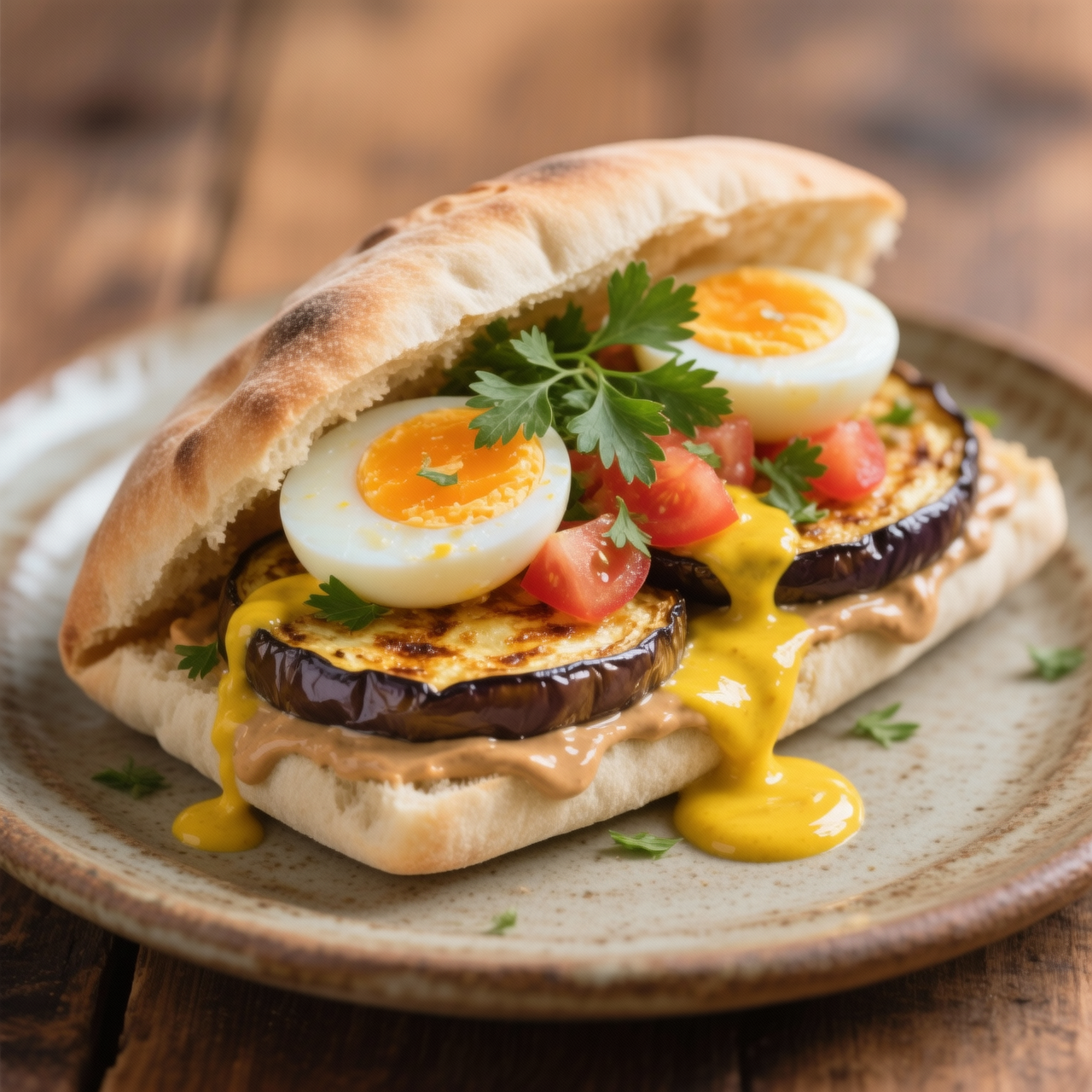
Sabich
When I first encountered sabich on a bustling Tel Aviv street corner, I didn’t realize I was holding a pocket of Iraqi-Jewish history. This humble pita sandwich, born from the traditions of Iraqi Jews who migrated to Israel in the 1950s, was originally a Saturday morning breakfast prepared before the Sabbath began. Families would fry eggplants and boil eggs on Friday evening, then assemble the sandwiches the next day when cooking was forbidden. What started as a practical workaround evolved into a beloved Israeli staple that transcends cultural boundaries. To me, sabich matters because it embodies the quiet resilience of immigrant communities, transforming necessity into culinary artistry. Yet, so many home cooks miss the mark by treating it as a mere assembly of ingredients rather than a balanced harmony of flavors and textures. The most common pitfall I see is rushing the eggplant; without proper salting, draining, and slow frying or roasting, it turns bitter and greasy instead of meltingly tender. Another frequent misstep is neglecting the tahini. It shouldn’t just be drizzled on top—it needs to be thinned with lemon and water until it’s silky enough to seep into every crevice. And please, never skip the Israeli salad or the amba. The sharp, tangy mango pickle is non-negotiable; it cuts through the richness of the fried eggplant and hard-boiled egg with a bright, almost electric acidity. When done right, sabich isn’t just food. It’s a warm, messy, deeply satisfying testament to patience, tradition, and the beautiful alchemy of simple ingredients.
Nutrition
| Per serving | Calories | Protein | Carbs | Fat | Sat fat | Fibre | Sugar | Sodium |
|---|---|---|---|---|---|---|---|---|
| beginner | 759kcal | 25g | 79g | 41g | 7g | 14g | 17g | 3113mg |
| intermediate | 759kcal | 25g | 79g | 41g | 7g | 14g | 17g | 3113mg |
| expert | 779kcal | 25g | 83g | 41g | 7g | 16g | 17g | 3114mg |
Per serving · Ava-estimated — a guide, not a clinical figure.
- 4 piecespita bread— freshly baked or thawed
- 12 piecepickles
- 2 mediumeggplant— globe or Japanese variety
- 6 largeegg— free-range preferred
- 2 mediumpotato— starchy variety
- 3 mediumtomato— ripe but firm
- 1 largecucumber— Persian or English
- 1 bunchfresh parsley— leaves only, roughly chopped
- 100 gtahini paste— well-stirred
- 1 wholelemon— juiced
- 3 clovesgarlic— peeled
- 80 gamba sauce— traditional mango pickle
- 150 mlneutral oil— for frying
- 10 gkosher salt— divided use
- 5 gground cumin— toasted preferred
- 100 gpickled cucumber— halved lengthwise
- 100 gpickled turnip— drained and sliced
- 30 gsumac
This beginner path embraces smart shortcuts to guarantee a confident first attempt without sacrificing the soul of the dish. You will use pre-made amba and jarred tahini, skipping the lengthy sauce development, while relying on a straightforward pan-frying method for the eggplant to avoid oil saturation. The focus here is on assembly discipline and timing. Watch your frying oil temperature closely; too hot and the eggplant burns, too cool and it drinks the oil. We use a simple spice rub for the hard-boiled eggs and a quick-hand Israeli salad that requires no advanced knife skills. Keep your pita warm in a low oven while you prep the vegetables to ensure the bread stays pliable. The goal is structural harmony: layer the hot components first, followed by the cool salad and pickles, finishing with generous but controlled drizzles of sauce. By the end of this version, you will understand how temperature contrast and textural balance define a classic sabich, setting a reliable foundation for future culinary exploration.
Equipment
- Heavy-bottomed skillet— 10-inch diameter works best
- Mixing bowl— medium size
- Chef's knife— sharp blade for clean cuts
Method
- 1
Place the eggs in a single layer in a saucepan and cover them with cold water by one inch.
Start with cold water to prevent cracking.
boiling~ 10 min - 2
Slice the eggplant into half-inch rounds and sprinkle both sides generously with salt.
Let them rest for ten minutes to draw out moisture.
salting~ 5 min - 3
Heat the neutral oil in a heavy-bottomed pan over medium heat until shimmering.
Test with a wooden spoon; bubbles indicate readiness.
heating~ 2 minTricky bit - 4
Fry the eggplant slices in batches until golden brown on both sides, then drain on paper towels.
Do not overcrowd the pan.
frying~ 10 minTricky bit - 5
Dice the tomatoes, cucumber, and parsley, then toss them in a bowl with lemon juice and salt.
Keep the salad crisp by salting right before assembly.
dicing~ 5 min - 6
Whisk the tahini paste with warm water and minced garlic until smooth and pourable.
Add water one tablespoon at a time.
emulsifying~ 3 min - 7
Warm the pita bread in a low oven until soft and pliable.
Wrap in foil to retain moisture.
warming~ 3 min - 8
Slice the warm pita open, layer the hot vegetables and potatoes, add the salad, eggs, and pickles, and finish with tahini and amba.
Build from the bottom up to prevent sogginess.
assembling~ 4 minTricky bit