
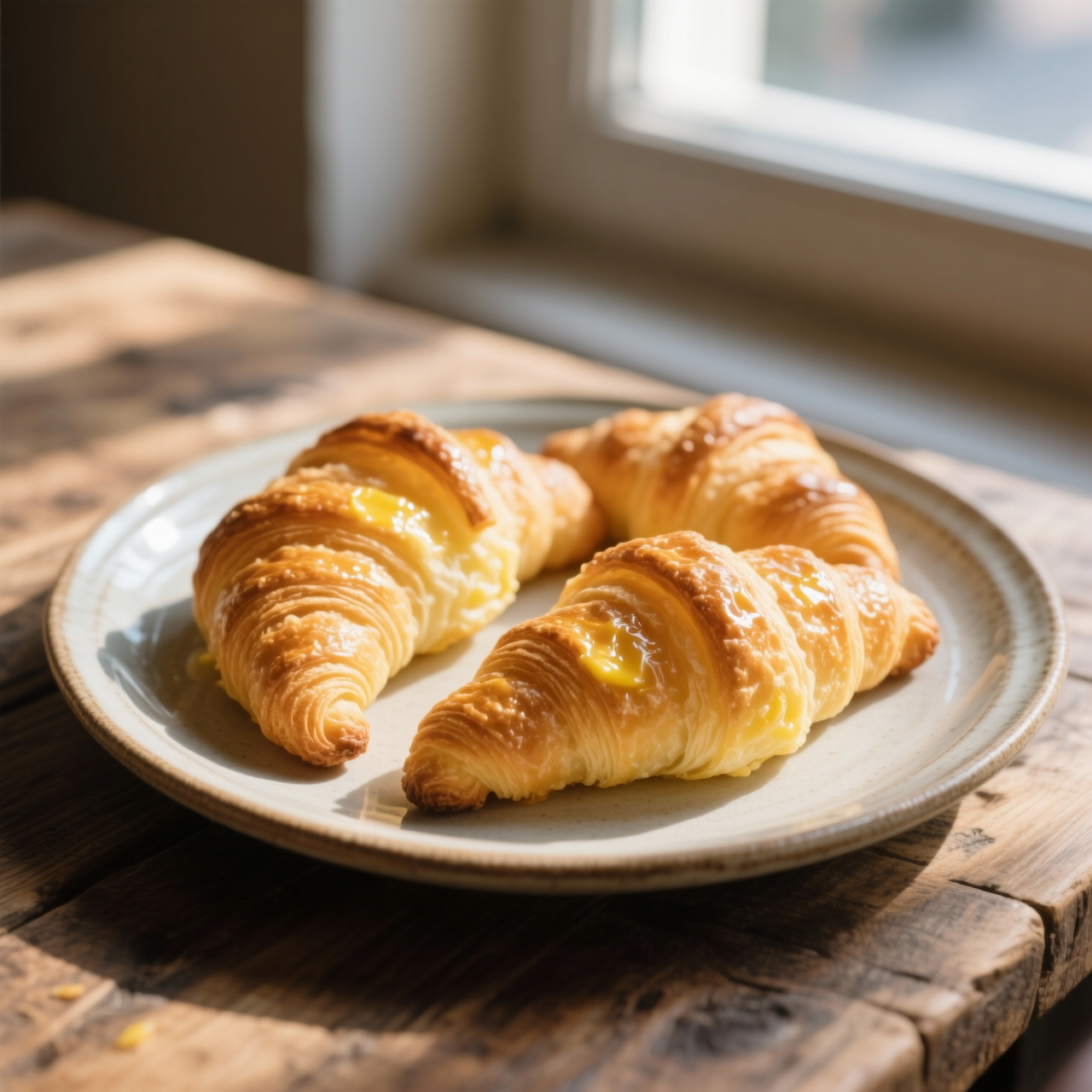
Cornetti (Italian croissants)
I’ve spent years chasing the perfect Italian cornetto, that tender, honeyed crescent you grab at a Roman bar at seven in the morning. Supermarket versions run about a euro each, but they’re pale imitations—loaded with cheap vegetable fats, stabilisers, and a dense, cakey crumb that never shatters. Real cornetti demand patience, but the reward is a flaky, butter-rich architecture that melts on your tongue and tastes of actual dairy and slow fermentation. The magic lies in lamination: folding cold, cultured butter into an enriched yeast dough without letting the two merge into a greasy mess. Most home bakers fail because they rush the chill, use warm hands, or substitute margarine, which simply can’t replicate the steam pockets that puff the layers. I always tell people to respect the temperature. If the butter softens, the dough weeps; if the dough gets too cold, it cracks. Keep everything between 4°C and 16°C, rest the dough thoroughly between turns, and proof until it just jiggles like a living thing. Skip the shortcuts—no pre-made sheets, no powdered mixes, no jarred glazes. Just flour, butter, eggs, milk, yeast, sugar, and salt. When you finally brush them with a light apricot syrup straight from the oven, you’ll understand why Italy guards this breakfast ritual so fiercely. It’s not just pastry; it’s a daily act of craftsmanship, and once you taste the difference, you’ll never buy another plastic-wrapped imitation.
Nutrition
| Per serving | Calories | Protein | Carbs | Fat | Sat fat | Fibre | Sugar | Sodium |
|---|---|---|---|---|---|---|---|---|
| beginner | 1197kcal | 21g | 137g | 63g | 38g | 4g | 46g | 1042mg |
| intermediate | 599kcal | 10g | 69g | 32g | 19g | 2g | 23g | 521mg |
| expert | 399kcal | 7g | 46g | 21g | 13g | 1g | 16g | 347mg |
Per serving · Ava-estimated — a guide, not a clinical figure.
- 500 gstrong bread flour— sifted
- 280 gunsalted butter— very cold, divided into 100g for dough and 180g for laminating
- 240 mlwhole milk— lukewarm
- 75 ggranulated sugar
- 10 gfine sea salt
- 7 ginstant yeast
- 1 unitlarge egg— room temperature
- 1 unitegg yolk— beaten with 15ml milk for glazing
- 5 mlvanilla extract
- 120 gapricot jam(optional)— seedless, for filling
- 20 gicing sugar(optional)— for dusting after baking
This beginner-friendly approach strips away the intimidating multi-day fermentation and rigid French-style lamination of traditional cornetti, replacing it with a single-day, room-temperature butter block method that forgives slight temperature variations. You will still make everything from scratch, avoiding the €0.80–€1.20 frozen or café cornetti that rely heavily on palm oil, synthetic emulsifiers, and dough conditioners to mimic flakiness while tasting stale and waxy. The key here is keeping your dough cool but pliable during the two quick roll-and-fold sessions. Watch the butter consistency closely during lamination; if it softens into the dough, pop the whole sheet in the fridge for ten minutes before continuing. We use a straightforward enriched dough that rests just long enough for the yeast to wake up, ensuring a tender, honeycomb crumb without demanding overnight patience. The final proof is forgiving at room temperature, and shaping the signature crescent takes only a few seconds per piece. Bake until deeply golden for that classic Italian breakfast crunch, and remember to freeze any unbaked shaped dough for fresh, bakery-quality cornetti on demand.
Equipment
- Rolling pin— wooden or silicone coated works best
- Baking sheet— line with parchment for easy transfer
- Pastry brush(optional)— silicone bristles hold up to egg wash
Method
- 1
Combine flour, milk, sugar, yeast, egg, and salt in a large bowl until a shaggy mass forms.
Use room temperature ingredients to speed up gluten development.
mixing~ 2 min - 2
Knead the dough on a lightly floured surface until smooth and slightly tacky.
Windowpane test should show a translucent stretch without tearing.
kneading~ 8 minTricky bit - 3
Flatten a quartered butter block into a rectangle, place it on the chilled dough, and fold the edges over to completely seal it.
Butter and dough must be equally firm to prevent blowouts.
lock-in~ 3 minTricky bit - 4
Roll the dough into a long rectangle, fold it into thirds, rotate ninety degrees, and repeat once.
Chill for fifteen minutes if the butter feels greasy or soft.
lamination~ 5 minTricky bit - 5
Roll the dough to half-inch thickness and cut into wide triangles with a sharp knife.
Keep edges straight for even rolling and consistent rise.
portioning~ 2 min - 6
Roll each triangle from the base to the tip, gently curving the ends inward to form crescents.
Place seam-side down on parchment-lined trays.
shaping~ 4 min - 7
Let the shaped cornetti rest at room temperature until visibly puffed and jiggly when tapped.
Avoid direct sunlight or drafts during this stage.
proofing~ 1 min - 8
Brush with beaten egg, sprinkle lightly with sugar, and bake until deeply golden and crisp.
Rotate tray halfway through for even color.
baking~ 18 min
Cooking from frozen
Thaw baked leftovers at room temperature, then warm at 160°C for five minutes to revive the flaky layers.
Storage times are a guide — always use your judgement and store food safely.