
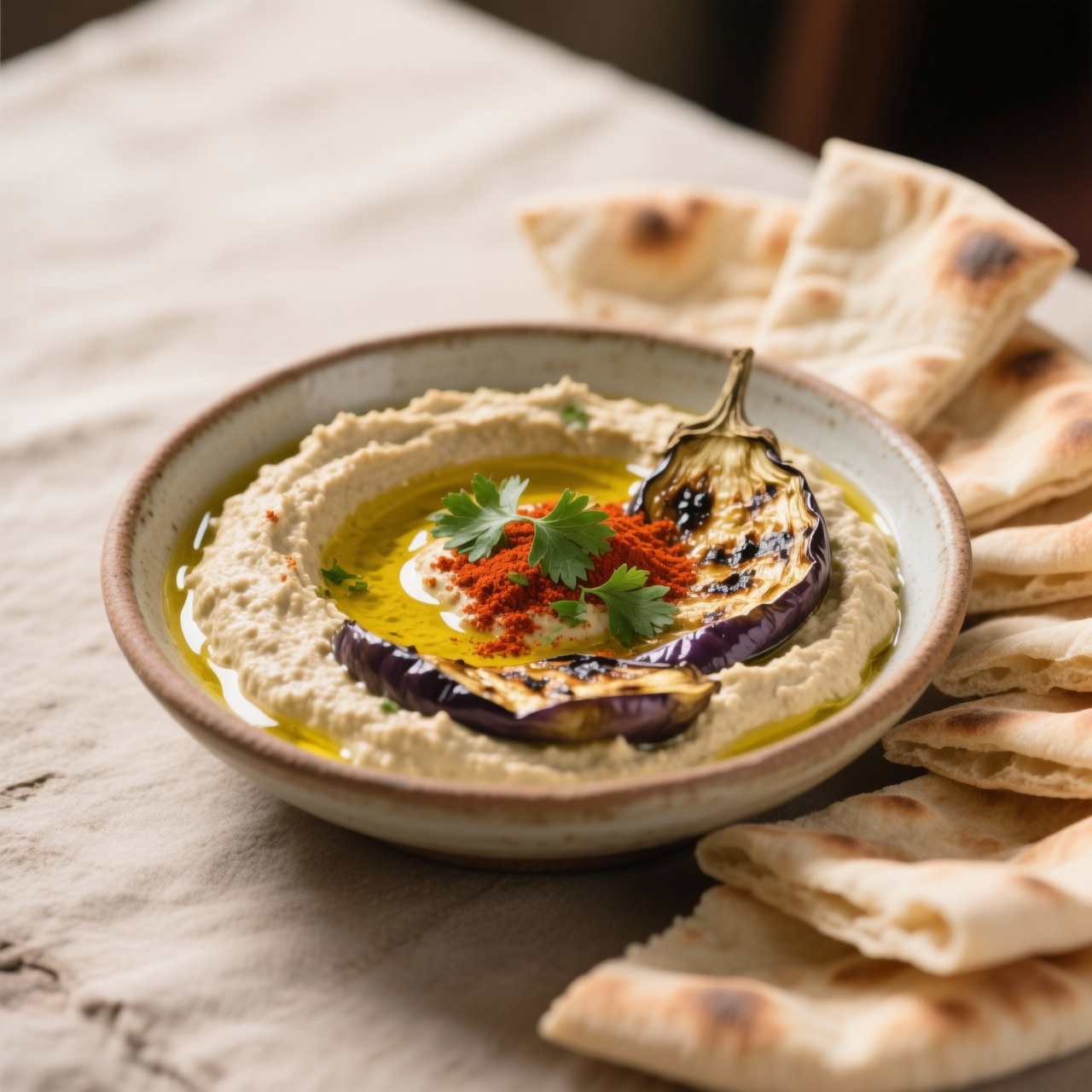
Baba ganoush
I have always believed that true baba ganoush begins long before the tahini touches the bowl. It starts over live fire, where whole aubergines are roasted until their skins blister and the flesh surrenders to smoke. In Lebanon, this dish is more than a mezze staple; it is a quiet meditation on patience and elemental cooking, born from Levantine villages where open hearths dictated the rhythm of daily meals. The magic lies in balancing the charred bitterness of the eggplant with the rich, nutty creaminess of tahini, brightened by lemon and garlic. Too often, home cooks rush the roasting process, steaming the aubergines in an oven or boiling them, which strips away that essential campfire essence. Another common misstep is overworking the flesh into a paste; baba ganoush should retain a gentle, rustic texture, never a uniform purée. I also warn against adding too much olive oil upfront or drowning it in garlic, which masks the delicate smoke rather than complementing it. When you respect the ingredients, draining excess liquid, letting the roasted eggplant cool before peeling, and folding the tahini and lemon in slowly, you create a dip that feels both ancient and deeply personal. It matters because it reminds us that simplicity, when treated with reverence, becomes extraordinary. Every spoonful should carry the memory of the flame, a whisper of the Mediterranean sun, and the quiet confidence that good food requires nothing but time and attention.
Nutrition
| Per serving | Calories | Protein | Carbs | Fat | Sat fat | Fibre | Sugar | Sodium |
|---|---|---|---|---|---|---|---|---|
| beginner | 161kcal | 4g | 13g | 12g | 2g | 5g | 4g | 490mg |
| intermediate | 161kcal | 4g | 13g | 12g | 2g | 5g | 4g | 490mg |
| expert | 161kcal | 4g | 13g | 12g | 2g | 5g | 4g | 490mg |
Per serving · Ava-estimated — a guide, not a clinical figure.
- 500 gaubergine— whole, pricked with a fork before roasting
- 60 gtahini— well-stirred before measuring
- 15 ggarlic— freshly minced or pressed
- 30 mllemon juice— freshly squeezed
- 15 mlolive oil— extra virgin
- 5 gsalt— fine sea salt, adjust to taste
- 2 gcumin(optional)— ground
- 5 gparsley(optional)— fresh, finely chopped for garnish
This beginner-friendly approach prioritizes reliability and ease over traditional charcoal grilling, delivering the same rich, smoky profile with minimal fuss. Instead of managing an open flame, we use a standard oven to blister and soften the aubergines, guaranteeing even cooking without the guesswork. Store-bought tahini and jarred minced garlic streamline the prep, while a basic food processor does the heavy lifting for a perfectly smooth emulsion. The key to success here is moisture management: after roasting, let the aubergine flesh drain thoroughly in a fine-mesh sieve to prevent a watery dip. Watch your tahini consistency closely; if it seizes when adding lemon juice, simply whisk in a tablespoon of ice water to coax it back to a creamy texture. Taste and adjust the salt and acidity gradually, remembering that flavors will deepen as the dip rests. Chill it for at least thirty minutes before serving to let the garlic mellow and the sesame shine. With these straightforward steps, you will achieve a consistently silky, restaurant-quality condiment on your very first try, ready to pair with pita, crudités, or grilled meats.
Equipment
- Rimmed baking sheet— line with foil or parchment for easy cleanup
- Food processor— a sturdy blender works in a pinch
- Fine-mesh strainer— essential for removing excess bitter juices
- Medium mixing bowl— for steaming the hot vegetables
Method
- 1
Preheat your oven to 400°F and thoroughly pierce two large aubergines with a fork.
Fork holes allow internal steam to escape safely during roasting.
piercing~ 1 min - 2
Roast the pierced vegetables on a prepared baking sheet until deeply softened and completely collapsed.
Turn halfway through for even heat distribution.
roasting~ 35 min - 3
Cover the hot aubergines tightly with aluminum foil and let them steam in the bowl.
Trapped moisture loosens the skin for effortless peeling.
sweating~ 15 min - 4
Peel away the blistered skins and place the soft flesh into a fine-mesh strainer.
Press gently to extract water without losing valuable pulp.
draining~ 5 min - 5
Combine the drained flesh, tahini, fresh lemon juice, minced garlic, and salt in a food processor.
Add ice water one teaspoon at a time if the mixture looks dry.
emulsifying~ 2 minTricky bit - 6
Blend until perfectly smooth, transfer to a bowl, and refrigerate before serving.
Resting time allows sharp garlic notes to mellow into the sesame base.
resting~ 30 min
Storage times are a guide — always use your judgement and store food safely.