
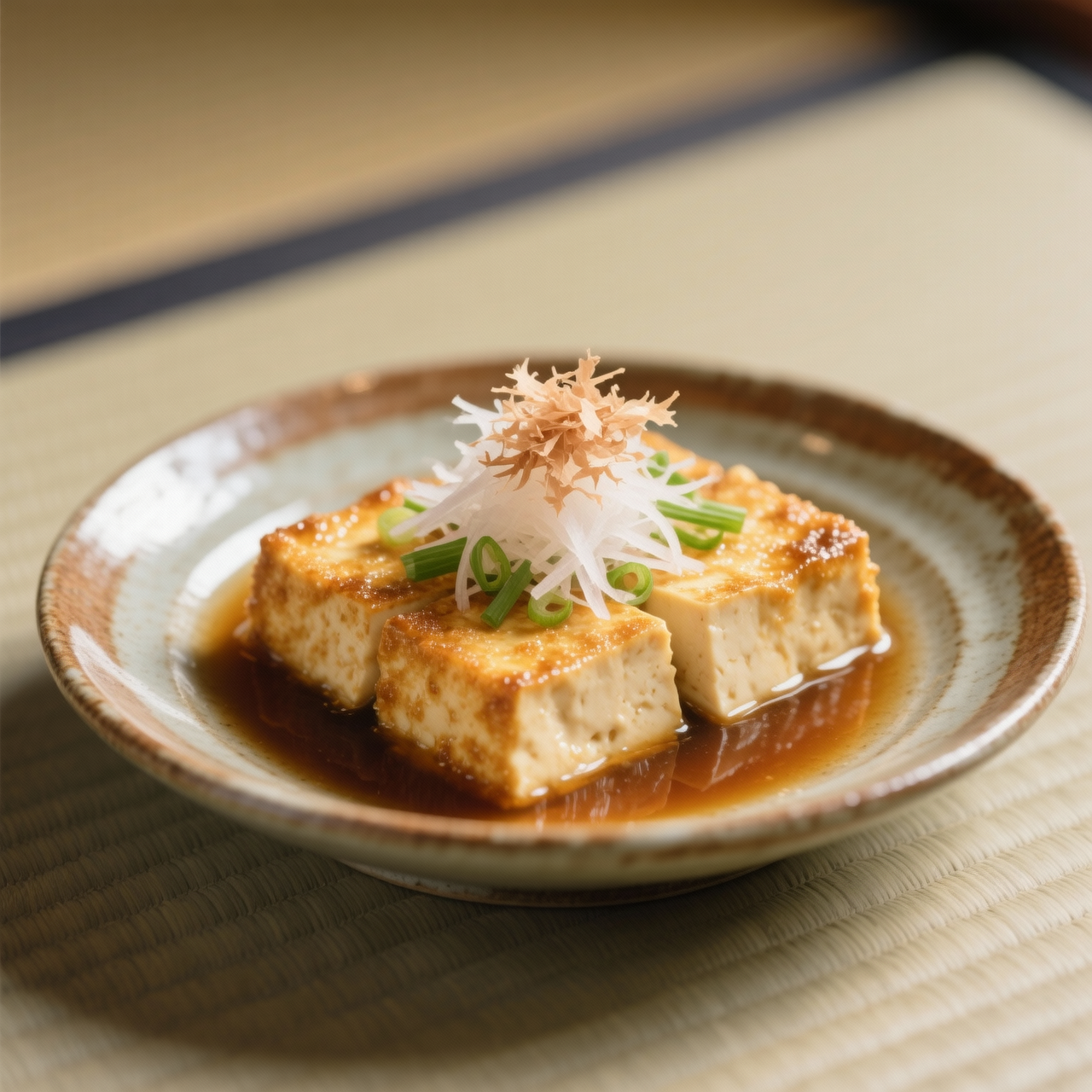
Agedashi Tofu
I first encountered agedashi tofu in a cramped Osaka kitchen where a master cook showed me that true comfort lives in the space between crisp exterior and trembling silk. Born in the Edo period as a clever way to elevate humble soy curd, this dish has always relied on the quiet alchemy of starch, hot oil, and a deeply savory dashi. What matters most is respecting that simplicity. Today, convenience stores and supermarket delis sell pre-made trays for around four pounds, but they are fundamentally broken. The coating turns gummy under fluorescent lights, the dashi is a flat chemical approximation, and the tofu itself sweats out its moisture into a soggy compromise. Making it at home from scratch reclaims the texture and depth that mass production strips away. You press firm tofu yourself, dust it lightly with potato starch, and fry it in clean oil until it shatters at the edges. The broth is simmered slowly from real kombu and bonito flakes or a careful vegan mushroom-and-seaweed reduction, finished with just a whisper of mirin and soy. The most common pitfall I see is rushing the prep. Skipping the pressing step floods the oil and ruins the crust. Dusting too heavily creates a pasty shell instead of a delicate glass-like crust. Over-simmering the dashi makes it bitter and overpowering. Treat each element with patience, and you will taste the difference immediately: a warm, umami-rich bath that cradles the tofu rather than drowning it, proof that the old ways still hold the best answers.
Nutrition
| Per serving | Calories | Protein | Carbs | Fat | Sat fat | Fibre | Sugar | Sodium |
|---|---|---|---|---|---|---|---|---|
| beginner | 690kcal | 8g | 31g | 61g | 8g | 1g | 6g | 914mg |
| intermediate | 675kcal | 8g | 27g | 61g | 8g | 1g | 2g | 914mg |
| expert | 641kcal | 8g | 19g | 61g | 8g | 1g | 2g | 914mg |
Per serving · Ava-estimated — a guide, not a clinical figure.
- 300 gtofu— firm or extra-firm, thoroughly pressed and cut into 1-inch cubes
- 10 gkombu
- 60 gpotato starch— for dredging
- 400 mldashi— vegetarian kombu and shiitake broth
- 30 mlsoy sauce— Japanese style preferred
- 20 mlmirin
- 500 mlvegetable oil— for deep frying
- 15 gscallion— thinly sliced for garnish
- 40 gdaikon— freshly grated for garnish
- 4 piecedried shiitake caps
- 15 gcaster sugar
- 40 gcornflour
- 40 gcornstarch
- 4 piecesun-dried shiitake caps
- 20 gginger
Store-bought agedashi tofu relies on pre-fried, preservative-laden blocks and instant dashi powders that deliver a flat, overly salty broth and a soggy coating. Making it from scratch takes only slightly longer but yields a delicate, umami-rich soup that perfectly complements a shattering-crisp exterior and a custardy interior. This beginner version simplifies the traditional workflow without sacrificing authenticity. Instead of managing multiple simmering pots, we steep a quick kombu-shiitake dashi at room temperature while pressing the tofu, then gently warm the broth to build the tsuyu. The coating uses a straightforward potato-starch-and-cornstarch blend that tolerates a slightly damp surface better than traditional pure potato starch, preventing the dreaded clumping. Watch your oil temperature closely; a steady 170°C (340°F) ensures the tofu fries through without absorbing excess grease. If you don’t have a thermometer, drop a small starch-coated cube in first—it should sink briefly, then rise with steady bubbles. Keep the final broth warm but never boiling when serving, as high heat will toughen the tofu and dull the delicate soy-mirin balance.
Equipment
- Heavy-bottomed skillet— provides even heat for consistent shallow-frying
- Fine-mesh strainer— for clarifying the dashi broth
- Instant-read thermometer(optional)— ensures oil stays at the ideal 170°C
Method
- 1
Pat 400g of firm tofu completely dry, then slice it into eight even triangles.
Wrap in paper towels under a heavy plate for 10 minutes first.
pressing~ 10 min - 2
Combine 500ml cold water, one 10cm strip of kombu, and four dried shiitake caps in a bowl and let sit.
Room-temperature steeping extracts clean umami without bitterness.
cold steeping~ 15 min - 3
Strain the infused water into a small saucepan, then stir in 3 tbsp soy sauce, 2 tbsp mirin, and 1 tsp caster sugar.
Taste the broth before heating; it should be distinctly savoury with a gentle sweetness.
balancing~ 2 min - 4
Gently warm the broth until just steaming, then remove from heat and keep covered.
Never boil the final tsuyu, as it will turn the soy sauce harsh.
warming~ 3 minTricky bit - 5
Toss 6 tbsp potato starch and 2 tbsp cornflour in a shallow dish, then dredge each tofu piece until evenly coated.
A light, matte layer prevents clumping and guarantees a shattering crust.
dredging~ 5 min - 6
Fry the coated tofu in 2.5cm of neutral oil at 170°C until pale gold and crisp, then drain on a wire rack.
Crowding the pan drops the temperature and leads to a greasy finish.
shallow-frying~ 6 minTricky bit - 7
Ladle the warm broth over the hot tofu in individual bowls and garnish immediately.
The coating will soften within minutes, so serve straight away.
plating~ 2 min
Storage times are a guide — always use your judgement and store food safely.