
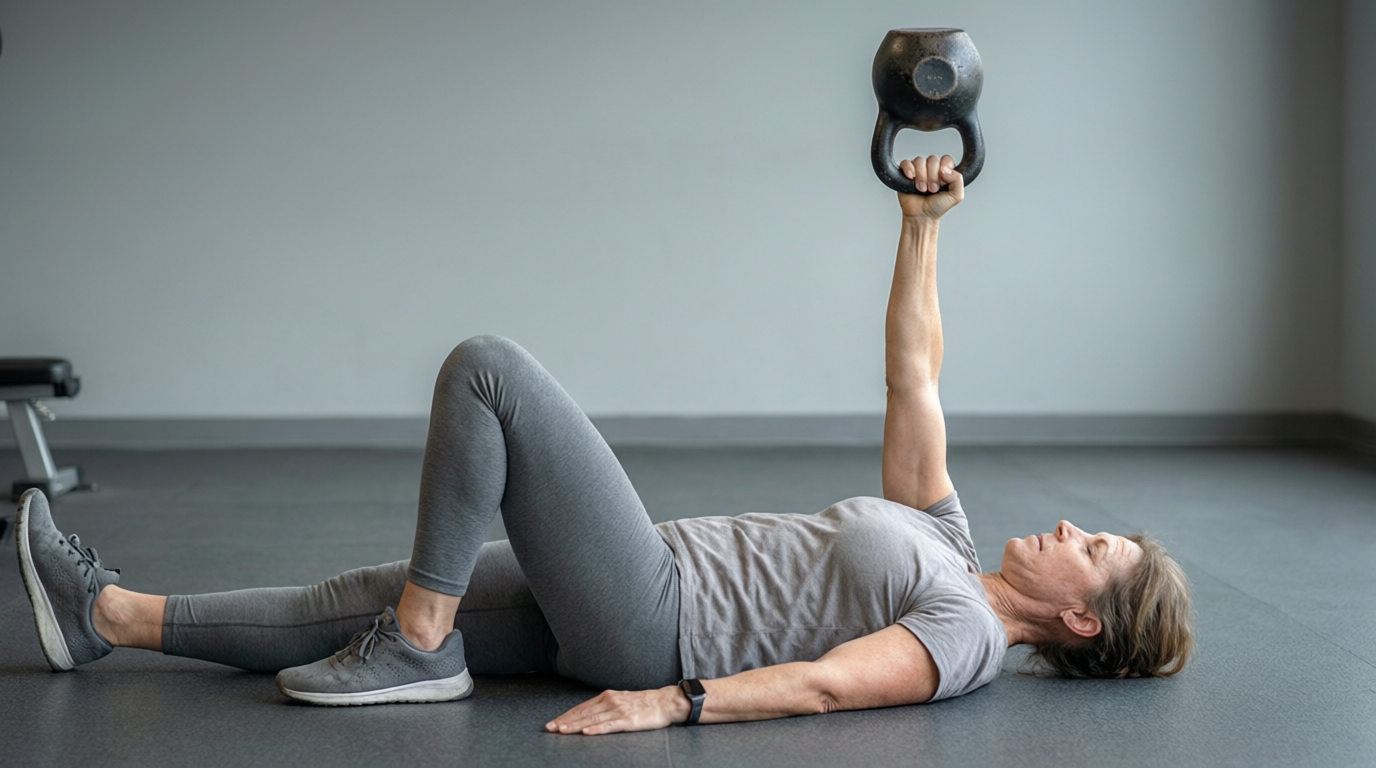
Turkish Get-Up
turkish-get-up
Take care with
- avoid · Shoulder impingement — The overhead position requires full shoulder stability and mobility. Substitute: Floor Press or Push-Up, which train the pressing pattern without the overhead demand.
A complex movement from lying on your back to standing while holding a kettlebell locked out overhead. Integrates shoulder stability, core control, hip mobility, and unilateral leg strength through a multi-stage sequence. The overhead position demands constant stability; the get-up demands coordination and control. Advanced — requires mobility, strength, and the ability to maintain tension through multiple planes of movement.
If you're new to this
This is not a beginner exercise. Before attempting the Turkish Get-Up, you should be comfortable with: holding a kettlebell overhead for 30 seconds with a stable shoulder, performing a get-up from the floor without weight, and maintaining a solid plank position. Start with a light kettlebell (or even a shoe balanced on your fist) to learn the sequence. If your shoulder shakes, your wrist bends, or you lose balance, the weight is too heavy or you're not ready for this movement yet.
Common mistakes
The most common error is rushing through the sequence instead of controlling each stage. This leads to: losing the overhead position (the kettlebell drifts forward or to the side), collapsing through the shoulder instead of packing it, or using momentum to swing up instead of driving through the heel. Another critical mistake is not keeping the eyes on the kettlebell throughout — looking away compromises neck and shoulder position. The return to the ground is often neglected; lowering with control is as important as getting up.
Routine
- Sets
- 3
- Reps
- 3-5 per side
- Rest
- 90s
- Tempo
- slow and controlled, 3-5 seconds per stage
- RPE
- 8
- Frequency
- 2-3
Start with a light kettlebell or even a shoe balanced on your fist to learn the sequence. Progress by increasing the weight once you can perform 5 reps per side with perfect form and a stable overhead position. If the kettlebell shakes or drifts, the weight is too heavy.
Cues
Muscles
- Shoulders
- Glutes
- Quadriceps
- Triceps
Equipment
- Kettlebell
- 1
Lie on your back with your right knee bent and right foot flat on the floor. Your left leg is straight, angled about 45 degrees from your body. Hold a kettlebell in your right hand, pressed straight up over your shoulder with your arm fully extended. Lock your elbow, pack your shoulder (pull it down and back into the socket), and keep your eyes on the kettlebell.
- 2
Place your left hand on the floor at a 45-degree angle from your left shoulder, palm down, fingers pointing away from your body. Your left arm is straight.
- 3
Drive through your right heel and your left hand simultaneously. Roll onto your left elbow, keeping your right arm locked overhead. Your torso is now at a 45-degree angle, your eyes still on the kettlebell.
- 4
Post up on your left hand by extending your left elbow. Your left arm is now straight, and you're supported on your left hand and right foot. Your hips are off the ground.
- 5
Thread your left leg under your body, bringing your left knee to the floor behind you. You're now in a kneeling lunge position: right foot forward, left knee back, left hand posted on the floor, right arm still locked overhead.
- 6
Drive through your right heel and extend your right hip and knee to stand up. Your left leg stays behind you as you rise. Finish standing tall with your feet together, right arm still locked overhead.
- 7
To return to the ground, reverse the sequence with control: step your left foot back into the kneeling lunge, post your left hand on the floor, lower your hips to the floor, bend your left elbow to lower to your left elbow, then roll back down to your starting position. The kettlebell stays overhead throughout the descent.