
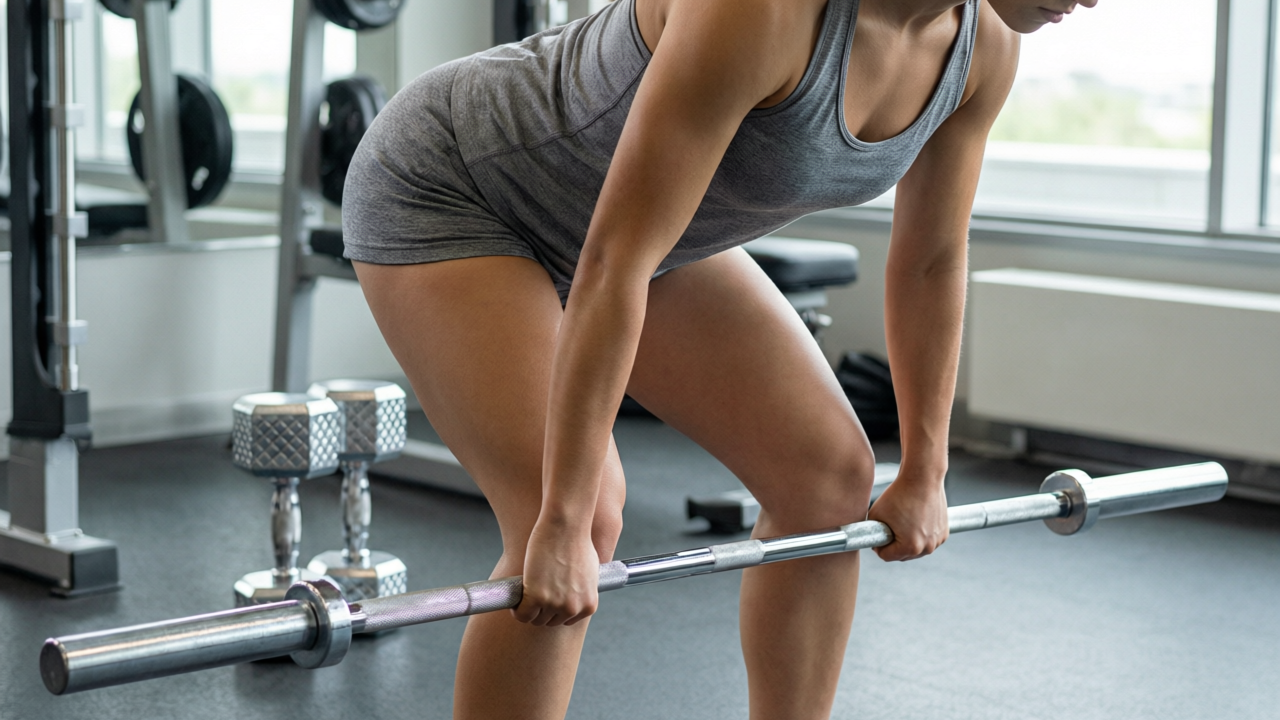
Romanian Deadlift
romanian-deadlift
Take care with
- avoid · Herniated disc — Flexion or even sustained loading in a hinged position can exacerbate disc protrusion. The leverage involved in the RDL increases intradiscal pressure. Avoid this movement entirely during active symptoms. Substitute with Bird-Dogs or Prone Planks to build core stability without spinal compression or flexion.
- caution · Osteoporosis — Forward bending under load increases the risk of vertebral compression fractures. While hinge mechanics are important, the barbell RDL may be too risky. Modify by performing a bodyweight hip hinge with a wall for tactile feedback, ensuring strict neutral spine, or substitute with seated resistance band rows to strengthen posterior chain without spinal loading.
- caution · Acute lower back injury — The Romanian Deadlift places significant shear force on the lumbar spine if form breaks down or if the individual lacks sufficient hip mobility. If acute pain is present, avoid. For chronic issues, modify by reducing range of motion to where neutral spine can be maintained, or substitute with a Glute Bridge which isolates hip extension with less spinal load.
When I nail a Romanian deadlift, I feel a deep, controlled stretch ripple through my hamstrings and glutes as I hinge back. The weight stays close to my legs, and my core stays fiercely braced to protect my spine. Each rep should feel heavy but smooth, like drawing a bowstring back and releasing it with deliberate tension. There is no rushing here, just steady, rhythmic power that leaves your posterior chain humming long after the set ends.
If you're new to this
When you first learn this movement, prioritize range of motion over heavy weight. Imagine closing a door behind you with your hips, keeping your chest proud and your back completely flat throughout the entire descent. Stop the moment your lower back begins to round or you feel your hamstrings lose tension, as that is your body signaling the end of your safe range. Common compensations include squatting the weight down or letting your shoulders roll forward, both of which steal tension from your target muscles and place unnecessary strain on your spine. You will know you are succeeding when your hamstrings burn steadily and your glutes fire hard to pull you upright. Start with lighter dumbbells or just a PVC pipe to groove the hinge pattern before adding plates. If your form breaks down mid-set, end the set immediately. Consistency beats intensity here, and mastering this controlled stretch will protect your back for years to come. Trust the process, move deliberately, and let your body adapt at its own pace.
Common mistakes
Lifters frequently turn the Romanian deadlift into a squat by bending their knees too much, which shifts the workload away from the hamstrings and onto the quads. Many also round their lower back at the bottom of the movement, sacrificing spinal neutrality and inviting injury under load. Another critical error is allowing the weight to drift away from the body, which creates excessive shear force on the lumbar spine and turns the lift into an awkward lever instead of a clean hinge. Finally, rushing the descent eliminates the eccentric tension that drives growth, turning a highly effective stretch into a sloppy drop. Keep your knees soft but locked in place, maintain a rigid torso, track the bar along your shins, and control every inch of the movement to maximize results.
Routine
- Sets
- 3
- Reps
- 8-12
- Rest
- 90s
- Tempo
- 3-0-1-0
- RPE
- 8
- Per set
- ~180s
- Frequency
- 2-3x/week
Increase load by 2.5-5 lbs when you can complete all sets at the top of the rep range with strict form and full control.
Muscles
- Hamstrings
- Glutes
- Lower back
- Abs
- Traps
Equipment
- Barbell
- Dumbbells
- 1
Stand with feet hip-width apart and grip the barbell or dumbbells with palms facing backward, arms hanging straight at the thighs.
- 2
Pull the shoulder blades down and back while bracing the abdominal muscles to stabilize the torso.
- 3
Inhale deeply into the diaphragm and lock the spine into a rigid, neutral alignment.
- 4
Push the hips straight backward while keeping a slight, fixed bend in the knees.
- 5
Lower the weight along the shins until a strong hamstring stretch signals the bottom position.
- 6
Drive the hips forward by squeezing the glutes and pushing the floor away with the midfoot.
- 7
Exhale steadily as the torso returns to the fully upright position.
- 8
Release core tension, adjust foot placement if needed, and take a full breath before the next repetition.