
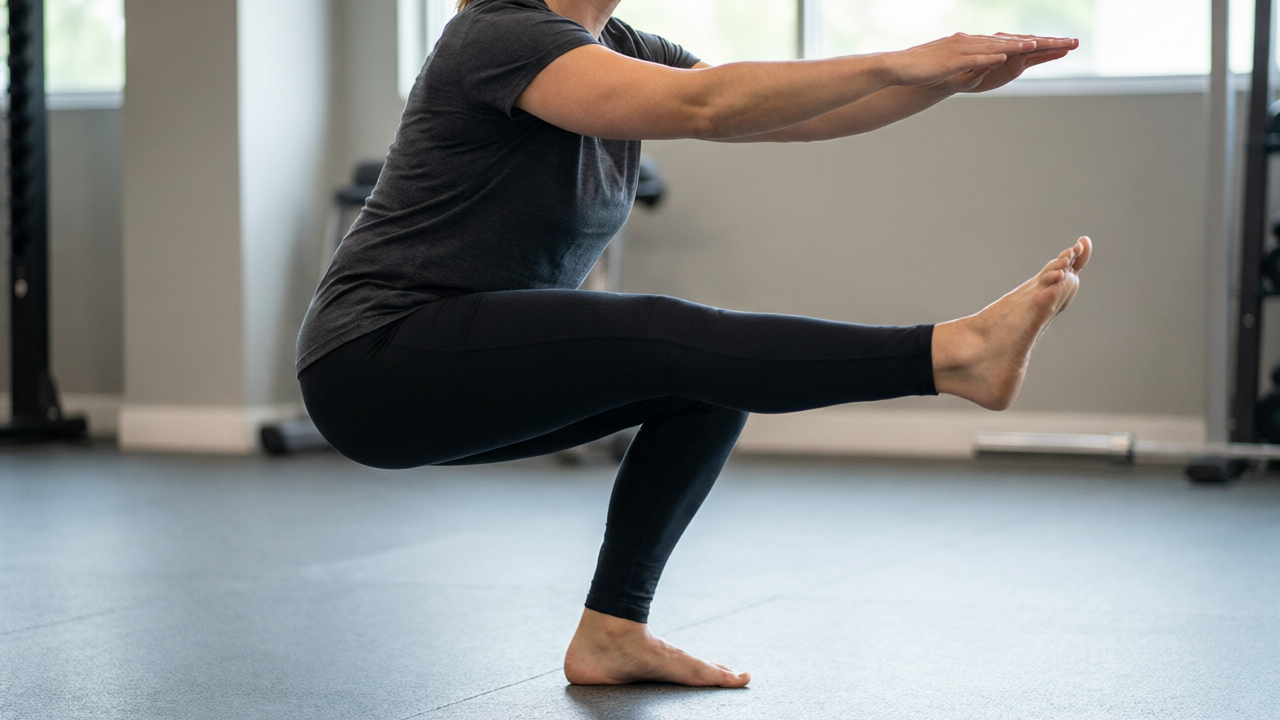
Pistol Squat
pistol-squat
Take care with
- avoid · Acute knee injury — The pistol squat places extreme shear force and compressive load on the knee joint, particularly the patellofemoral joint and meniscus, due to deep flexion under full bodyweight. This can aggravate existing injuries or instability. Instead, perform box squats or split squats with a limited range of motion to build strength safely.
- avoid · Hip replacement (post-op) — The deep hip flexion required to touch the hamstring to the calf often exceeds safe range-of-motion limits for hip replacement patients, posing a risk of dislocation or impingement. Instead, perform sit-to-stand exercises from a chair or box that keeps hip flexion within the surgeon-approved safe zone.
- caution · Acute lower back injury — Maintaining an upright torso while descending deeply on one leg requires significant lumbar stability and hip mobility. If mobility is lacking, the lower back may round (flex) under load, risking disc irritation. Instead, try assisted pistol squats holding a counterweight or TRX straps to maintain spinal neutrality, or regress to standard bodyweight squats.
A true pistol squat feels like controlled defiance. You’ll notice a smooth, uninterrupted descent where your balance stays locked over your working heel, and your extended leg floats effortlessly. The ascent should feel driven from the mid-foot, with your core braced and your spine tall. When executed well, it’s a seamless blend of mobility, stability, and raw unilateral power. Breathe steadily, trust the tension, and let the movement flow.
If you're new to this
Start by mastering the assisted pistol using a doorframe, TRX strap, or elevated box. Your working heel must stay planted; if it lifts, your ankle mobility or hip hinge needs attention. Focus on keeping your spine neutral and your extended leg straight without rounding your lower back. You’ll feel a deep stretch in your hamstring and glute as you descend. Stop immediately if your knee caves inward or your heel peels off the floor, as these signal compromised joint alignment. True failure here isn’t muscular exhaustion—it’s a loss of balance or spinal rounding. Prioritize depth and control over rep count. Breathe into your diaphragm, engage your glutes before descending, and trust that consistent practice will unlock full range of motion. Celebrate small depth gains, and never sacrifice joint integrity for a lower descent.
Common mistakes
Most lifters rush the descent, sacrificing ankle mobility and causing the heel to lift prematurely. Another frequent error is allowing the working knee to drift inward, which places unnecessary shear force on the joint and destabilizes the entire chain. Many also round the lower back to force depth, turning a controlled squat into a compromised hinge that shifts tension away from the quads. Finally, forgetting to actively engage the extended leg often leads to a heavy, swinging limb that throws off your center of gravity. Keep your chest proud, track your knee over your toes, and treat the bottom position as a moment to reset tension rather than a bounce point.
Routine
- Sets
- 3
- Reps
- 3-6 per leg
- Rest
- 90s
- Tempo
- 3-1-1-0
- RPE
- 8
- Per set
- ~150s
- Frequency
- 2-3x/week
Add a light counterweight held at chest level or elevate your heel on a small plate to improve depth and control.
Muscles
- Quadriceps
- Glutes
- Hamstrings
- Abs
- Calves
Equipment
- Bodyweight
- 1
Stand tall on one leg, keeping your working foot flat and your toes slightly turned out.
- 2
Extend your free leg straight forward, hovering it just above the floor with your ankle dorsiflexed.
- 3
Inhale deeply, brace your core, and push your hips back while lowering your torso.
- 4
Keep your chest upright and track your knee directly over your middle toes as you descend.
- 5
Lower until your hamstring lightly touches your calf, maintaining full foot contact with the ground.
- 6
Exhale forcefully, drive through your mid-foot, and press back to the starting position.
- 7
Lower your extended leg and reset your stance before switching sides or repeating.