
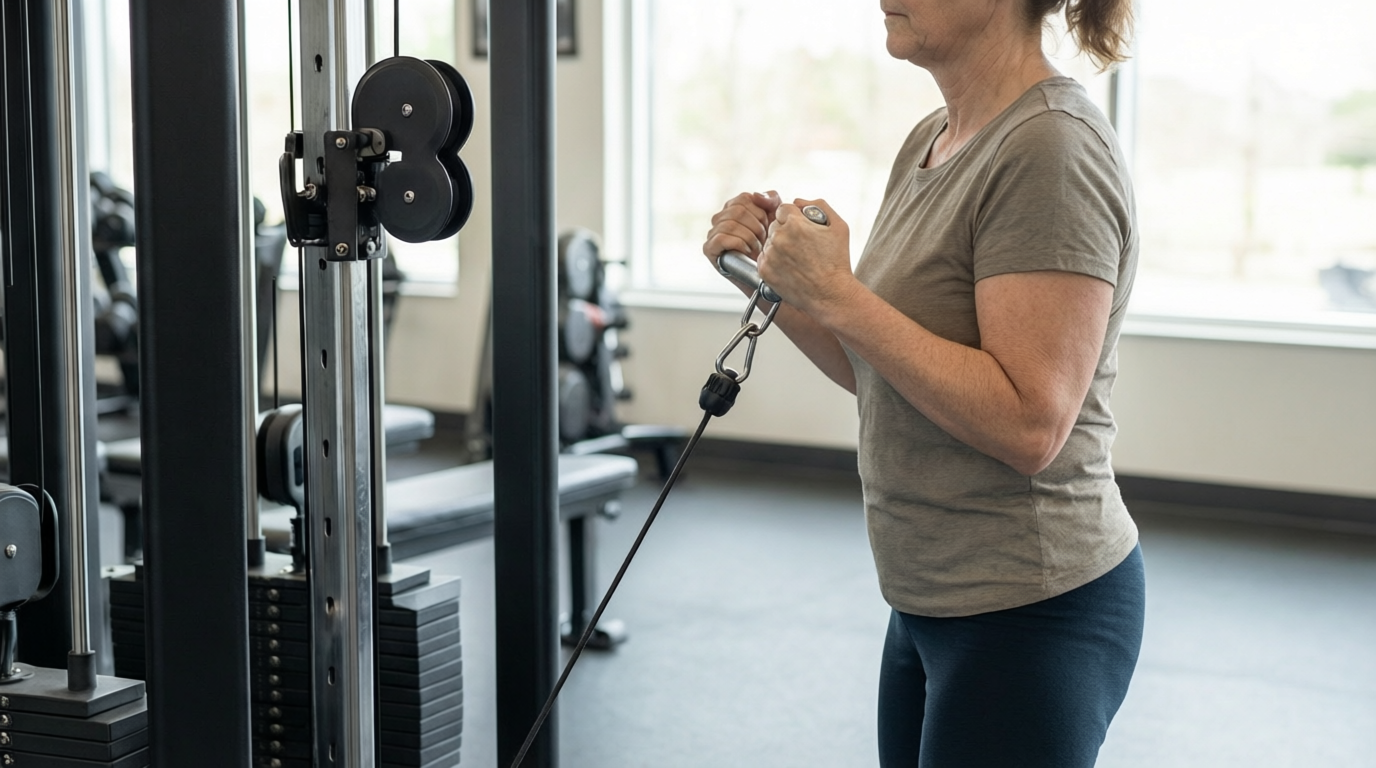
Pallof Press
pallof-press
Take care with
- caution · Uncontrolled hypertension — The isometric hold and core bracing can cause a temporary spike in blood pressure (Valsalva effect). Focus on continuous breathing during the hold rather than breath-holding, and reduce resistance intensity.
- caution · Acute lower back injury — While anti-rotation is generally protective, acute lower back pain may be aggravated by the isometric tension required to stabilize the spine. Ensure neutral spine alignment; if pain occurs, switch to a supported variation like a seated Pallof press or dead bugs.
- modify · Shoulder impingement — Holding the arms fully extended at chest height can compress the subacromial space in some individuals. Reduce the range of motion so arms do not fully lock out, or lower the anchor point to reduce shoulder flexion angle.
When I perform a clean Pallof press, I don’t feel my arms working; instead, I notice a deep, steady tension wrapping around my midsection. Each extension challenges my core to resist twisting, keeping my torso perfectly still. I feel a quiet, braced stability through my obliques and deep abdominals, like an invisible brace holding me strong against the pull. That’s the sweet spot I chase—controlled, grounded, and fiercely anti-rotational.
If you're new to this
Start with a lighter setting than you think you need, because your core will be doing all the work. Keep your knees softly bent and your weight evenly distributed across both feet. If you feel your lower back arching or your shoulders hiking toward your ears, pause, reset your brace, and reduce the tension immediately. True muscular failure here means you can no longer hold your torso perfectly still without twisting or leaning; stop the set before that happens to preserve your spine. Beginners often compensate by shifting their hips forward or leaning away from the anchor point to make the weight feel easier. Instead, think of your body as a solid pillar that only your arms move away from and back toward. Breathe out during the press and in during the return, never holding your breath. Trust the slow tempo, focus on the subtle engagement along your sides, and celebrate each rep where your posture remains completely unchanged. Consistency with lighter resistance will rapidly build the foundational stability you need for heavier lifts.
Common mistakes
Most lifters rush through the movement and sacrifice the isometric hold, which completely defeats the anti-rotational purpose. Others allow the cable or band to pull their shoulders forward, turning the exercise into a chest press rather than a core stabilizer. A frequent error is hyperextending the lower back as fatigue sets in, which shifts the load away from the abdominals and onto the lumbar spine. Finally, many people grip the handle too tightly, causing unnecessary forearm tension and pulling the movement out of alignment with their center of mass. Keep your grip relaxed, your torso rigid, and your focus entirely on resisting rotation rather than moving the weight quickly.
Routine
- Sets
- 3
- Reps
- 8-12
- Rest
- 60s
- RPE
- 7
- Per set
- ~90s
- Frequency
- 2-3x/week
Increase cable resistance, extend the isometric hold at full extension to 3-4 seconds, or advance to a split-stance position.
Muscles
- Obliques
- Abs
- Glutes
- Shoulders
Equipment
- Cable machine
- Resistance bands
- 1
Stand perpendicular to the cable or band anchor with the attachment positioned at chest height.
- 2
Grip the handle with both hands and pull it snugly against your sternum.
- 3
Plant your feet shoulder-width apart, bend your knees slightly, and align your hips straight ahead.
- 4
Engage your abdominal muscles to stabilize your torso before initiating movement.
- 5
Exhale fully as you press the handle straight out until your arms fully extend.
- 6
Hold the extended position for two seconds while actively resisting rotational forces.
- 7
Inhale slowly as you return the handle to your chest under controlled tension.
- 8
Reset your stance and shoulder alignment before beginning the next repetition.