
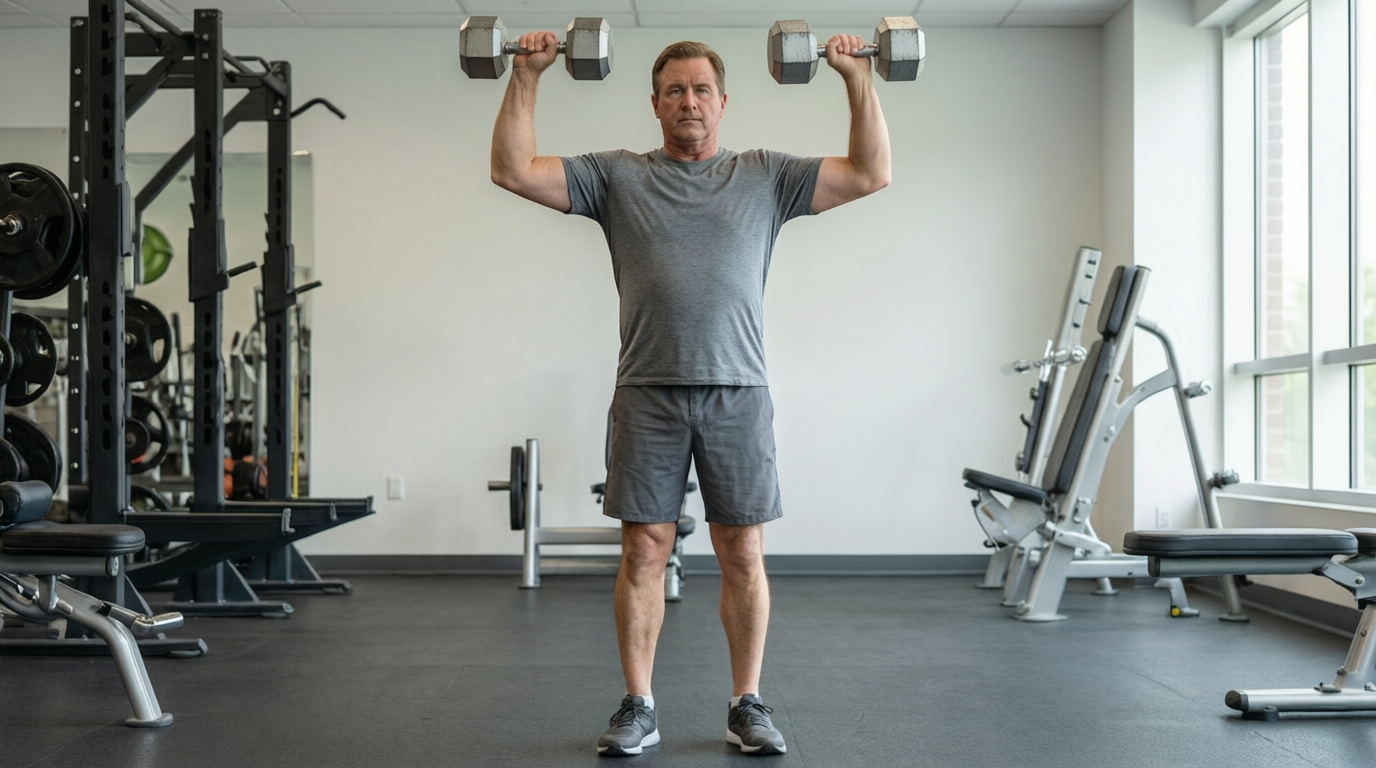
Overhead Carry
overhead-carry
Take care with
- avoid · Rotator cuff tear — The overhead position places significant stress on the rotator cuff tendons for stabilization, risking further tearing or pain. Instead, use a Suitcase Carry (one-handed hold at the side) to challenge anti-lateral flexion safely.
- avoid · Uncontrolled hypertension — Sustained overhead tension combined with walking can cause dangerous spikes in blood pressure due to the Valsalva effect and increased vascular resistance. Instead, perform a standard Goblet Hold (weight at chest level) while standing still or marching in place.
- avoid · Shoulder impingement — Full overhead lockout compresses the subacromial space, aggravating impingement. Instead, perform a Farmer's Carry holding weights at the sides to build core stability and grip strength without shoulder elevation.
When I lock a dumbbell or kettlebell overhead, my entire body wakes up into one rigid, unified pillar. Good reps feel like a steady, controlled march where my core stays braced, my shoulder stays packed, and my breath stays rhythmic despite the load. There’s a satisfying tension that runs from my palm down through my ribs and into my hips. It’s not about brute strength; it’s about disciplined alignment and unwavering stability as I cover ground with purpose.
If you're new to this
If this is your first time loading the carry, start light and keep your steps intentionally short. Focus on keeping the weight directly over your shoulder joint, never letting it drift forward or backward. You will likely feel a strong urge to arch your lower back or lean your torso away from the load; actively resist this by squeezing your glutes and drawing your lower ribs down. Stop immediately if you feel sharp shoulder or back pain, or if your breathing becomes ragged and you lose core tension. Beginners often compensate by hiking the shoulder toward the ear or bending the elbow; maintain a straight arm and pack the shoulder down and back. Walk only as far as you can maintain perfect alignment, usually twenty to thirty paces. Quality always wins over distance. As your stability improves, gradually increase the load or distance without ever sacrificing your stacked posture.
Common mistakes
The most frequent error is allowing the torso to lean laterally away from the weight, which turns a stabilizing challenge into a structural compromise. Many lifters also let the working elbow bend slightly or the shoulder hike upward, shifting tension away from the lats and into the smaller rotator cuff muscles. Another common issue is rushing the steps, which creates momentum that breaks core bracing and forces the lower back into excessive extension. Finally, some practitioners forget to engage the glutes, leaving the pelvis anteriorly tilted and placing unnecessary shear force on the lumbar spine.
Routine
- Sets
- 3
- Reps
- 30-45 seconds per side
- Rest
- 90s
- RPE
- 7
- Per set
- ~120s
- Frequency
- 1-2x/week
Increase load or extend carry distance while maintaining strict overhead positioning and a braced core.
Muscles
- Shoulders
- Abs
- Obliques
- Glutes
Equipment
- Dumbbells
- Kettlebell
- 1
Stand with feet shoulder-width apart and place a dumbbell or kettlebell directly in front of your toes.
- 2
Hinge at the hips and bend the knees to grip the handle securely, keeping the spine flat and chest up.
- 3
Exhale forcefully to clean the weight to your shoulder, then press it straight overhead until the elbow locks out.
- 4
Inhale deeply to brace the core, pull the shoulder blade down, and keep the wrist stacked directly over the elbow.
- 5
Take short, deliberate steps forward while keeping the torso rigid and the weight centered over the midline.
- 6
Exhale rhythmically with each stride, maintaining a neutral neck and preventing the ribs from flaring.
- 7
Plant both feet firmly, bend the elbow to lower the weight to your shoulder, and exhale fully to guide it safely to the floor.
- 8
Release the grip, stand tall, and reset your stance before the next set.