
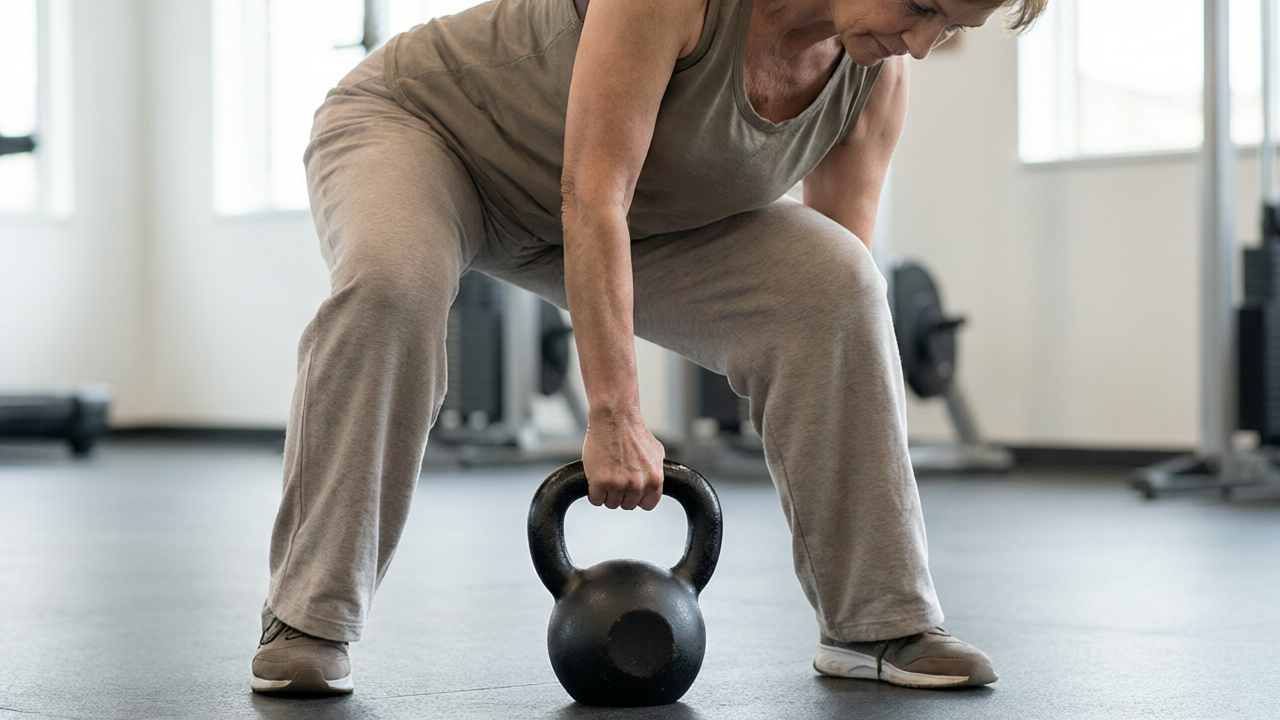
Kettlebell Snatch
kettlebell-snatch
Take care with
- avoid · Rotator cuff tear — The rapid overhead lockout places extreme shear and compressive force on the glenohumeral joint, risking further tearing. Instead, perform Kettlebell High Pulls to develop hip power without the vulnerable overhead position.
- avoid · Shoulder impingement — The aggressive upward punch and full elbow lockout can pinch the supraspinatus tendon against the acromion. Instead, use Single-Arm Kettlebell Swings to train the hinge pattern safely within a pain-free range of motion.
- caution · Acute lower back injury — The ballistic nature of the snatch requires precise timing; if the hips stall, the lower back often compensates with shear force. Instead, perform Deadlifts or Rack Carries to build posterior chain strength with controlled, static loading.
When I execute a perfect kettlebell snatch, it feels like a single, seamless explosion of energy. The weight floats effortlessly overhead, guided by a sharp hip snap and a relaxed, confident grip. There is no wrestling or grinding, just a crisp, rhythmic pulse where power meets precision. Each rep leaves my shoulders open, my core engaged, and my breathing steady, reminding me that true strength flows through momentum, not brute force.
If you're new to this
Start light and focus entirely on timing rather than weight. Your first priority is mastering the hip hinge; think of it as a powerful swing that you redirect upward, not a pull with your arm. Keep your elbow tucked during the ascent and let the bell’s momentum do the work. If your shoulder starts burning before your hips do, you are likely muscling the bell instead of letting it float. Stop immediately if you feel sharp lower back pain, if your wrist bends backward excessively at the top, or if your breathing becomes erratic. Beginners often compensate by leaning back too far or using a wide, sweeping arc that pulls them off balance. Keep the bell tracking in a straight vertical line close to your center. Practice the hike and punch separately until they connect seamlessly. Trust that the movement will feel awkward at first, but with consistent, mindful reps, the rhythm will emerge naturally. Focus on quality over quantity, and you will build a foundation that translates safely to heavier loads.
Common mistakes
Most lifters treat the snatch like a heavy shoulder press, which immediately breaks the kinetic chain and overloads the rotator cuff. Instead of driving from the hips, they pull with the biceps and shoulders, turning a ballistic movement into a slow grind. Another frequent error is allowing the kettlebell to swing too far away from the body during the ascent, which creates a dangerous lever and forces the lower back to compensate. Finally, many athletes fail to actively punch the hand through at the top, leaving the elbow slightly bent and the shoulder vulnerable to impact. Correcting these habits requires slowing down, lightening the load, and prioritizing a tight vertical path with full hip extension.
Routine
- Sets
- 3
- Reps
- 3-5 per arm
- Rest
- 90s
- RPE
- 8
- Per set
- ~120s
- Frequency
- 2-3x/week
Increase kettlebell weight only when you can consistently achieve full hip extension and a stable overhead lockout without compromising speed or form.
Muscles
- Glutes
- Shoulders
- Hamstrings
- Lats
- Abs
Equipment
- Kettlebell
- 1
Stand with feet shoulder-width apart, toes pointed slightly outward, and position the kettlebell on the floor directly between the heels.
- 2
Hinge at the hips, bend the knees slightly, and grip the kettlebell handle with one hand while keeping the wrist completely straight.
- 3
Inhale deeply, brace the abdominal muscles, and pull the shoulder down and back to lock into a stable starting posture.
- 4
Exhale sharply as you drive through the heels, forcefully extending the hips and knees to launch the kettlebell upward.
- 5
Keep the arm loose and guide the kettlebell in a tight vertical path close to the torso as upward momentum builds.
- 6
Punch the hand straight upward at the top of the arc, rotating the palm forward and locking the elbow completely.
- 7
Exhale fully while stabilizing the weight overhead, keeping the ribcage down and glutes tightly engaged.
- 8
Inhale while softly bending the elbow and actively pulling the kettlebell down along the same vertical line.
- 9
Hinge the hips backward, absorb the descending weight with slightly bent knees, and guide the kettlebell back to the floor.
- 10
Release the grip, straighten the torso, and reset the stance to prepare for the next repetition.