
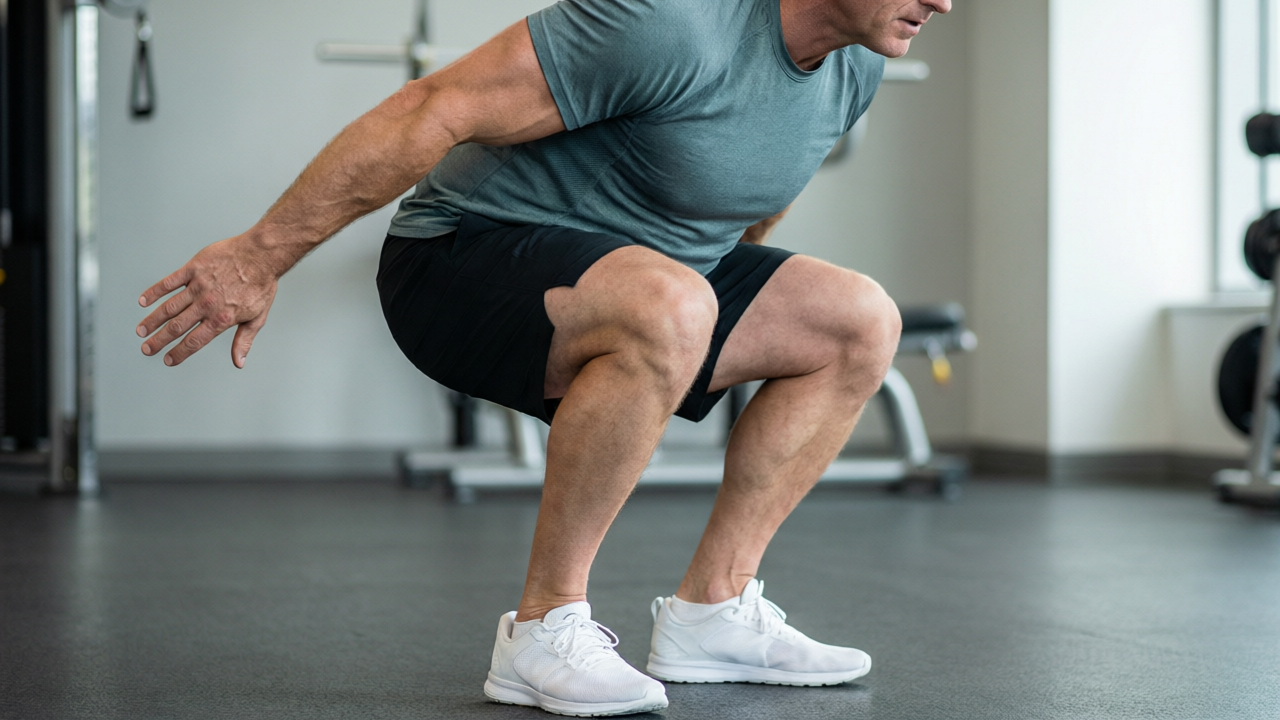
Jump Squat
jump-squat
Take care with
- avoid · Osteoporosis — High-impact landings significantly increase the risk of vertebral compression fractures or lower extremity stress fractures in individuals with low bone density. Instead, perform seated leg presses or resistance band squats to maintain muscle mass without impact loading.
- avoid · Acute knee injury — High-impact landing and explosive knee extension place excessive shear force on compromised joint structures. Instead, perform bodyweight squats or box step-ups to build strength without impact.
- avoid · Acute lower back injury — The rapid transition from eccentric loading to explosive concentric movement creates high compressive and shear forces on the lumbar spine. Instead, perform glute bridges or controlled tempo squats to strengthen the posterior chain safely.
When I nail a jump squat, it feels like pure, explosive energy channeling straight through my legs. Each rep is a quick, controlled descent followed by an effortless launch that leaves me momentarily airborne. My landing stays soft and quiet, absorbing the impact smoothly before I immediately reset. It’s not about maximum height, but that crisp, rhythmic bounce that wakes up my entire lower body and keeps my heart pounding.
If you're new to this
If you are new to jumping, start by mastering a smooth bodyweight squat before adding height. Focus on a controlled descent, keeping your knees tracking over your toes and your back flat. When you push off, aim for a modest height that allows you to land softly rather than jumping as high as possible. Fatigue typically arrives when your form breaks down into heavy, slapping landings or when your knees cave inward. Stop immediately if you feel sharp joint pain or if your landing becomes loud and uncontrolled, as this signals excessive impact on your connective tissue. Beginners often compensate by overextending the lower back or leaning too far forward during the jump. To prevent this, keep your chest up, engage your core throughout, and visualize landing like a feather. Build volume gradually with three to four sets of four to six clean repetitions, prioritizing crisp mechanics over speed. Consistency will quickly translate into effortless, powerful movement.
Common mistakes
Most lifters ruin the jump squat by landing stiff-legged, which sends shockwaves straight through the joints instead of absorbing them through muscular tension. Another frequent error is allowing the knees to collapse inward during the ascent or landing, which compromises tracking and places undue stress on the ligaments. Many also cut the descent short, turning the movement into a shallow hop rather than utilizing a full stretch-shortening cycle. Over-swinging the arms or leaning excessively forward to generate momentum is common as well, which disrupts spinal alignment and shifts the center of gravity. Finally, rushing between repetitions without resetting the core leads to sloppy mechanics and diminished power output.
Routine
- Sets
- 3
- Reps
- 5-8
- Rest
- 90s
- RPE
- 8
- Per set
- ~90s
- Frequency
- 2-3x/week
Increase jump height or add light external load while prioritizing maximal velocity and controlled landings.
Muscles
- Quadriceps
- Glutes
- Calves
- Hamstrings
- Abs
Equipment
- Bodyweight
- 1
Stand with feet shoulder-width apart and toes angled slightly outward.
- 2
Brace the abdominal muscles and keep the chest tall.
- 3
Push the hips back and bend the knees to lower into a squat while inhaling deeply.
- 4
Pause briefly at the bottom with thighs roughly parallel to the floor.
- 5
Drive upward through the entire foot and explode into a vertical jump while exhaling forcefully.
- 6
Swing the arms straight overhead to maximize lift and maintain mid-air balance.
- 7
Land softly on the midfoot and immediately bend the knees to absorb the impact.
- 8
Return to a stable standing position and reset the arms to the sides.