
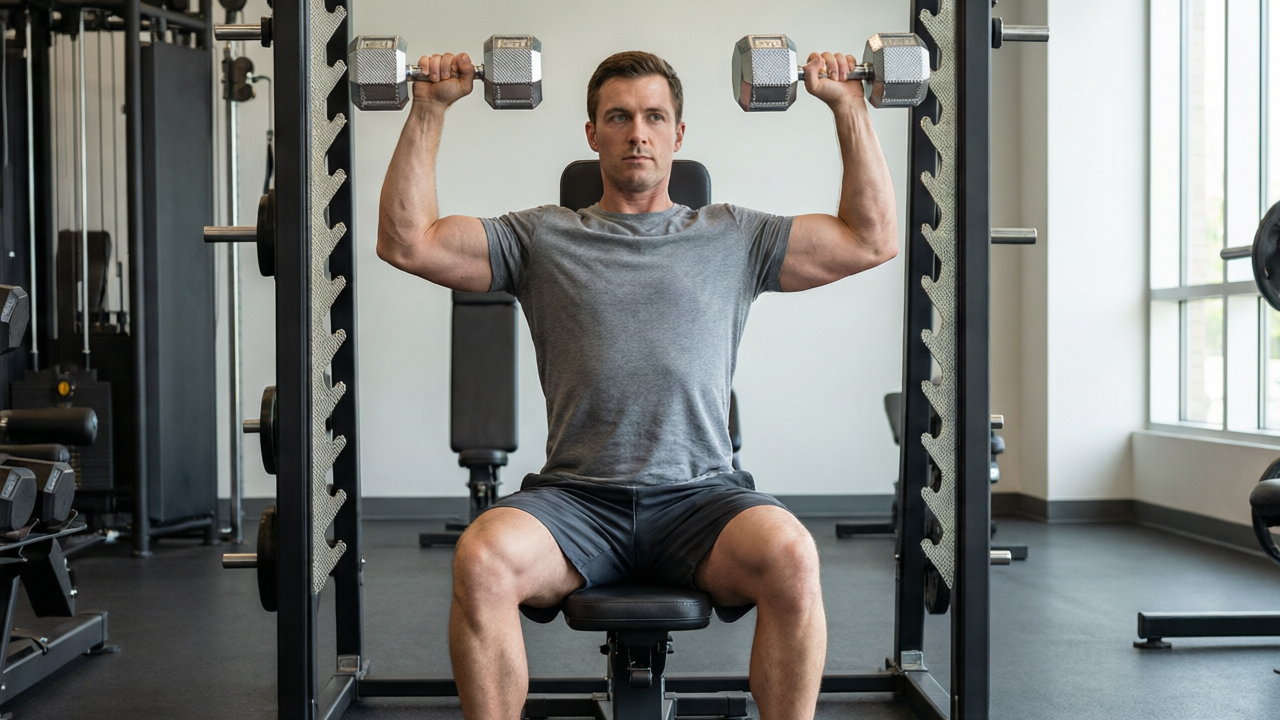
Dumbbell Shoulder Press
dumbbell-shoulder-press
Take care with
- avoid · Rotator cuff tear — Heavy overhead loading places significant shear stress on the glenohumeral joint and compromised rotator cuff tendons, risking further tearing. Instead, focus on isometric holds or scaption raises with very light resistance as tolerated by a physical therapist.
- avoid · Shoulder impingement — Overhead pressing in the scapular plane can compress subacromial structures and aggravate impingement. Instead, perform Landmine Presses or high-angle incline dumbbell presses which allow a more natural scapular path.
- modify · Acute lower back injury — Sitting upright requires significant spinal stabilization; heavy loads may cause compensatory lumbar hyperextension. Instead, perform the press standing with a braced core, or use a bench with back support to reduce axial load on the spine.
When I press the dumbbells overhead, I feel a clean burn across my shoulders and triceps that never compromises my spine. Good reps move smoothly, with a tight core anchoring my ribs as the weights travel straight up. I notice a satisfying stretch at the bottom and a crisp lockout at the top. Every rep leaves my upper body energized, not strained. I focus on steady breathing and packed shoulders so the movement builds strength without grinding my joints.
If you're new to this
As you begin this lift, prioritize control over heavy weight. Keep your ribs down and your core engaged throughout to prevent your lower back from arching excessively. If you feel the weights drifting too far forward, pull your elbows slightly closer to your torso to protect your shoulder joints. True muscular failure in this movement feels like a sudden inability to press upward, accompanied by a sharp tremor in the deltoids. Stop the set the moment your form breaks, your lower back hyperextends, or the dumbbells start to wobble uncontrollably. Many beginners compensate by leaning back aggressively or using their legs to generate momentum, which shifts the tension away from your shoulders and into your spine. Breathe consistently, reset at the bottom if needed, and treat every rep as a deliberate practice session. You will build remarkable shoulder strength quickly by respecting the movement’s natural rhythm and trusting the process.
Common mistakes
The most frequent error is flaring the elbows completely out to the sides, which places unnecessary stress on the rotator cuff and reduces pressing efficiency. Lifters also tend to overarch their lower back, especially as fatigue sets in, turning a strict shoulder exercise into a risky lower-back lever. Another common misstep is pressing the dumbbells inward until they collide overhead, which disrupts the natural shoulder mechanics and limits your range of motion. Finally, rushing the descent and bouncing the weights off the clavicles sacrifices tension and invites joint strain. Keep the path vertical, brace your midsection, and lower with purpose to maximize shoulder development.
Routine
- Sets
- 3
- Reps
- 8-12
- Rest
- 90s
- Tempo
- 2-0-1-0
- RPE
- 8
- Per set
- ~180s
- Frequency
- 2-3x/week
Increase dumbbell weight by 2.5-5 lbs once you complete 12 reps across all sets with strict form.
Muscles
- Shoulders
- Triceps
- Traps
- Abs
Equipment
- Dumbbells
- Bench
- 1
Sit upright on a supported bench and plant both feet firmly on the floor.
- 2
Position the dumbbells at shoulder height with elbows bent at 90 degrees and palms facing forward.
- 3
Tighten the core and press the weights straight overhead while exhaling steadily.
- 4
Extend the arms fully without locking the elbows and pause briefly at the top.
- 5
Lower the dumbbells back to shoulder level while inhaling slowly.
- 6
Control the descent to keep tension on the shoulders and stop just before the elbows drop below shoulder height.
- 7
Guide the weights down to your thighs and maintain a secure grip.
- 8
Set the dumbbells on the floor and step away from the bench to complete the set.