
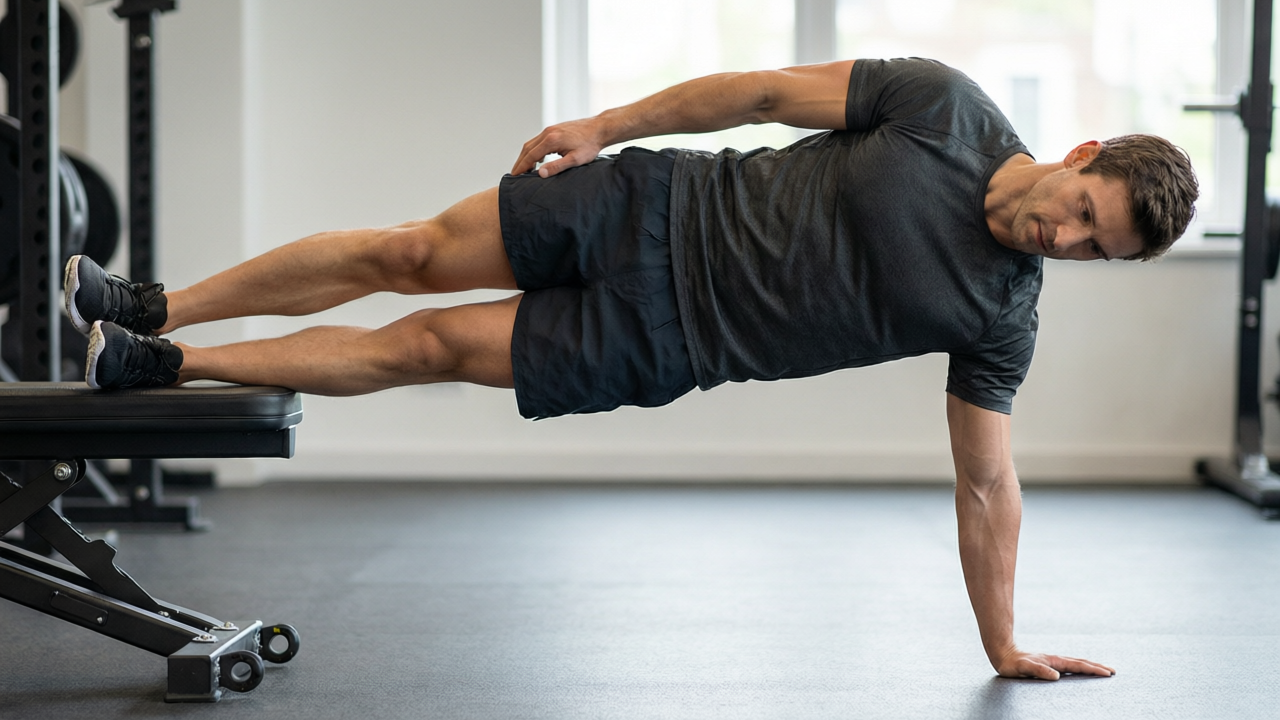
Copenhagen Plank
copenhagen-plank
Take care with
- caution · Shoulder impingement — The side plank position loads the supporting shoulder. If this causes pain, reduce the hold time or substitute with a plank with alternating leg lifts (less adductor demand, no shoulder loading).
A side plank variation with the top foot elevated on a bench or box, demanding isometric hip adduction from the bottom leg while the entire body resists rotation and lateral flexion. The adductors of the supporting leg work to pull the top leg down, while the obliques, glute medius and deep core stabilizers prevent the hips from sagging or rotating.
If you're new to this
This is an advanced isometric. Most people cannot hold a full Copenhagen plank for more than 10-15 seconds on the first attempt. Start with the top foot on a lower surface (a step or low box) to reduce the lever arm, or bend the bottom knee slightly to shorten the resistance. If your hips sag or rotate, the set is over — quality over duration.
Common mistakes
Letting the hips sag toward the floor (loads the shoulder instead of the adductors), rotating the torso to face the ceiling (cheats the anti-rotation demand), or holding the breath throughout the set (spikes blood pressure and reduces stability). The bottom leg should be straight but not locked — a micro-bend in the knee protects the joint while maintaining adductor tension.
Routine
- Sets
- 3
- Reps
- 15-30 seconds per side
- Rest
- 60s
- Tempo
- isometric hold
- RPE
- 7
- Frequency
- 2-3
increase hold time by 5 seconds per week, or elevate the bench height to increase the lever arm
Cues
Muscles
- Obliques
- Abs
Equipment
- Bench
- 1
Position a bench or sturdy box at knee height and lie on your side next to it, with your top leg resting on the bench and your bottom leg straight on the floor.
- 2
Place your bottom forearm on the ground with your elbow directly under your shoulder, fingers pointing forward.
- 3
Press through your forearm and the inside of your top foot to lift your hips off the ground, forming a straight line from your head to your heels.
- 4
Engage your bottom leg by gently pulling your top leg down into the bench — this is the isometric adductor contraction.
- 5
Keep your torso facing forward, your hips stacked (not rotated), and your core braced as if preparing for a light punch.
- 6
Hold this position for the prescribed duration while breathing steadily — do not let your hips sag or rotate.
- 7
Lower your hips to the ground with control, rest briefly, and repeat on the opposite side.