
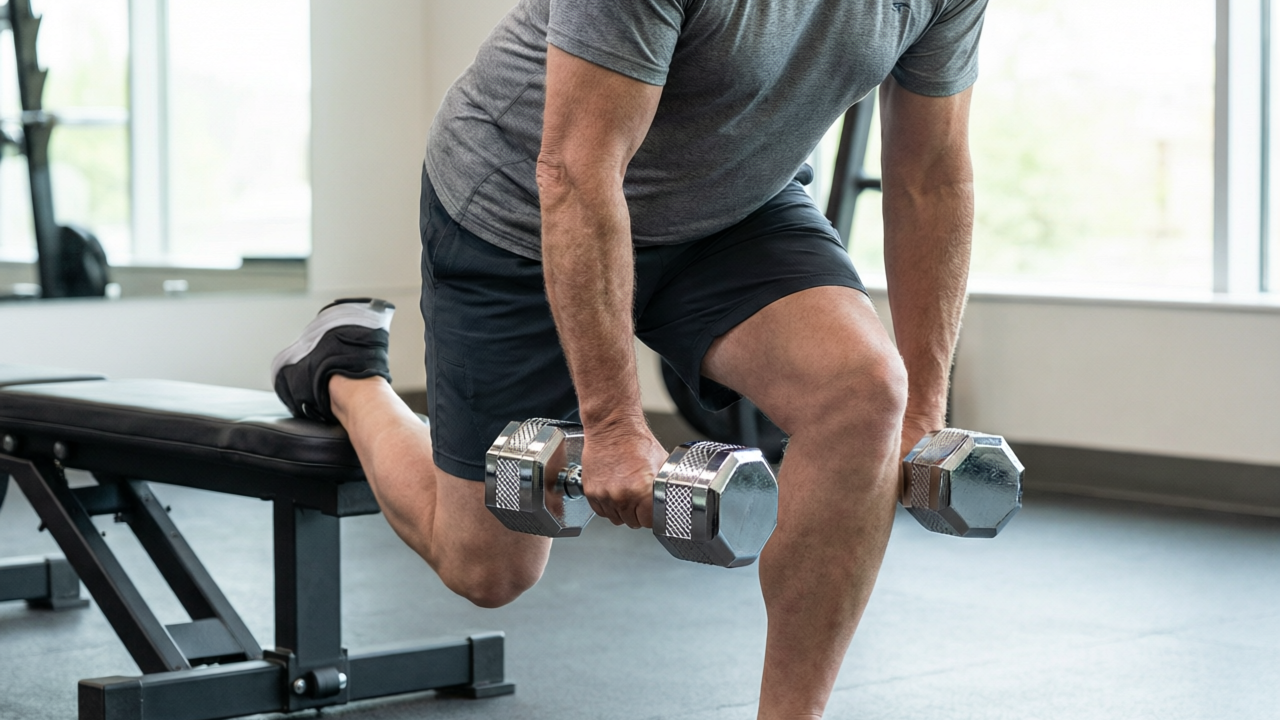
Bulgarian Split Squat
bulgarian-split-squat
Take care with
- avoid · Hip replacement (post-op) — The extreme hip extension of the rear leg combined with deep flexion of the front leg may exceed safe range of motion limits or cause impingement depending on surgical approach. Substitute with a supported split squat (rear foot on floor) with limited depth or a glute bridge.
- caution · Vertigo / balance disorder — The narrow base of support and unilateral stance require significant balance, which may trigger dizziness or instability. Perform near a wall for support, reduce range of motion, or substitute with a bilateral goblet squat for greater stability.
- caution · Acute knee injury — High unilateral load and deep knee flexion can aggravate patellar or meniscal issues. Ensure pain-free range of motion; if discomfort occurs, switch to a standard reverse lunge with reduced depth or a box step-up to control eccentric loading.
I love how the Bulgarian split squat isolates each leg while demanding total-body control. When you nail the rep, you’ll feel a deep, steady burn in the front thigh and glute, with a smooth hinge through the hips and zero joint strain. Keep your torso tall, drive through the midfoot, and let the stretch in your back leg guide your depth. Master this rhythm, and you’ll build resilient, balanced power that translates to every movement you do.
If you're new to this
Start light and focus entirely on balance before adding load. You should feel tension building steadily in your front quad and glute, not sharp pain in your knee or lower back. If your knee caves inward or your front heel lifts off the floor, pause and reset your foot placement slightly wider. True muscular failure means you can no longer control the descent without your torso collapsing forward; stop immediately when form breaks down to protect your joints. Beginners often rush the bottom position or let the back leg take over. Keep your weight centered over your midfoot, maintain a proud chest, and treat the rear foot as a light stabilizer rather than a weight-bearing leg. Breathe consistently, trust the eccentric phase, and celebrate small wins as your balance and unilateral strength improve week after week.
Common mistakes
Most lifters struggle because they lean too far forward, shifting the tension away from the glutes and quads and placing unnecessary stress on the lower back. Another frequent error is letting the front knee collapse inward during the ascent, which compromises joint alignment and reduces power output. Many also place their front foot too close to the bench, turning the movement into a knee-dominant quad exercise rather than a balanced hip-and-knee pattern. Finally, rushing through the bottom position without pausing to stabilize eliminates the stretch reflex and reduces time under tension, making the exercise far less effective for building strength and control.
Routine
- Sets
- 3
- Reps
- 8-12
- Rest
- 90s
- Tempo
- 2-0-2-0
- RPE
- 8
- Per set
- ~180s
- Frequency
- 2-3x/week
Increase the dumbbell weight by 2.5 to 5 pounds once you can complete all sets with strict form and a controlled tempo.
Muscles
- Glutes
- Quadriceps
- Hamstrings
- Adductors
- Abs
Equipment
- Dumbbells
- Bench
- 1
Stand facing away from a sturdy bench, positioning your front foot roughly two feet forward.
- 2
Rest the top of your trailing foot securely on the bench edge, keeping your ankle relaxed.
- 3
Hold a dumbbell in each hand at your sides, brace your core, and pull your shoulders down and back.
- 4
Inhale deeply as you slowly bend both knees, lowering your back knee toward the floor.
- 5
Descend until your front thigh reaches parallel, maintaining an upright torso and a flat front foot.
- 6
Exhale forcefully as you drive through the center of your front foot to return to the starting position.
- 7
Fully extend both legs at the top without locking your knees, then reset your balance.
- 8
Complete all repetitions on one side before carefully switching legs and repeating the sequence.