
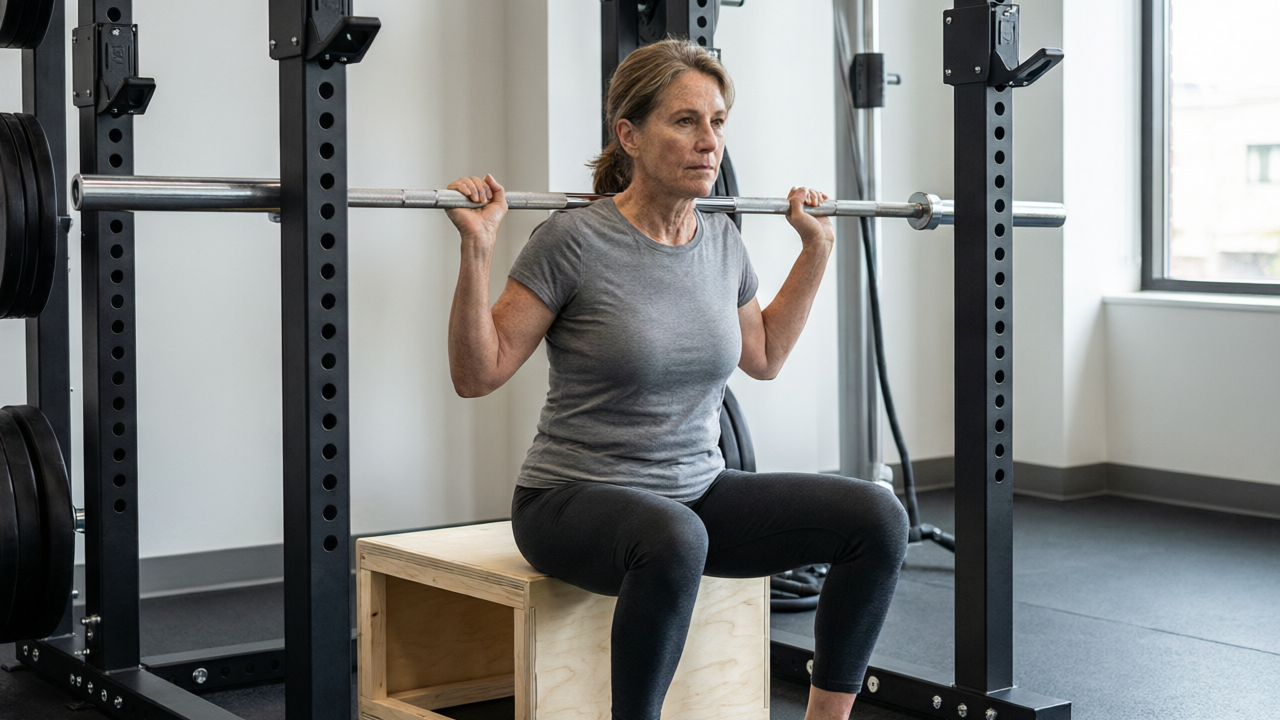
Box Squat
box-squat
Take care with
- avoid · Osteoporosis — Heavy barbell loading on the upper traps creates high compressive forces on the thoracic and lumbar vertebrae, increasing fracture risk. Instead, use a goblet squat holding a dumbbell at chest height to shift the center of gravity forward and reduce spinal compression.
- avoid · Herniated disc — The axial loading of a barbell combined with the deceleration required to sit on the box places significant compressive and shear force on the lumbar spine. Instead, perform bodyweight box squats or goblet squats to reduce spinal load while maintaining the movement pattern.
- caution · Acute knee injury — While the box limits depth, the pause eliminates the stretch-shortening cycle, requiring pure concentric strength from the quads which can aggravate patellar tendonitis. Instead, perform standard tempo squats without a pause to maintain tissue elasticity, or use a higher box to reduce knee flexion angle.
I love how the box squat strips away the fear of falling backward, replacing it with controlled, deliberate power. When you execute it well, each rep feels like a coiled spring releasing. You will feel your hips driving back to kiss the target, your core braced like armor, and your quads firing as you explode upward without momentum stealing the tension. It is a masterclass in patience, precision, and raw lower-body strength.
If you're new to this
Start lighter than you think you need. The goal is mastering the hip hinge and building confidence in the bottom position, not chasing heavy numbers. Keep your chest proud and your knees tracking over your toes throughout the descent. If your heels lift, shift your weight slightly forward or widen your stance. True muscle failure on this movement feels like a sudden inability to generate upward drive from the seated position, while form failure reveals itself as a rounded lower back or a slumped chest. Stop immediately if you feel sharp pain in your knees or spine. Beginners often rush the descent, bouncing off the box to cheat the pause. Fight that urge. The brief pause is your teacher—it eliminates momentum, forces your muscles to restart from zero, and guarantees you own the entire range of motion. Embrace the slow, deliberate rhythm. Your nervous system will adapt quickly, and your squat foundation will become bulletproof.
Common mistakes
The most frequent error is treating the box as a rebound surface, bouncing off it to skip the crucial pause and rely on the stretch reflex. Lifters also tend to collapse their torso forward the moment they sit, which shifts the load dangerously onto the lumbar spine instead of keeping it distributed across the posterior chain. Another widespread issue is letting the knees cave inward during the ascent, which destabilizes the hips and compromises knee tracking. Finally, many rush the descent instead of controlling it, losing tension in the glutes and core before the movement even begins. Mastering the deliberate pause and maintaining rigid torso alignment will instantly correct these patterns.
Routine
- Sets
- 3
- Reps
- 8-12
- Rest
- 90s
- Tempo
- 3-1-1-0
- RPE
- 8
- Per set
- ~210s
- Frequency
- 2-3x/week
Add 2.5 to 5 pounds to the bar once you can complete all sets with perfect form and a controlled pause.
Muscles
- Quadriceps
- Glutes
- Lower back
- Hamstrings
- Abs
Equipment
- Barbell
- Plyo box
- Squat rack
- 1
Set a sturdy plyo box at knee height and load the barbell on a squat rack.
- 2
Step under the bar, position it across your upper traps, and unrack with a straight back.
- 3
Take two steps back, plant your feet shoulder-width apart, and brace your core deeply.
- 4
Inhale steadily, push your hips back, and descend under strict control until your glutes lightly touch the box.
- 5
Pause for one full second on the box while maintaining full-body tension and an upright chest.
- 6
Drive through your midfoot, exhale forcefully, and extend your hips and knees simultaneously to return to standing.
- 7
Reset your stance, take a fresh breath, and repeat for the prescribed reps before racking the weight.