The United States and Iran exchanged intensifying rounds of strikes across the Middle East over the weekend, with the immediate trigger being an Iranian attack on a container ship in the Strait of Hormuz and Tehran’s subsequent declaration that the critical waterway was closed "until further notice."
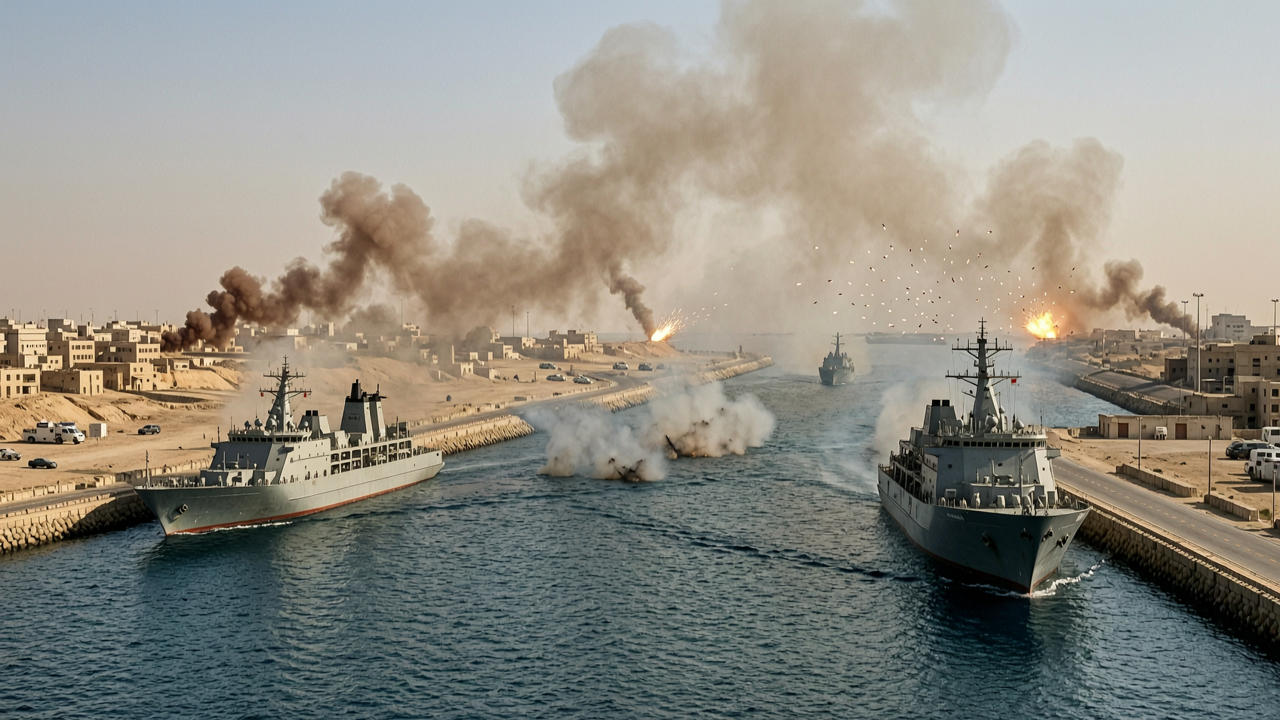
US Central Command said it launched several waves of strikes on Iran on Sunday, beginning at 17:00 ET, in response to an Iranian attack on a container ship in the Strait of Hormuz that set it ablaze and left a crew member missing earlier in the weekend. The US military stated the strikes were intended to "continue degrading their ability to attack civilian mariners and commercial ships freely transiting the Strait of Hormuz." The targets included missile sites and Iranian Revolutionary Guard Corps (IRGC) small boats around the strait, with US forces hitting approximately 140 targets in Iran overnight Saturday into Sunday, according to reports from the BBC and The Guardian.
Iran’s state media announced that the Strait of Hormuz would remain closed until further notice and until "the end of US interference in the region." The IRGC said it had fired on a vessel attempting to use an "unapproved route" through the strait, which it claimed justified the closure. Iran’s state-run IRNA news agency cited the governor of Qeshm island near the strait as saying projectiles had been fired at military targets, with no casualties reported.
In retaliation for the US strikes, Iran launched missile and drone attacks targeting US military assets and bases in Jordan, Oman, and Qatar, according to the New York Times. The United Arab Emirates, Kuwait, Bahrain, and Oman all reported intercepting Iranian aerial attacks. Qatar condemned the strikes as a violation of international law, according to Al Jazeera, which also reported that three people, including a child, were wounded in Qatar by falling shrapnel from intercepted Iranian projectiles.
The conflicting claims over the status of the Strait of Hormuz remained unresolved. US President Donald Trump insisted the strait was open to commercial traffic, directly contradicting Iran’s announcement. US Central Command reiterated that "Iran does not control the strait. Traffic is flowing," according to NBC News. Meanwhile, Iran’s IRGC maintained the closure was in effect until its conditions were met.
The escalation has disrupted shipping in the region, with the Strait of Hormuz serving as a critical chokepoint for global oil and natural gas supplies. The exchange of strikes has also endangered ongoing ceasefire negotiations, with mediators scrambling to salvage the fragile truce talks amid the renewed hostilities.
The sequence of events began with Iran’s attack on a Cyprus-flagged container ship, which the US said was using an authorized route. Iran claimed the vessel was on an "unapproved route," a justification it has used previously to assert control over the waterway. The US response included strikes on Iranian military targets, including air defense systems and port facilities, as confirmed by multiple independent outlets including AP News, PBS, and The Guardian.
Regional spillover from the conflict was immediate. Explosions were reported on Iran’s Qeshm Island, with state media confirming projectiles had struck military targets. The UAE, Bahrain, Kuwait, and Oman all reported intercepting Iranian missiles and drones, while Qatar condemned the attacks. The Times of Israel reported that Kuwait suffered damage from the strikes, with air defense systems actively engaging incoming projectiles.
The latest round of hostilities marks the most intense exchange of fire between the US and Iran in months, with both sides striking numerous military targets. The US has demanded that Iran publicly affirm the Strait of Hormuz is fully open to shipping traffic, a condition Tehran has so far refused to meet. Instead, Iran has reiterated its demand for an end to US interference in the region as a prerequisite for reopening the waterway.
Independent reporting from 19 distinct outlets confirms the broad sequence of events: the initial Iranian attack on the container ship, the US retaliatory strikes, Iran’s declaration of the strait’s closure, and the subsequent Iranian attacks on Gulf states. However, the exact status of the Strait of Hormuz remains contested, with the US and Iran offering directly contradictory claims.